





 Portuguese
  English
  Spanish
  5 min of reading
  0 comments


Discover How Infrastructure Opportunities Transform Cities, Improve Quality of Life, and Open Paths for Lasting Personal and Professional Growth.
When we hear the word infrastructure, it’s common to think only of large projects like highways, bridges, railroads, and power grids.
However, the truth is that infrastructure goes far beyond that. It is present in everything that sustains modern life — from the water that reaches your home to the internet connection you use every day.
Historically, the first major transformations in infrastructure began with ancient civilizations such as the Egyptians, Romans, and Mesopotamians, who built irrigation systems, roads, and aqueducts that still serve as models for many of our modern works today.
-
Employee Fired After Accumulating 114 Days of Medical Leave in One Year, Labor Court Upholds Company’s Decision

-
Employee Fired While Treating Depression Wins in Court and Vale Is Required to Rehire Him Following Decision Based on the CLT and INSS Benefits

-
Workers Should Be Aware! March 6 Will Be The Fifth Business Day Of March And The Final Deadline For Companies To Pay Salaries According To The CLT

-
2026 FGTS Anniversary Withdrawal Is Released According to Birth Month, Sets Amounts by Balance Range, Establishes Deadlines for March and April, and Changes Rules in Case of Dismissal


According to historian Victor Davis Hanson, the Romans, for example, used their vast network of roads not only to facilitate the transport of armies but also to integrate regions of the empire and promote trade, culture, and innovation.
Therefore, although it may seem like a distant topic from our daily lives, understanding infrastructure opportunities can profoundly change the way we see the world, business, and even our future.
Nowadays, the concept of infrastructure has expanded significantly.
It now includes, in addition to physical structures, essential systems for the functioning of society, such as electricity, urban mobility, basic sanitation, telecommunications, logistics, and, more recently, digital infrastructure.
Thus, new infrastructure opportunities arise that not only drive the economy but also directly affect the quality of life of people.
It is no surprise that significant social transformations depend on good infrastructures.
The Impact of Infrastructure on Business and Quality of Life
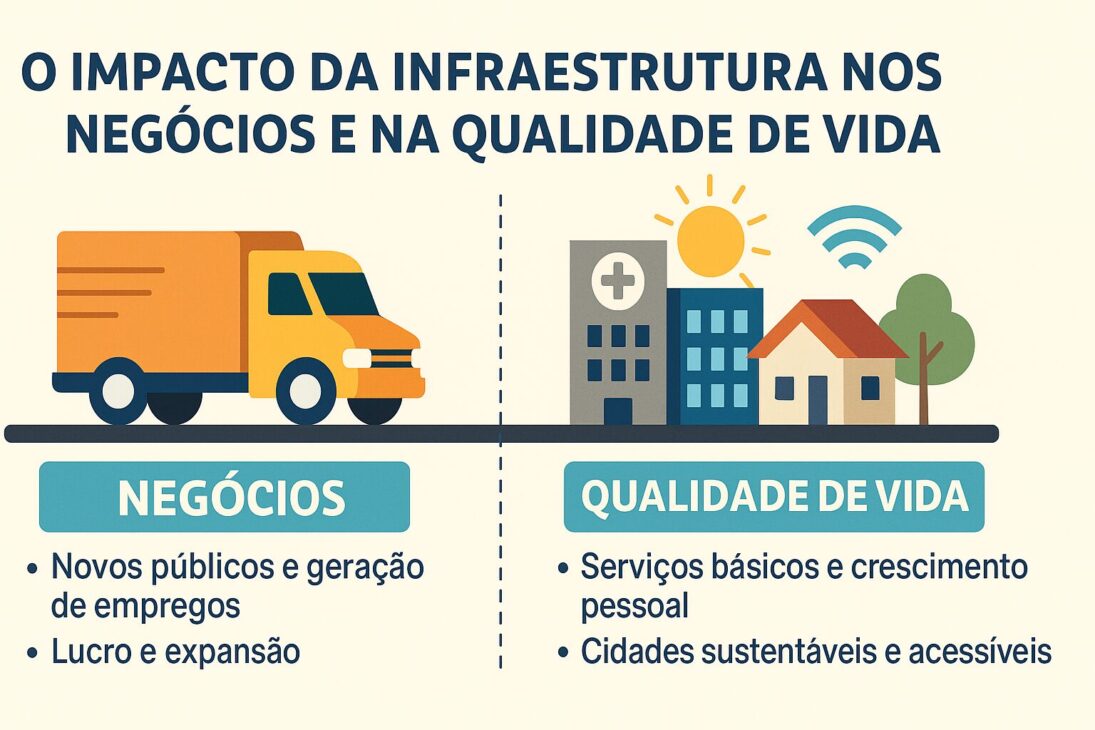
Indeed, for businesses, these opportunities represent fertile ground for growth.
For example, imagine a small company that decides to sell products online. Without an efficient logistics network, it will face difficulties in serving customers in other regions.
However, with improvements in roads and digital infrastructure — such as quality internet and online payment methods — that same business can expand rapidly, reach new audiences, and generate jobs.
Thus, a local business that once depended on its region can, thanks to good infrastructure, now reach consumers from anywhere. This results in profit and expansion.
Furthermore, infrastructure plays a crucial role in the lives of those residing in less developed areas.
Building hospitals, schools, and roads in rural areas, for instance, has a direct impact on improving quality of life.
And indeed, it’s not just large urban centers that benefit from infrastructure improvements.
Access to basic services such as health, education, and transport, through an efficient network, enables the personal and professional growth of everyone, without exceptions.
Another point to consider is that infrastructure is closely linked to the advancement of smart cities.
With the implementation of technologies and innovations that facilitate urban life — such as real-time traffic monitoring, waste management, and the use of renewable energy — cities become more sustainable and accessible.
As a result, this positive cycle directly impacts citizens’ lives. It ensures a safer, healthier, and more efficient environment to live and work.
Infrastructure and Its Role in Social and Environmental Inequalities
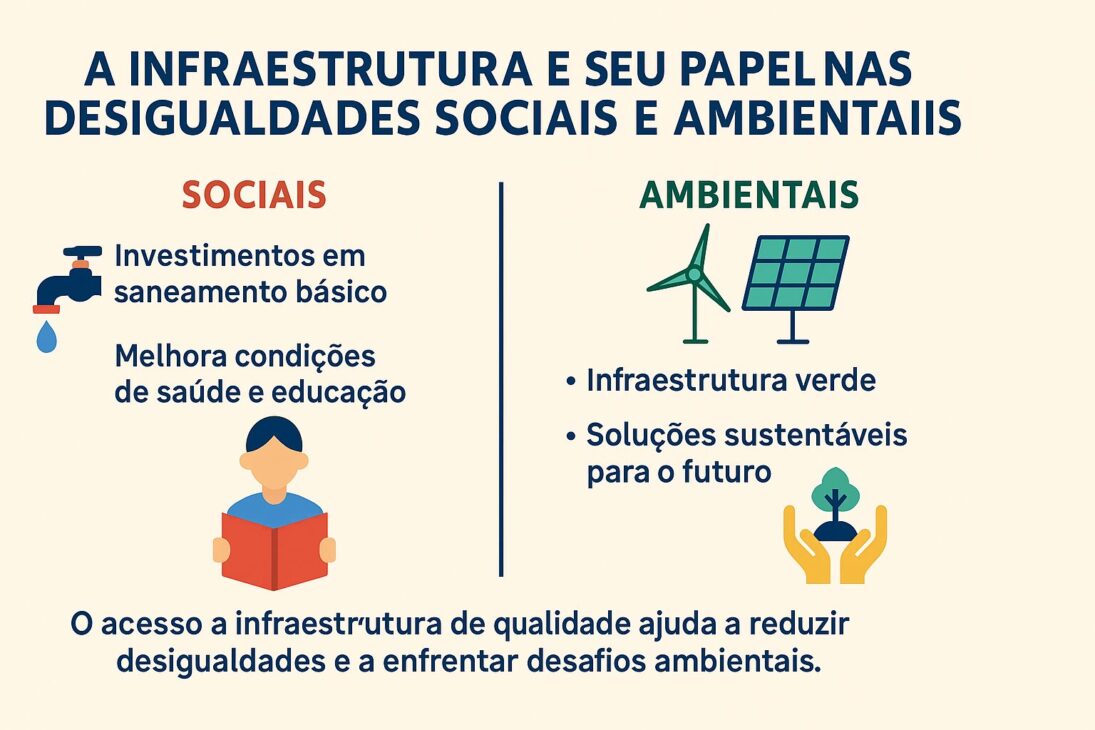
On the other hand, infrastructure also plays an important role in reducing social inequalities.
In many communities, the lack of basic sanitation is still a reality.
Investing in infrastructure in this area not only reduces diseases but also provides dignity and improves conditions for education and work.
Moreover, in an increasingly digital world, the lack of internet access is a significant obstacle to learning and growth.
The importance of infrastructure was highlighted in 2017 when the United Nations (UN) included access to basic services as part of its Sustainable Development Goals (SDGs), emphasizing that infrastructure should be considered a global priority.
The UN advocates that to combat poverty and inequalities, it is necessary to ensure that all populations, especially the most vulnerable, have access to basic infrastructure.
By providing quality connection, infrastructure opportunities can open doors to a more inclusive future. This ensures that everyone has the same chances.
With the advancement of technology and environmental needs, new frontiers emerge to explore.
Green infrastructure, for example, seeks sustainable solutions that combine development with respect for the environment.
Projects such as green roofs, rainwater harvesting systems, public transportation powered by clean energy, and the revitalization of degraded urban areas have gained traction in cities that are committed to a more sustainable future.
Thus, these are infrastructure opportunities that not only move the construction sector but also generate jobs and drive innovation.
Moreover, with the increasing pressure for more sustainable solutions, many countries are investing in new models of construction and infrastructure that minimize environmental impacts.
The use of eco-friendly materials, reduction of energy consumption, and more intelligent use of natural resources are examples of how infrastructure can genuinely contribute to a greener future.
Therefore, by investing in sustainable infrastructure, we create a legacy that benefits future generations.
The Private Sector and the Growth of Infrastructure Opportunities
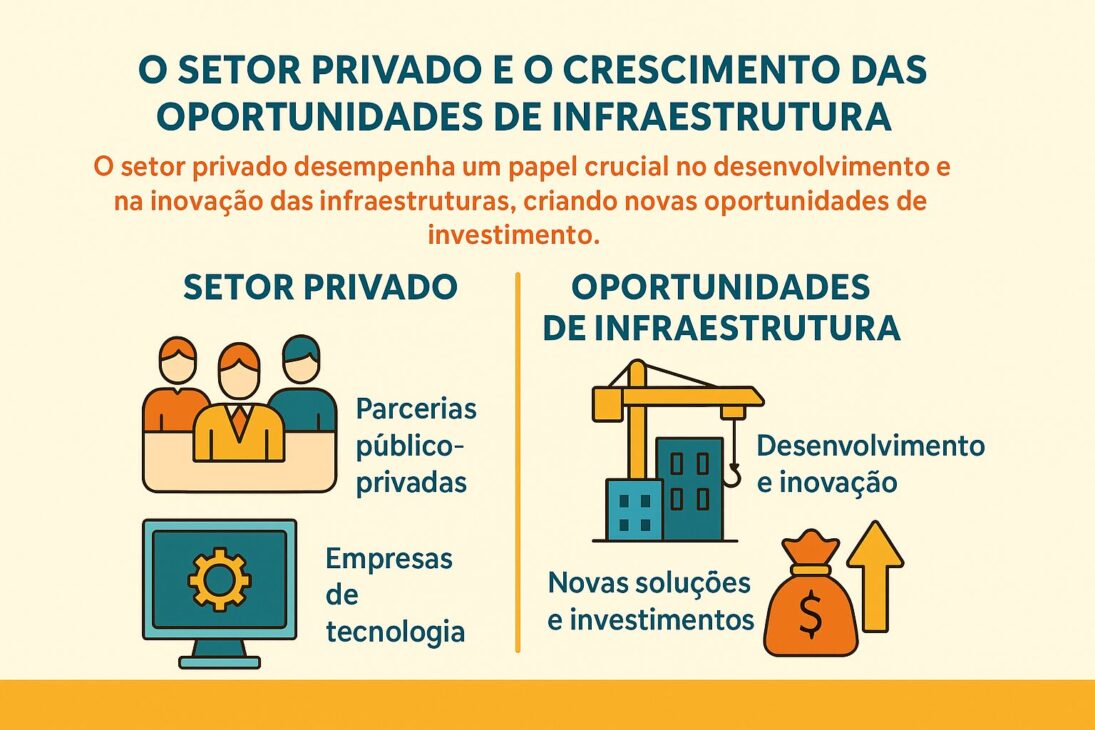
Indeed, investing in infrastructure is not solely the responsibility of the public sector.
Increasingly, the private sector has been involved in these projects, either through public-private partnerships or by creating solutions that meet society’s demands.
Technology companies, logistics startups, renewable energy companies, and urban mobility platforms have leveraged these gaps to grow and innovate.
Moreover, infrastructure opportunities are also related to the advancement of the digitalization of processes. The improvement of data and communication networks.
For instance, it is essential for the development of smart cities and increasingly connected businesses.
E-commerce platforms, mobility solutions, and technology companies have benefited from these infrastructures to provide faster, cheaper, and more effective services.
This benefits both consumers and businesses.
Thus, for those looking to entrepreneur or invest, understanding these opportunities is a smart strategy.
Sectors such as solar energy, sanitation, logistics, and connectivity have received special attention in recent years and present significant growth potential.
This is especially true in developing countries, where many structural challenges still need to be overcome.
By identifying these opportunities, entrepreneurs can position themselves competitively. They leverage the expansion of infrastructure.
Actively Participating in Infrastructure Transformation
Finally, being aware of infrastructure transformations is also a way to participate more actively in society.
Demanding improvements in public transportation, following urban projects in your city, and understanding how technology can facilitate access to services — all these make us more aware citizens, prepared for the challenges of the future.
This also means being willing to adopt practices that benefit the community. Examples include using public transport, recycling, and participating in environmental preservation projects.
Therefore, when looking at a new bridge being built, a highway being renovated, a neighborhood finally receiving sewage systems, or a school connected to the internet, it’s important to remember that it’s not just about construction.
They are, in fact, investments that create jobs, reduce inequalities, incentivize innovation, and open paths for new businesses.
Infrastructure opportunities are everywhere. They directly impact our present and shape the future.
Understanding this scenario is essential not only for those who want to entrepreneur or invest but also for all those who wish to live in a fairer, more efficient, and connected world.










Seja o primeiro a reagir!