





 Portuguese
  English
  Spanish
  6 min of reading
  11 comments


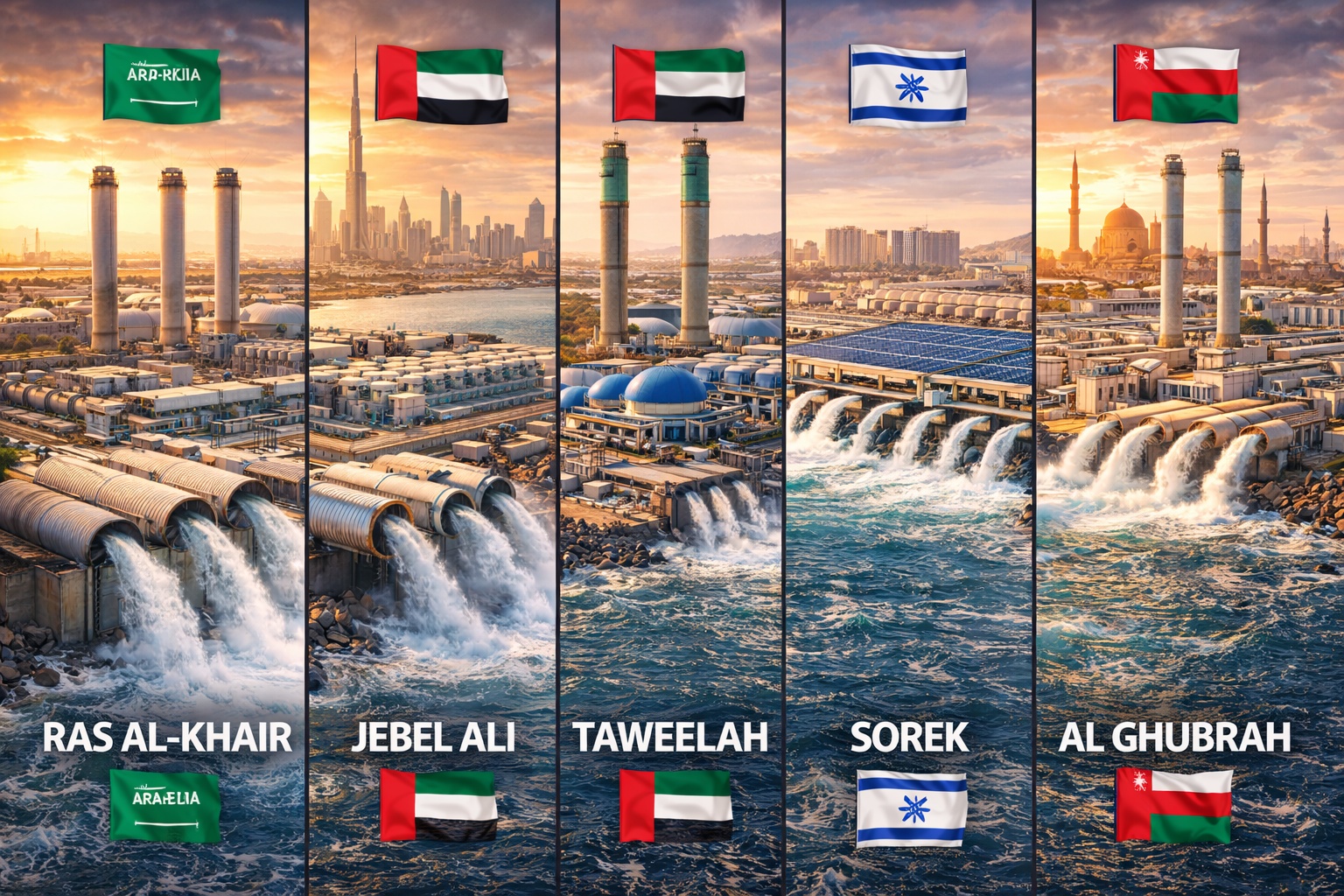


In The Gulf, Desalination Already Accounts For A Large Part Of Drinking Water. Mega Plants Expand Capacity And Move To Reverse Osmosis With Solar Support.
In a region where rainfall is limited and evaporation is high, water has become treated as critical infrastructure and, in many places, seawater has become the main source of drinking water. It is not an abstract concept: some Gulf countries depend on desalination for most domestic supply. Surveys cited by international analyses indicate that desalination provides about 90% of drinking water in Kuwait, 86% in Oman, 70% in Saudi Arabia, and approximately 42% in the United Arab Emirates.
These percentages explain why the Middle East hosts some of the largest desalination plants on the planet, many in continuous operation with decades-long contracts. The region is also at the center of significant technological transition: the shift from traditional thermal systems to reverse osmosis (RO), which tends to consume less energy per cubic meter, and the attempt to reduce dependence on gas and oil through integration with solar energy.
Next, how this “water production line” works in practice, where the most emblematic projects are located, and what numbers define the scale of this new water map.
-
Friends have been building a small “town” for 30 years to grow old together, with compact houses, a common area, nature surrounding it, and a collective life project designed for friendship, coexistence, and simplicity.

-
This small town in Germany created its own currency 24 years ago, today it circulates millions per year, is accepted in over 300 stores, and the German government allowed all of this to happen under one condition.

-
Curitiba is shrinking and is expected to lose 97,000 residents by 2050, while inland cities in Paraná such as Sarandi, Araucária, and Toledo are experiencing accelerated growth that is changing the entire state’s map.

-
Tourists were poisoned on Everest in a million-dollar fraud scheme involving helicopters that diverted over $19 million and shocked international authorities.

Desalination In The Middle East: Why The Region Became A “Global Power In Seawater”
The Persian Gulf concentrates countries with high urbanization, high industrial demand, and agriculture in naturally arid areas. This creates a structural mismatch: demand grows with population and economy, while the natural supply of freshwater is limited.


In this scenario, desalination has ceased to be an “alternative” and has become part of the basic supply. The most direct data is the weight of the process in drinking water consumption in Gulf countries: Kuwait, Oman, and Saudi Arabia are among the cases where desalination is predominant.
The consequence is a network of plants that operate as strategic infrastructure: seawater intake, pretreatment, desalination, post-treatment, and pumping to urban and industrial networks.
How A Mega Plant Transforms Seawater Into Drinking Water
The industrial process usually follows well-defined stages:
- Intake and Pretreatment: Seawater is taken in and undergoes filtration and control of solids and organisms.
- Desalination: Salt removal can occur through thermal technologies (evaporation/condensation) or through membranes (reverse osmosis).
- Post-Treatment: Chemical adjustments are made to make the water suitable for consumption and for the networks (pH correction, remineralization).
- Distribution: Large pumping systems and pipelines deliver the water to urban centers and industrial hubs.
In recent years, the most changing aspect in the region is desalination technology: reverse osmosis has been gaining ground for operating with lower energy intensity than many traditional thermal configurations and for being more compatible with renewable electricity.
Mega Plants In Operation: Taweelah, The Largest Reverse Osmosis Plant In The World
One of the recent symbols of this technological turn is the Taweelah plant in Abu Dhabi. In various statements and institutional pages, it is described as the largest reverse osmosis facility in operation in the world, with a final capacity of 200 MIGD (million imperial gallons per day), equivalent to 909,200 m³/day.

The scale is not just a record: it indicates the size of the demand the region needs to meet daily. Taweelah also serves as an example of integration with solar energy within the complex: there is a reference to an on-site photovoltaic installation of 70 MWp associated with the project.
The project is structured as an “Independent Water Plant (IWP)” with a long-term water purchase contract, a common model in the region to enable billion-dollar investments with predictability.
The Next Wave: Mega Plants With Solar Energy And Energy Efficiency In Reverse Osmosis
The Gulf has also become a laboratory for “scale + efficiency.” A relevant case is the Hassyan plant (Dubai), cited in corporate communications and financial coverage as a reverse osmosis-based facility that aims to achieve 818,000 m³/day and is described as a project to be “the largest solar-powered desalination plant” in its promotional framing.

Beyond capacity, the project is cited for energy consumption metrics per cubic meter (kWh/m³) in technology and supply communications, precisely because the cost and environmental impact of desalination strongly depend on how much energy it requires to produce each unit of water.
Why Saudi Arabia Appears As A “Giant” Of The Sector
Saudi Arabia is not just a user; it continuously plans and contracts capacity. Sources cited in analyses about the Gulf point to a goal of reaching 8.5 million m³/day of desalination capacity by 2025 in one of the segments presented.
Meanwhile, the Saudi Water Partnership Company (SWPC) publishes capacity plans with lists of projects and deliveries (COD) and volumes per day, showing a pipeline of plants in various regions of the country (Rabigh, Shuqaiq, Jubail, Jazan, among others), with individual volumes in the hundreds of thousands of m³/day.
This set of projects helps explain why desalination accounts for such a large share of Saudi drinking water in widely cited estimates.
“More Than 20% Of The Consumed Water”: How This Number Makes Sense In The Gulf
When it is stated that desalination accounts for a huge portion of water consumption in the Middle East, the data mainly holds because entire countries primarily depend on the process. Kuwait (90%), Oman (86%), Saudi Arabia (70%), and the Emirates (42%) pull the regional average up, even though other countries have different matrices.
In practical terms, it is not about “some isolated plants”, but rather an infrastructure that has become part of urban life: domestic supply, hotels, hospitals, industry, and in many cases, indirect support for the agricultural sector via reallocating sources (desalinated water for cities, other sources for irrigation where possible).
The Industrial Side: Billion-Dollar Contracts And Continuous Expansion
Desalination in the Gulf is treated as foundational investment. Plants like Taweelah are presented with project costs in the range of hundreds of millions of dollars (for example, US$ 874 million in corporate project promotional materials).
The logic is similar in other ventures: long-term contracts, consortia with global companies, and state/utility companies as off-takers.
The Financial Times describes global expansion and highlights the Middle East’s role as a capacity center, in addition to emphasizing the transition to reverse osmosis and the incorporation of solar energy in plants like Taweelah to reduce dependence on fossil fuels.
Desalination “Pulling Energy”: Why The Region Is Trying To Reduce Carbon Footprint
Desalination does not create water out of nothing—it converts an abundant source (sea) into drinking water at the cost of energy. Therefore, the sector faces a sensitive point: as Gulf countries set climate targets and attempt to “decarbonize” their matrix, the challenge is to maintain affordable and stable water without increasing emissions.
This context appears in international analyses that discuss desalination as a “blessing and a curse” due to its dependency on energy and the environmental impacts it generates if there is no mitigation, highlighting the effort to shift to more efficient technologies and integrate renewables.
The Other Product Of The “Production Line”: Brine And The Environmental Challenge
An unavoidable aspect of the process is brine, the effluent concentrated in salt and, depending on the pre/post-treatment, with traces of chemicals. This disposal is one of the main environmental challenges associated with desalination, especially in regions with a high concentration of plants and little water renewal in specific coastal areas.
Analyses and reports on the sector highlight that brine management is still a debated issue, with initiatives ranging from controlled dilution and dispersion to research in “brine mining” (mineral extraction) and new disposal and reuse routes.
What The Gulf Map Shows: Water As Permanent Strategic Infrastructure
When summed up:
- very high percentages of drinking water coming from desalination in Gulf countries,
- mega plants in operation with nearly 1 million m³/day at a single site (Taweelah),
- a continuous pipeline of Saudi projects listed by a water partnership agency,
- and new projects with explicit discourse on solar integration and efficiency,
the emerging picture is of an “industrialized water system” in permanent expansion.
Desalination in the Middle East is not restricted to a specific dry period. It is treated as a structural basis of supply, with investment, contracts, and technology evolving to sustain urban and industrial growth in one of the most arid regions on the planet.










Que el ministro caprichoso lea este artículo y se deje de romper las bolas con Casupá.
Totalmente de acuerdo. El contrato original era con la empresa israelí de agua potable que es la que hace todos estos inventos incluído el de sacar agua del aire. Va a gastar millones para preparar la campaña para el 29.
Excelente sería, que todos los líderes del mundo, se unieran sin ideología política qué los separe, para hacer de este un gran proyecto en PRO de la humanidad… Donde todos los países en el mundo tuvieran acceso a este vital recurso.. “El agua es VIDA”
Si el agua dulce se mezcla con la extracción del agua desalinizada del mar, será mejor para todo, y sobre todo hay que aprovechar hasta la última gota para reciclarla, poner arboles donde se pueda y hacer invernaderos para plantar verduras etcétera, y regenerar con el compostaje las áridas tierras, recuperar diversidad, y especies que pueden ayudar a revertir el día stado actual del desierto.