





 Português
  Inglês
  Espanhol
  6 min de leitura
  0 comentários


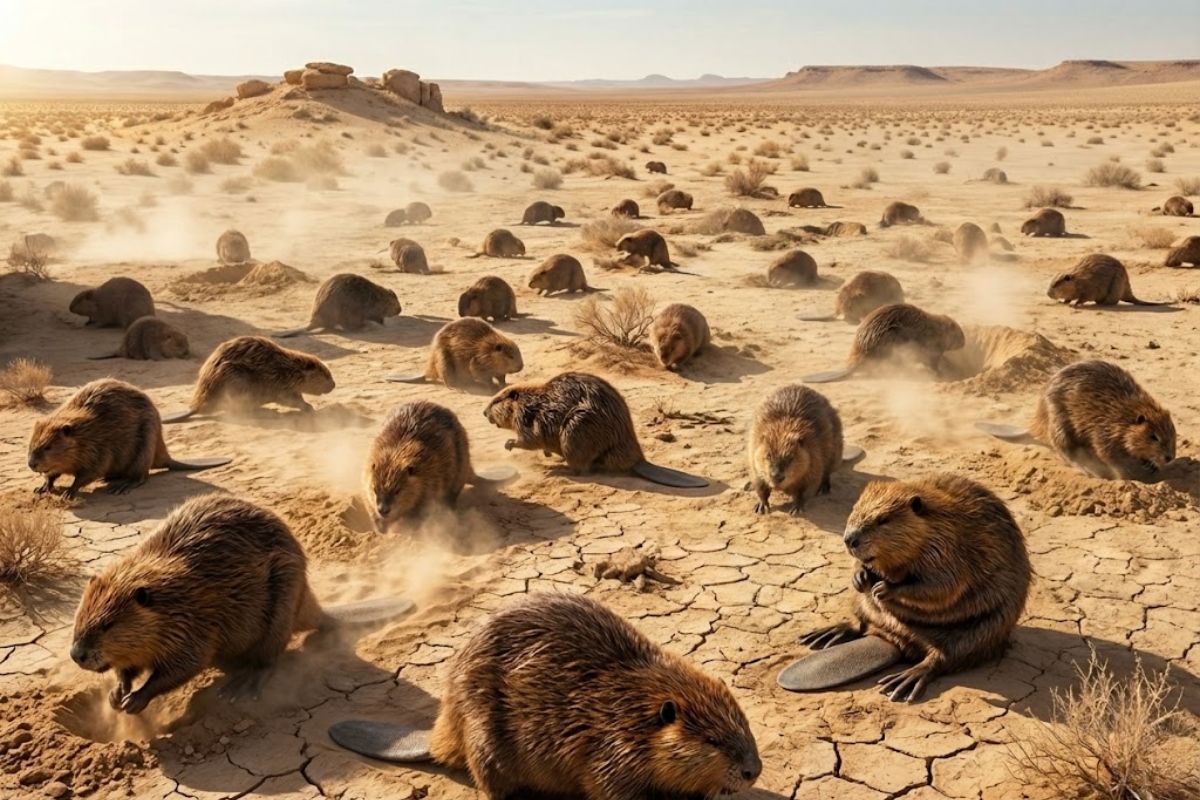
After Decades Of River Degradation, Teams In The Utah Desert Began Relocating Beavers To Arid Valleys. With A 3-Day Quarantine, Microchip, And Radio, 47 Animals Have Been Released Since 2019. Natural Dams Spread Water, Form Wetlands, And Create Refuges That Burn Less In Wildfires.
The strategy of taking beavers to the Utah desert seems absurd at first glance, but it has become a practical attempt to return water to landscapes that have dried up. Instead of reshaping valleys with machines and spending fortunes, researchers have relied on beavers as natural engineers capable of reconstructing rivers on their own.
The plan gained traction when it became clear that the problem was not just a lack of rain. In Utah, rivers and floodplains have been altered by decades of intervention, the snowpack has diminished, and wildfires have destroyed what still held water in the soil. The idea was simple and risky: place beavers in critical points and let the natural dams do the work.
Why Rivers Dried Up And Turned Into Fast Channels

The Utah desert did not dry up for a single reason. One cited example is the depletion of the Great Salt Lake, with an estimated inflow decline of 39% since 1850, largely because water has been continuously diverted.
-
Found in one of the most radioactive places on Earth, this Chernobyl fungus may be doing something with radiation that no one has been able to explain to this day.
-
A bright yellow mushroom imported from Asia escaped from a cultivation farm in the United States in 2010 and is now aggressively spreading across 25 states, destroying entire communities of native fungi in American forests.

-
Buried under China, a colossal machine weighing 20,000 tons began operating as the largest neutrino detector on the planet and, in just 59 days, surpassed results that science took half a century to achieve.

-
Iran enters the center of a climate alert after the war emitted 5.6 million tons of CO2 in two weeks, surpassing the annual pollution of entire countries.


The effect is repeated across various water systems: degraded rivers, lowered channels, and disconnected floodplains.
Under normal conditions, a river overflows into the floodplain approximately every 18 to 24 months. This overflow helps retain water, filter sediments, and sustain ponds and wetlands.
When human intervention transforms the riverbed into a straight and fast channel, water flows like on a highway, it does not infiltrate, does not recharge the soil, and does not support the ecosystem.
The picture is broad. In the state itself, more than 99% of major rivers, including the Colorado and Verde, have already been altered.
In the West as a whole, approximately half of river systems have been damaged, adding up to about 140,000 miles of rivers.
Less Snow Means Less Water Year-Round
Snow functions as a natural water bank. In winter, it accumulates; in warming, it gradually melts and feeds streams, rivers, and reservoirs.
The problem is that the snowpack is decreasing: since 1979, when Utah began consistently monitoring with Snowtel stations, the peak accumulated snow has fallen by about 16%.
Less snow means less available water throughout the seasons. And when levels fall, ecosystems disintegrate, fish and wildlife suffer, and biodiversity comes under pressure.
In this scenario, beavers are seen as a way to restore retention and stability to the system.
Wildfires Accelerate Erosion And Shrink Rivers
Wildfires act as an amplifier of collapse. One cited example is the Milford Flat fire, the largest in Utah’s history: it started with a lightning strike on July 6, 2007, around 4 PM, near the town of Milford, and burned nearly 363,000 acres.
After the fire, the soil loses its ability to retain water.
Following rains carry sediments into the rivers, banks collapse, erosion gullies open up, and previously wide valleys turn into narrow trenches.
The water then tears through the bed continuously, without infiltrating and without nourishing the riparian areas.
The Sign That Beavers Could Help Contain Wildfires
The shift in perception came from another wildfire, outside of Utah. In 2018, Idaho faced the Sharps fire, which burned around 64,000 acres, lasted more than 12 days, and required over 400 firefighters.
When the area cooled, a green pocket was observed in the middle of the burned zone: a common wetland linked to beavers.
From there, researchers analyzed large wildfires after 2000 in five states, searching for dams and ponds near burned areas.
The pattern described was straightforward: vegetation near beaver dams burned, on average, three times less than in areas without dams.
The logic is simple: water does not burn, and wetlands reduce dry fuel and keep plants green.
How Beavers Were Relocated In The Utah Desert
The adopted strategy was passive restoration: instead of bringing in machines to redesign the valley, the team sought to place beavers in degraded rivers and allow them to rebuild the environment through natural dams.
Work focused on two rivers in eastern Utah, the Price and San Rafael.
The beavers came from rehabilitation centers and conflict situations, animals captured because they caused problems elsewhere, such as flooding and impacts on roads.
Before being released, each beaver underwent a 3-day quarantine to reduce the risk of disease, received a microchip, and a radio transmitter for tracking. The first test occurred in May 2019 and the second in 2020. In total, 47 beavers were relocated.
Results, Limits, And What Happened To The Beavers
No one expected 100% success. Some beavers did not survive the heat, some did not make it through the stress of the change, and some were killed by predators. Lynxes, cougars, or black bears were mentioned as likely predators, with one case certainly attributed to a coyote. Three deaths had an unknown cause. There were also losses of trackers due to entanglement in vegetation.
Even so, the experiment indicated visible changes: dams began to appear in locations where there were previously no beavers.
Some animals stayed where they were released; others moved up to 12 miles downstream, an enormous distance for a slow animal on land.
Life in the Utah desert is tough for relocated beavers. Survival was below 40%, compared to around 80% for local beavers.
Nonetheless, this percentage represented beavers that stopped being culled as “pests” and began to act as restorers of the river itself.
Why Natural Dams Transform The Valley Into Wetlands
The chain is physical and quick. A natural dam slows down the water and causes the flow to stop running solely through the main channel.
The water spreads to the sides, moistens the banks, and begins to infiltrate again. Over time, ponds, marshes, and slow-water areas emerge, forming wetlands.
These environments improve water quality by retaining sediments, reduce erosion and turbidity, and increase habitat complexity.
They also serve as natural fire barriers, creating moist refuges amid landscapes vulnerable to wildfires.
Artificial Dams As “Baits” For Beavers
In some stretches, the challenge was not just water, but material. Many tributaries of the Verde and Colorado Rivers had little wood available, and the channels have changed so much that beavers had no resources to start from scratch.
The described solution was to build pre-installed dam structures with permits, integrated into the landscape.
They serve as a base for beavers to reinforce and complete the natural dam, increasing the chances of permanence and that the system begins retaining water earlier.
Why Beavers Are Being Seen As A Solution Again
Historically, beavers were hunted almost to extinction between the 16th and 19th centuries because of the fur trade.
Today, a cited estimate places the global population at around 10 million, still well below the past, when North America alone might have had about 100 million.
In the Utah desert, the proposal is not to romanticize the animal, but to use an objective capacity: beavers reshape the landscape, build natural dams, and create wetlands that hold water when the river system has been “straightened” and emptied.
Do you think beavers can become part of the permanent strategy against drought and wildfires, or should this type of relocation be used only in extreme situations?







-

-

-

-

7 pessoas reagiram a isso.