





 Portuguese
  English
  Spanish
  5 min of reading
  1 comment


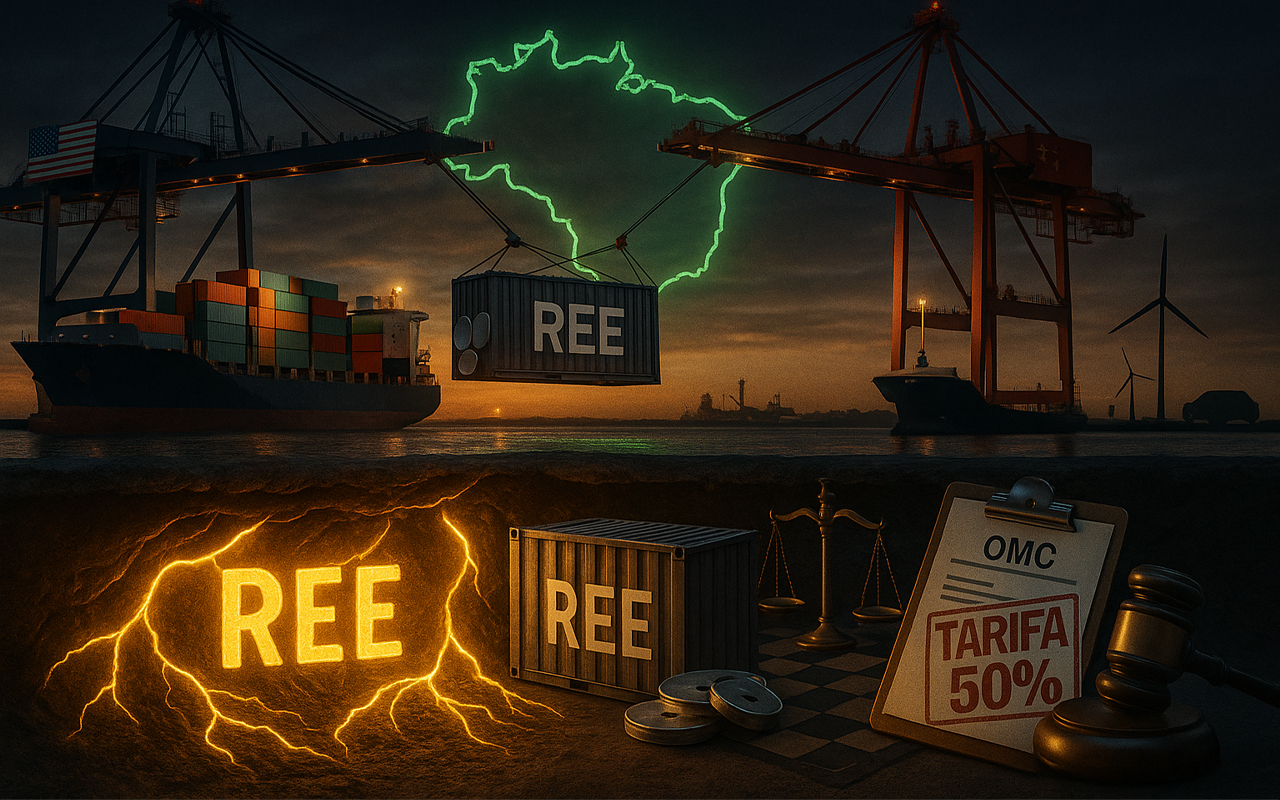


Brazil Holds About 21 Million Tons of Rare Earths, Essential for Electric Cars, Turbines, and Defense. The 50% Tariff from the U.S. Cooled Cooperation and Rekindled the Debate on Mineral Sovereignty.
Brazil was negotiating with Washington for technical support and investment to accelerate the exploration of rare earths and reduce Western dependence on China in the processing of these minerals. In August, the imposition of 50% tariffs by the United States cooled cooperation, took the case to the WTO, and reignited the debate on mineral sovereignty and the reconfiguration of supply chains.
With approximately 21 million tons estimated in reserves, the country can jump from being a promise to a leading player if it advances beyond extraction. The bottleneck lies in the refining and production of permanent magnets, stages that concentrate value and technology. Attracting qualified capital, ensuring regulatory predictability, and strengthening local content are decisive points to transform resources into industry.
The central question now is who benefits from this subterranean treasure. An agreement with the U.S. could accelerate investment and technology transfer. An alternative path, with Europe and Asia, preserves maneuvering room and sovereignty. The coming weeks, with consultations at the WTO, possible tariff exemptions, and financing announcements, will indicate which path Brazil will take.
-
Unemployment rises again to 5.8% at the beginning of 2026, raising alarms about the end of temporary positions and its impact on the Brazilian job market.

-
Document organization can cut invisible costs in small businesses, a simple step that prevents waste, rework, and losses in daily operations.

-
Chinese giant worth nearly R$ 4 billion that manufactures cables for electric cars, solar energy, and robotics wants to open a factory in SC.
-
Many employers do not know, but the law guarantees domestic workers a 25% increase in salary during trips, 50% for overtime, 20% for night shifts, and 17 additional benefits that can lead to labor lawsuits if not paid.


What Are Rare Earths and Why Has Brazil Become a Key Player in Critical Minerals
Rare earths are a group of 17 elements used in high-performance magnets, found in everything from electric cars to wind turbines and military applications. Despite being abundant in the crust, they are difficult to separate and refine at scale. Today, China concentrates most of the global processing, which exposes other economies to geopolitical and supply risks.
In Brazil, recent surveys indicate 21 million tons in reserves, placing the country among the world leaders. The USGS Mineral Commodity Summaries 2025 confirms this figure, while the Brazilian Geological Service (SGB) reports that the volume accounts for about 23% of global reserves or resources, a difference explained by distinct methodologies and concepts between resources and reserves. Explaining the difference to readers helps understand why percentages vary.
The SGB also resumed in 2025 aerogeophysical surveys with the Spanish company Xcalibur to update maps and reduce geological uncertainties, a basis for attracting capital and licensing new projects. The advancement of mapping reduces risks, improves asset pricing, and shortens the time between discovery and production.
50% Tariffs and WTO: How the Brazil-U.S. Crisis Halted Partnership
On July 30, 2025, the White House published acts that designated Brazil as a threat to U.S. national security, a measure that underpinned punitive tariffs and raised diplomatic tension. In early August, Washington instituted a 50% tariff on most Brazilian imports, with exceptions, and the Brazilian government brought the case to the WTO.
On August 19, the United States accepted Brazil’s request for consultations at the WTO but claimed that the issue involves national security and therefore would be outside the scope of the dispute resolution mechanism. In practice, this adds legal uncertainty and impacts investment decisions in critical minerals in the short term.
In an economic response, BNDES announced on August 22 and 23 a credit line of 10 billion reais for affected companies, part of a broader package to sustain liquidity, diversify markets, and cushion the shocks from tariffs. Sectors such as coffee are already reporting price and competitiveness impacts. Regulatory predictability will be key to reintegrating any specific agreement on minerals.
Who Is Investing Today: Serra Verde, Aclara, and the Emerging Permanent Magnet Chain
Serra Verde is Brazil’s first commercial rare earth project in production. In 2024, the company received US$ 150 million from U.S. investors and was included in the list of projects of the Minerals Security Partnership (MSP), an initiative led by the U.S. and allies to diversify supply chains outside China. The current setup, however, still sends part of the material for processing abroad, highlighting the local refining gap.
The Canadian company Aclara Resources is advancing in Brazil and has signed a supply agreement with the German company Vacuumschmelze (VAC), which is building a magnet factory in South Carolina with the support of the Pentagon. The company is also seeking U.S. public funding to integrate mining, processing, and manufacturing of magnets, creating a bridge between Brazil and the U.S. in the value chain. High tariffs and political noise may delay timelines or redirect partnerships to Europe and Asia.
Domestically, Brazil launched the MagBras project in July, a R$ 73 million initiative coordinated by SENAI and industrial partners to consolidate a national chain of permanent magnets. Meanwhile, the laboratory-factory in Lagoa Santa (MG) is being pointed out as a piece of R&D and pre-series to scale the production of alloys and magnets with local content. If the industrial phase takes off, the country will capture more value than simply exporting concentrate.
Possible Paths for Brazil in Rare Earths and Critical Minerals
Scenario 1. Negotiated Accommodation. Brazil and the U.S. create sector-specific exceptions or a “critical minerals understanding,” unlocking technical cooperation and investment. Indicators to watch: WTO consultations agenda, potential tariff exemptions, and resumption of technical missions tied to the MSP.
Scenario 2. Prolongation of the Dispute. The 50% tariffs and legal contention reduce U.S. capital appetite for Brazilian projects, with companies seeking offtakes and financing in other hubs. This environment delays decisions on refining and magnets in the country and may concentrate gains in basic mining.
Scenario 3. Geopolitical Pivot and Local Content. Without an agreement with the U.S., Brazil intensifies partnerships with the EU and Asia, accelerates aerogeophysics and licensing, and imposes processing countermeasures domestically. The competitive differential relies on legal security, environmental speed, and infrastructure quality, as well as protecting mineral sovereignty with transparent governance.
What to Follow in the Coming Weeks to Stay on Track
Keep track of the progress of the WTO consultations, as a clear timeline tends to reduce uncertainty and reopen sectoral discussions. Also watch for announcements from BNDES and the mines and energy sector regarding credit, mapping, and local content regulations, as well as investment decisions from Serra Verde and Aclara. Finally, monitor signals from the MSP and the magnet industry in the U.S., as the coordination between mining, refining, and manufacturing will determine where value will lie in the next decade.
Now it’s up to you: do the 50% tariffs and the dispute at the WTO change the game for Brazilian rare earths? In your view, should Brazil prioritize mineral sovereignty and local processing or seek an understanding with the U.S. to accelerate investments in critical minerals?









Bom dia.
Eu acho que o Brasil deve priorizar a “Soberania Mineral” e o “Processamento Local!”