





 Portuguese
  English
  Spanish
  4 min of reading
  0 comments


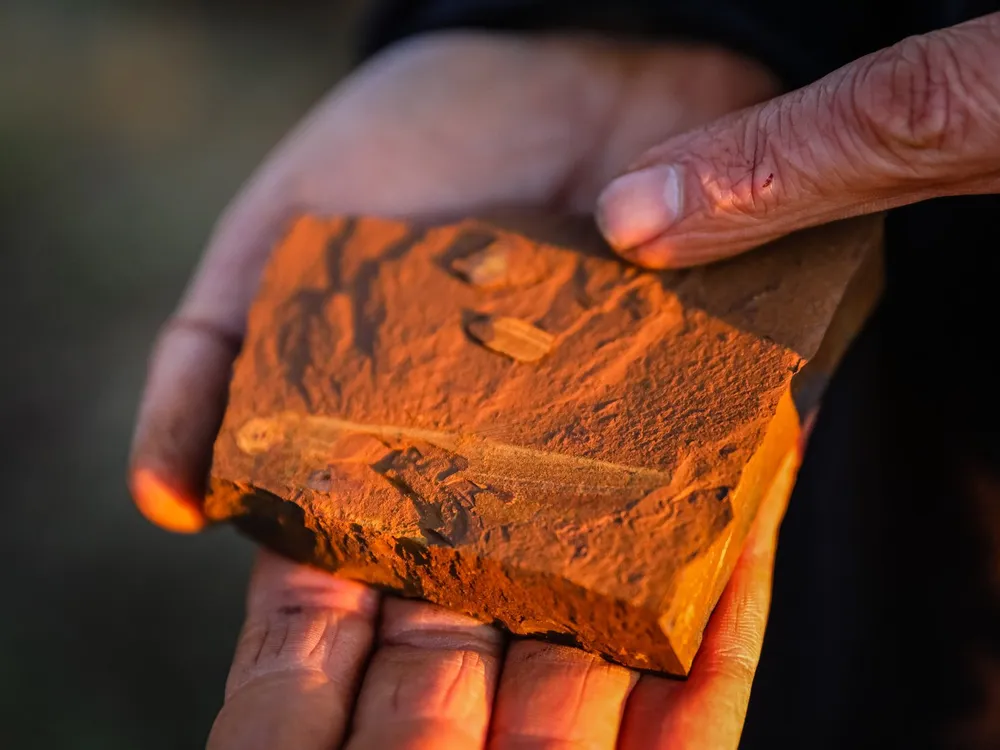
In A Surprising Discovery, Paleontologists Found Fish Fossils About 15 Million Years Old In Impressive Condition
Paleontologists in Australia made a surprising discovery: fish fossils about 15 million years old, so well-preserved that it is still possible to see what they ate before they died.
The revelation from the paleontologists came during an excavation at the site of McGraths Flat, near the town of Gulgong in New South Wales.
The team of researchers did not expect to find anything that day. They had just come from another site, without success. But, by chance, they decided to examine some rocks.
-
Son of a seamstress from the rural area of Ceará who did not speak English wins a scholarship of over 2 million reais at Williams College, one of the top 10 universities in the United States, covering everything including dormitory, meals, and annual trips to Brazil.

-
Bill Gates revealed that the true secret behind every great achievement is not a brilliant leap but rather small improvements repeated over the years, and the data from his own career and the fight against climate change prove that he is right.

-
With 22 thousand tons of steel, a height nearly three times greater than the Eiffel Tower, and a cost of R$ 1.6 billion, China is building the highest bridge on the planet over a colossal canyon, reducing a crossing time of over 2 hours to just over 2 minutes.

-
With more than 635,000 doctors, Brazil sees competition increasing in large cities, and recent graduates are competing for shifts at an accelerated pace while the countryside still faces shortages.


An Accidental Find
The scientist Jochen Brocks from the Australian National University was the one who opened the rock that brought the surprise.
Inside it, there was a nearly intact fossilized fish. It had soft tissue, an articulated skeleton, and visible details. The team did not recognize the species immediately.
Curious, they continued digging. They found more dozens of identical fossils. All very well preserved.
So well that the researchers were able to observe mosquito larvae, insects, and even mollusks that were in the stomachs of the fish.
One of them still had a small parasite attached to its tail, the glochidium, a juvenile form of a freshwater mussel.
New Species Identified
The fossils belong to a new species of fish called Ferruaspis brocksi. The name was chosen in honor of Jochen Brocks, the scientist who made the discovery. “Ferru” comes from Latin for iron. “Aspis” is a common term in names of fossil fish.
These fish lived during the Miocene epoch, a time when the interior of New South Wales was a humid tropical forest. Today, this same region is mostly arid and used for agriculture.
Ferruaspis brocksi was a small freshwater fish that belonged to the group of Osmeriformes. This group includes species like the Australian smelt and the Australian grayling. But until now, no fossilized Osmeriformes had been found in Australia.
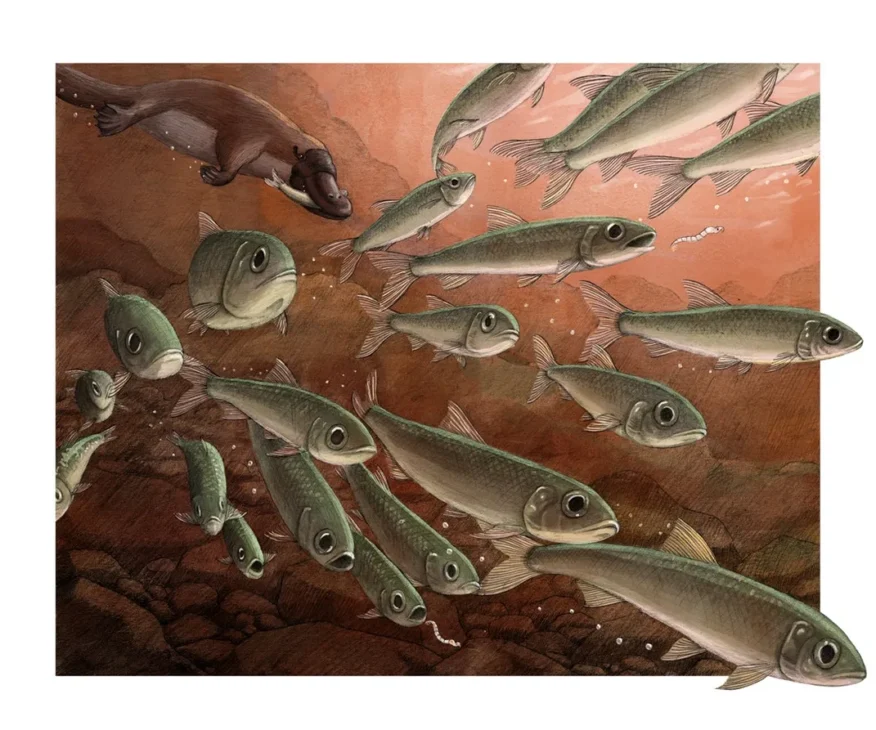
F. brocksi Might Have Looked Like In Life.
Alex Boersma
Surprise In The Type Of Preservation
The fossils were found inside a mineral called goethite, rich in iron. This surprised the scientists.
Normally, well-preserved fossils are not expected to be found in iron-rich rocks. The discovery could open new research possibilities.
“We Usually Think That Iron-rich Rocks Do Not Preserve Good Fossils,” said Kate Trinajstic, a paleontologist at Curtin University, who did not participate in the study. “This Opens A New Area Of Investigation.”
The quality of preservation also allowed for detailed studies. Scientists used a scanning electron microscope to analyze the fish.
They found melanosomes—cells that produce melanin, the pigment responsible for color. This Allowed Them To Discover The Fish’s Color Pattern: Two Lateral Stripes, Light Belly, And Dark Back.
An Unprecedented Record
This Is The First Time That Fossilized Melanosomes Have Been Used To Reconstruct The Color Pattern Of An Extinct Fish. Previously, This Type Of Study Had Only Been Done With Fossilized Bird Feathers.
Furthermore, the fossils can help better understand the evolutionary history of the Osmeriformes in Australia.
Since there were no previous records in the country, scientists were not sure when this group arrived in the region. Now, there is a concrete clue.
According to researchers, the presence of these fossils also helps reconstruct past ecosystems. The period when the fish lived was a phase of climatic transition in Australia.
“At The Time These Fish Died And Were Preserved, The Climate Of The Continent Was Changing,” said Michael Frese, a co-author of the study and a virologist at the University of Canberra. “It Is Like A Lesson In Geological History About What Happens When The Climate Changes Deeply.”
A Step Toward New Finds
The article with the discovery was published in the Journal Of Vertebrate Paleontology. The fossils are under study and continue revealing details.
The chance of finding such well-preserved fossils in iron-rich rocks may change how evidence from the past is sought. Scientists are already considering looking more closely at regions with goethite.
It was an accident that turned into a find. And the find may open doors to better understand the life that existed millions of years ago—and how it was affected by climate changes.







Seja o primeiro a reagir!