





 Português
  Inglês
  Espanhol
  6 min de leitura
  0 comentários


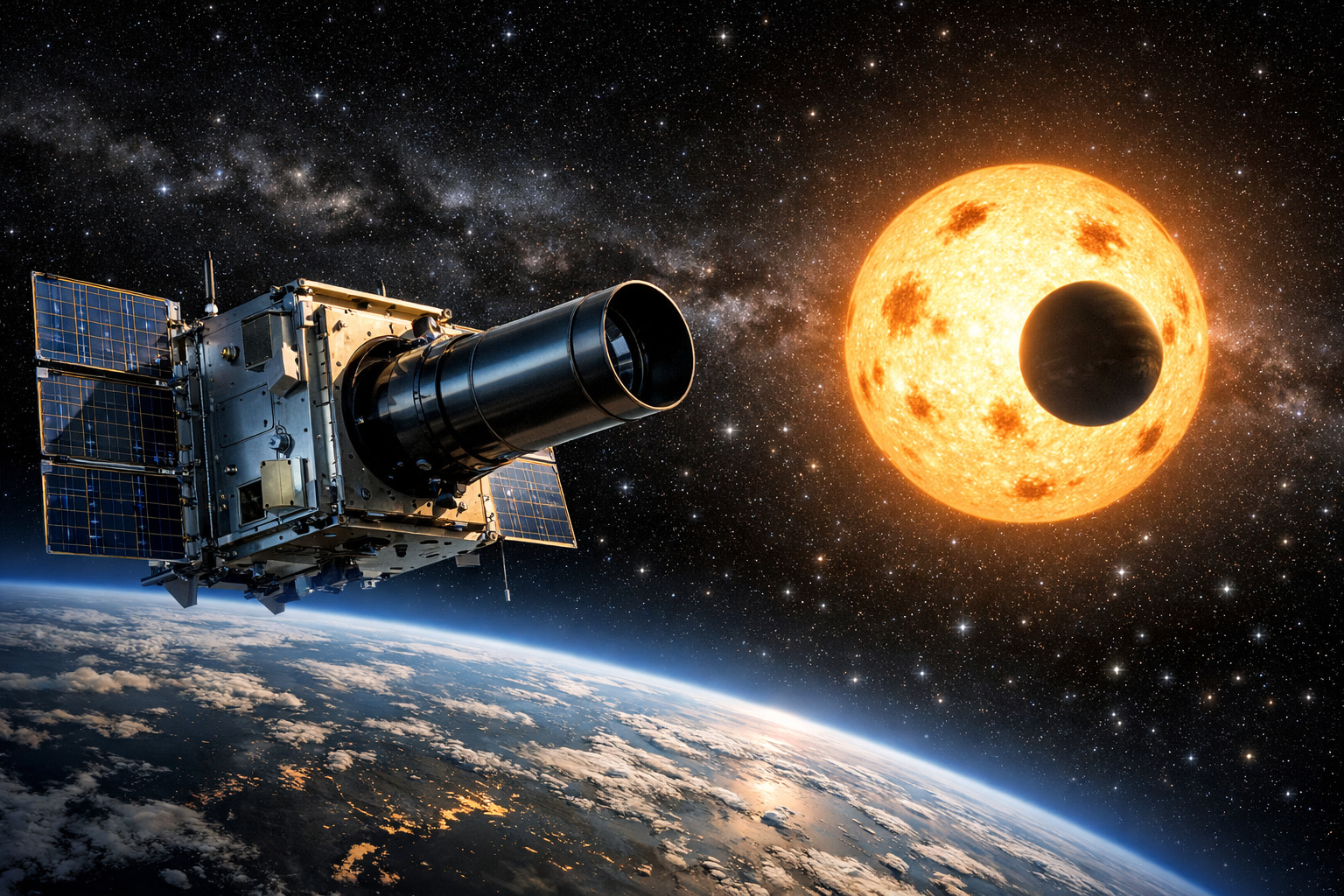
A New Space Mission Promises to Solve One of the Biggest Obstacles of Modern Astronomy by Separating, for the First Time, the Signal from Stars from the Atmosphere of Distant Worlds, Paving the Way for the Search for Potentially Habitable Planets
The search for life beyond Earth, one of humanity’s oldest and deepest questions, is about to enter a new phase. On January 11, 2026, NASA will launch the Pandora satellite, a compact yet highly sophisticated scientific mission designed to tackle one of the greatest challenges in exoplanet astronomy: the interference from the stars themselves in the analysis of planetary atmospheres.
The launch will take place from Vandenberg Space Force Base in California aboard a SpaceX Falcon 9 rocket. Despite its modest size—comparable to that of a household refrigerator—Pandora carries a gigantic scientific ambition: to simultaneously study stars and their planets, an unprecedented feat in space exploration so far.
The information was disclosed by Phys.org, in a report authored by Daniel Stolte, published in January 2026, based on official data from NASA, the University of Arizona, and the Jet Propulsion Laboratory (JPL).
-
A bright yellow mushroom imported from Asia escaped from a cultivation farm in the United States in 2010 and is now aggressively spreading across 25 states, destroying entire communities of native fungi in American forests.

-
Buried under China, a colossal machine weighing 20,000 tons began operating as the largest neutrino detector on the planet and, in just 59 days, surpassed results that science took half a century to achieve.

-
Iran enters the center of a climate alert after the war emitted 5.6 million tons of CO2 in two weeks, surpassing the annual pollution of entire countries.

-
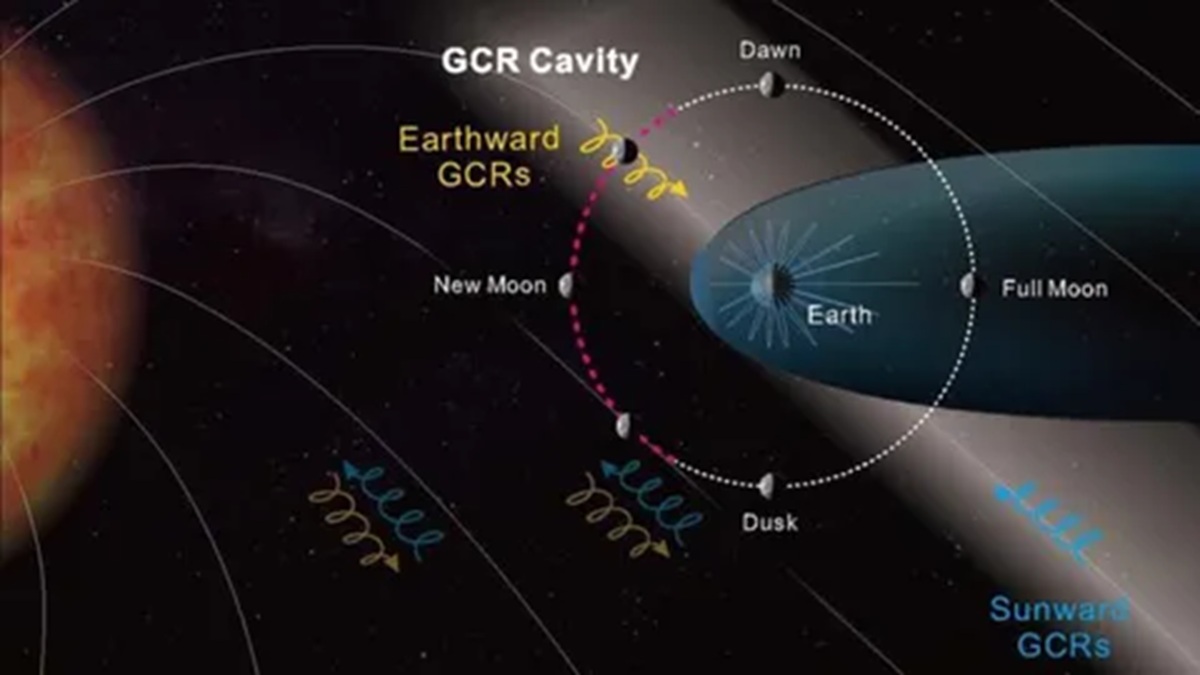
Lunar exploration may change after a Chinese probe finds a “cavity” of radiation that reduces the impact on astronauts by up to 20% at certain times on the Moon.
Throughout its primary mission of one year, Pandora will analyze at least 20 exoplanets, investigating their atmospheres for water vapor, clouds, hazes, and other key molecules. To achieve this, the satellite was specifically developed to solve a problem that has limited the interpretation of astronomical data for decades: the so-called stellar spots, cooler and darker regions on the surfaces of stars that distort the atmospheric signals of transiting planets.
How the Pandora Satellite Was Designed to “Clean” Exoplanetary Atmospheric Data

Credit: NASA/Goddard Space Flight Center/Conceptual Image Lab
Unlike previous missions, Pandora does not only observe the planet during transit. Instead, its strategy is to continuously monitor the host star, both during and outside the planetary transit. This seemingly simple detail represents a methodological breakthrough in modern astronomy.
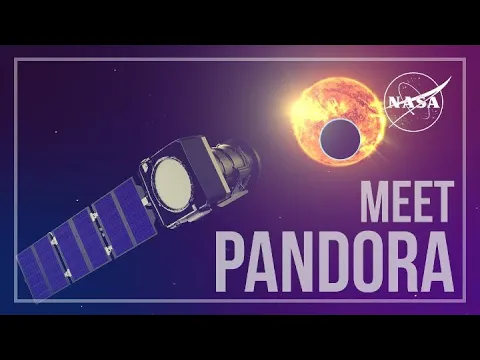
The satellite is part of NASA’s Astrophysics Pioneers program, an initiative created to enable smaller, faster missions that are highly focused on specific scientific challenges. Pandora is a SmallSat, equipped with an 18-inch (45 centimeters) diameter reflecting telescope, carefully calibrated for ultra-high stability photometric measurements.
Furthermore, the mission features two central scientific instruments. The first is an infrared spectrometer, capable of analyzing stellar light across multiple wavelengths in the near-infrared, where molecules such as water vapor and methane leave clear signatures. The second is a visible light photometer, designed to measure extremely subtle variations in the brightness of stars over time.
This combination allows for simultaneous multicolor observations, which is essential for differentiating whether a particular variation in the signal comes from the planet’s atmosphere or the unstable surface of the star. For each of the 20 target exoplanetary systems, Pandora will perform 24-hour continuous observations, repeated 10 times throughout the mission, generating a statistically robust dataset.
After launch, the satellite will undergo a commissioning period of approximately one month, during which all systems will be tested and calibrated. Subsequently, scientific operations will be conducted from the Multi-Mission Operation Center (MMOC), located at the University of Arizona, which will monitor telemetry, satellite health, and data collection in real-time.
The Problem of Stellar Spots That Confused Astronomers for Decades

Since the confirmation of the first exoplanet in 1992, astronomy has advanced rapidly. Today, more than 6,000 exoplanets have been confirmed, many of which were discovered using the transit method, which detects small drops in the brightness of stars when a planet passes in front of them.
However, correctly interpreting this data has never been trivial. Stars are not homogeneous surfaces. They feature stellar spots, cooler and darker regions, as well as faculae, hotter and brighter areas. When a planet transits through one of these regions, the observed signal can vary significantly.
In practice, this means that stellar spots can mimic the presence of clouds or atmospheric hazes, leading to incorrect interpretations regarding the composition of the planet. In other cases, they may completely mask real signals, such as the presence of water vapor.
As Daniel Apai, the leader of the Pandora mission at the University of Arizona, explains, the major innovation resides precisely in observing the star and the planet as a unified system. By continuously mapping stellar variability, Pandora enables scientists to accurately model the “contamination” from the star and subtract this effect from the final data.
This process results in much cleaner, more reliable, and interpretable atmospheric spectra—something that no previous mission has been able to offer in a dedicated manner.
Pandora and the James Webb Telescope: A Decisive Partnership in the Search for Habitable Worlds

The scientific impact of the Pandora mission goes far beyond its own data. One of its main objectives is to enhance the use of the James Webb Space Telescope (JWST), launched in December 2021.
The JWST has unprecedented sensitivity for detecting atmospheric molecules in exoplanets, including water vapor and carbon dioxide. However, without accurate models of the host star, even its data can produce ambiguities. Pandora emerges as precisely the missing piece in this puzzle.
By providing a detailed catalog of stellar variability for 20 planetary systems, Pandora will allow JWST observations to be interpreted with much greater confidence. This way, the extremely valuable time of the most powerful telescope ever built can be used more efficiently and purposefully.
Additionally, all scientific data from the Pandora mission will be made publicly available, strengthening global collaboration and allowing researchers worldwide to test models, validate theories, and identify the most promising targets for future investigations.
The mission also stands out for its human and institutional aspect. More than half of the leadership positions are held by young scientists and engineers, reinforcing the Pioneers program’s goal of nurturing the next generation of leaders in space exploration.
A Small Satellite with a Gigantic Impact on Cosmic Exploration

Although Pandora does not aim directly to detect extraterrestrial life, its role is absolutely fundamental. By refining the tools, methods, and data interpretation, the mission lays a solid foundation for future generations of telescopes to finally search for biosignatures with greater precision.
Every clean spectrum, every refined stellar model, and every better-understood atmosphere brings us closer to answering the question that has accompanied humanity for millennia: Are we alone in the universe?
With its launch scheduled for January 11, 2026, Pandora symbolizes a new era in exoplanet astronomy. Small in size but monumental in scientific ambition, the satellite represents the best of modern space engineering and international collaboration. This time, unlike the myth, Pandora’s box does not unleash evils but rather knowledge—and perhaps, in the future, the greatest discovery in the history of science.
Source: NASA






-

Uma pessoa reagiu a isso.