





 Portuguese
  English
  Spanish
  7 min of reading
  30 comments


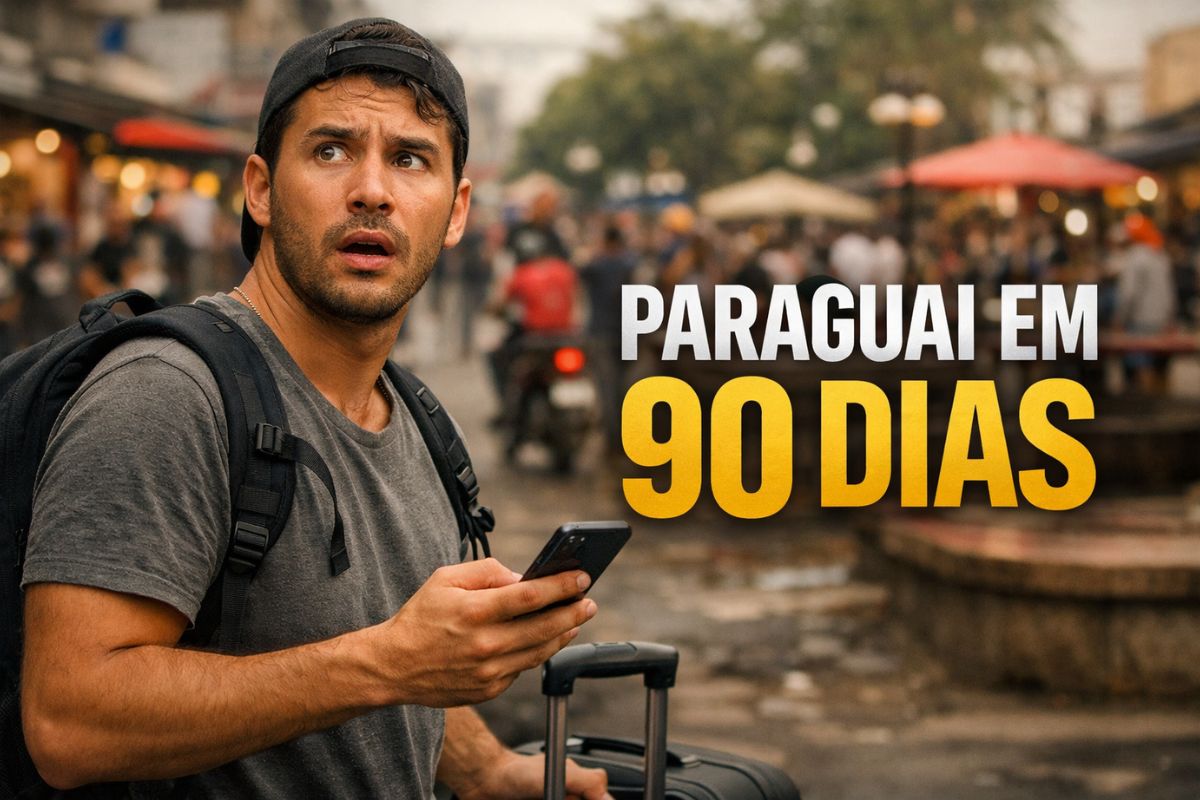


In 90 Days, Paraguay In 90 Days V Shows Cultural Shock With Language Blocked, Slow Pace, Less Bureaucracy And More Physical Presence, Cheap Essential Bills, Safety On The Streets At Night And Brazil Becoming Emotional Trauma For Families That No Longer Want To Return Under Any Circumstances, Even With Nostalgia
In the first 90 days of adaptation, Paraguay In 90 Days V ceases to be the promise of a “new Switzerland” or “new Dubai” and reveals itself as a country with simple streets, lighter bureaucracy, a slower routine, and a daily life where safety in the squares at night and lower electricity and water bills weigh more than shop windows and skyscrapers. The initial shock mainly comes from the language, the more human work pace, and how the local population deals with time, money, and police.
Throughout this period, reports from Brazilians who move to cities like Asunción, Encarnación, and Mariano Roque Alonso indicate a pattern: first comes the feeling of strangeness, then the relief with the reduction of violence, and finally the realization that Brazil transforms into a distant trauma. For many interviewees, the combination of lower essential costs, the feeling of honesty in daily life, and the real possibility to plan for the future makes the idea of returning to the home country no longer a concrete option.
Language Blocked, Groups Of Brazilians And Slower Pace In The First 30 Days

In the first 30 days, the shock is dominated by the language. Although Spanish is not a technical barrier, the recurring perception is of feeling “dumb” in daily conversations.
-
50 viaducts, 4 tunnels, 28 bridges, and 40 kilometers of bike paths: BR-262 in Espírito Santo will receive 8.6 billion reais for the largest engineering project in the state’s history, inspired by the Immigrant Highway in São Paulo.

-
Brazil produces too much clean energy and doesn’t know what to do with it: over 20% of solar and wind capacity was wasted in 2025 while investors flee and 509 renewable generation projects were abandoned in the last year.

-
Piauí will produce a new fuel that replaces diesel without needing to change anything in the truck’s engine and reduces pollutant gas emissions by half: truck drivers from all over the Northeast are already celebrating the news that will arrive later this decade.

-
A new Brazilian shopping center worth R$ 400 million will be built in an area equivalent to more than 4 football fields, featuring 90 stores, 5 cinemas, a supermarket, a college, and parking for 1,700 cars, potentially generating 3,000 jobs.


The newcomer understands loose words but cannot fully follow simple dialogues in markets, banks, and government offices, which creates frustration and a sense of helplessness.
In this scenario, many fall into the temptation to seek refuge in groups of Brazilians, creating a “mini Brazil” within Paraguay.
Immigration experts warn that this choice can delay adaptation and prevent mastery of the language even after two or three years.
The recommendation is clear: interact less in bubbles of Brazilians and expose oneself more to interactions with Paraguayans to accelerate the learning curve.
Meanwhile, the shock of the pace of life quickly arises. Brazilians used to managing multiple daily tasks, taxes, and bureaucracies report strangeness with a Paraguay In 90 Days V where no one seems to be in too much of a hurry.
Service providers, merchants, and employees maintain their own pace, without adhering to the urgency typical of large Brazilian cities.
Less Bureaucracy On Paper, More Physical Presence And End Of “Everything By App”
A central point in the first months is the relationship with bureaucracy.
Paraguay In 90 Days V shows that renting property, opening a bank account, or registering a company tends to be simpler and require fewer documents than in Brazil.
Rentals without a guarantor, account openings with few requirements, and company registrations with short deadlines are reported as the rule, not the exception.
At the same time, this “ease” comes with a requirement: physical presence.
Many banking or administrative transactions cannot be resolved via app or digital channels.
It is common to need to go to the bank, notary, or office to sign documents and request services.
The country combines less formal bureaucracy with more in-person displacement, which requires a reorganization of the routine for those used to resolving almost everything via cell phone.
Urban Reality: Neither Dubai Nor Switzerland, But It Changes The Sense Of Safety


In the analyzed reports, one phrase is recurrent: Paraguay is not Las Vegas, it is not Dubai, it is not Switzerland, it is Paraguay.
In 90 days, the newcomer discovers a territory with streets that are often simple, abandoned sidewalks, poor roads in some sections, and neighborhoods with maintenance issues, alongside good highways, new buildings, and well-kept areas.
The main difference compared to Brazil, however, lies not in urban aesthetics, but in the sense of safety.
In several Paraguayan cities, squares with children playing and families gathered at 10 PM or 11 PM are still part of daily life, a scenario that many interviewees claim to no longer see in large Brazilian centers.
The evaluation is that Paraguay is not a country with a perfect state, but with a population that does not support criminals and does not normalize criminality, which sustains a more stable sense of security.
Cheap Essential Bills, Utilities On And Greater Access To Healthcare
Another shock reported in Paraguay In 90 Days V is the issue of essential bills. Families migrating indicate surprise with electricity, water, and health plan bills.
Even with intense air conditioning use, longer showers, and higher water consumption, the bills tend to be lower than in Brazil in equivalent situations, making room for “luxuries” that were previously unthinkable.
Reports mention cases of families who, in Brazil, had to concentrate in one room to save energy, and who, in Paraguay, manage to keep more appliances on without straining the budget.
Health plans with broad coverage, often without co-payment and including medications, allow for an increase in consultations and check-ups, enhancing preventive care.
In the real estate market, rents for medium and high-standard houses also appear to be significantly lower, at levels that would allow living in neighborhoods or properties that would be unfeasible in Brazil with the same income.
Negative Shocks: Traffic, Police, Services And Limited Internet
Not everything is positive in Paraguay In 90 Days V.
Among the negative shocks, chaotic traffic frequently appears in certain areas of Asunción, with short trips taking up to an hour during peak times, a scenario that leads some Brazilians to avoid the capital as a place of residence.
Another sensitive point is police action. Reports indicate that there are still cases of police officers that “bother” during stops and try to obtain bribes, although there is a perception of gradual change with the departure of older officers and the entry of new agents.
Public services and some private services are also evaluated as limited in quality and variety, especially in cities outside the central axis.
There are also limitations in product availability, earlier store closures in certain neighborhoods, and occasional problems with quality internet, which particularly affects professionals who depend on a stable connection to work. These elements compose the less glamorous face of the initial impact.
Entrepreneurship, Negotiating And Networking In A Country With Another Logic
In the first 90 days, entrepreneurs report difficulty understanding the local negotiation logic.
In many cases, there is no discount for upfront payment, and merchants prefer to keep the full price by splitting the amount, even taking on more risk.
Typical proposals of “if we close now, I’ll do it for this price” meet resistance, as the decision-making time and requested amount follow their own logic.
In the realm of networking, the difference is even more marked.
While the Brazilian model relies on formal groups, events, and business meetings, in Paraguay, trust-building passes through family relationships, barbecues, and informal gatherings, where one family introduces another and business emerges over time.
Traditional networking events with lectures and business card exchanges are seen by many locals as a waste of time.
At the same time, there is demand for almost all types of services – from metallurgy to gardening, from accounting to law – but the combination of low prices and low professionalization in several sectors requires the Brazilian entrepreneur to position themselves with more quality without falling into the trap of being “too cheap” to the point of nullifying tax advantages and cost of living benefits.
Mental Shift: Slowing Down, Planning And Brazil As Trauma
The main turning point recorded in reports of a Paraguay In 90 Days V is mental.
With the reduction of daily pressure, many Brazilians say they are sleeping better again, resuming walks, sports, and simple leisure activities like fishing or playing ball with their children, something they couldn’t fit into their schedules in Brazil.
As the routine stabilizes, the perception emerges that it is possible to work 8 to 10 hours a day strategically and still build wealth and improve one’s life.
Planning for the future begins to make sense again, including plans to apply the so-called “theory of flags,” spreading investments and structures across more than one country, with Paraguay as plan A and other destinations as plan B or C.
In this process, Brazil ceases to be a reference and becomes a trauma.
Many interviewees report that they no longer want to invest, buy real estate, or hire in the country of origin, limiting themselves, at most, to using Brazilian opportunities to generate income and transfer it abroad.
The criticism is not only directed at the economy, but at the overall environment of insecurity, polarization, and instability.
In light of this scenario of Paraguay In 90 Days V, with a challenging language, lighter bills, greater safety, and emotional rupture with Brazil, do you think it would be worth facing this reality shock to try for a simpler and more predictable life outside the country?









Sim, com certeza . O Brasil acabou. Tudo que o PT encosta ele destrói, ****, piora e lasca os brasileiros.
O IVA no Paraguai é 10%,aqui será coisa de 28%, o imposto de renda de pessoa física lá é 10%,aqui chega a 27,5%,o imposto de renda sobre empresas é 10%, aqui pode passar de 30%. Além disso a energia é barata e grande parte é produzida em Itaipu, mas eles conseguem um preço bom e nós não.
Quais as melhores cidades pra se morar?