





 Portuguese
  English
  Spanish
  4 min of reading
  0 comments


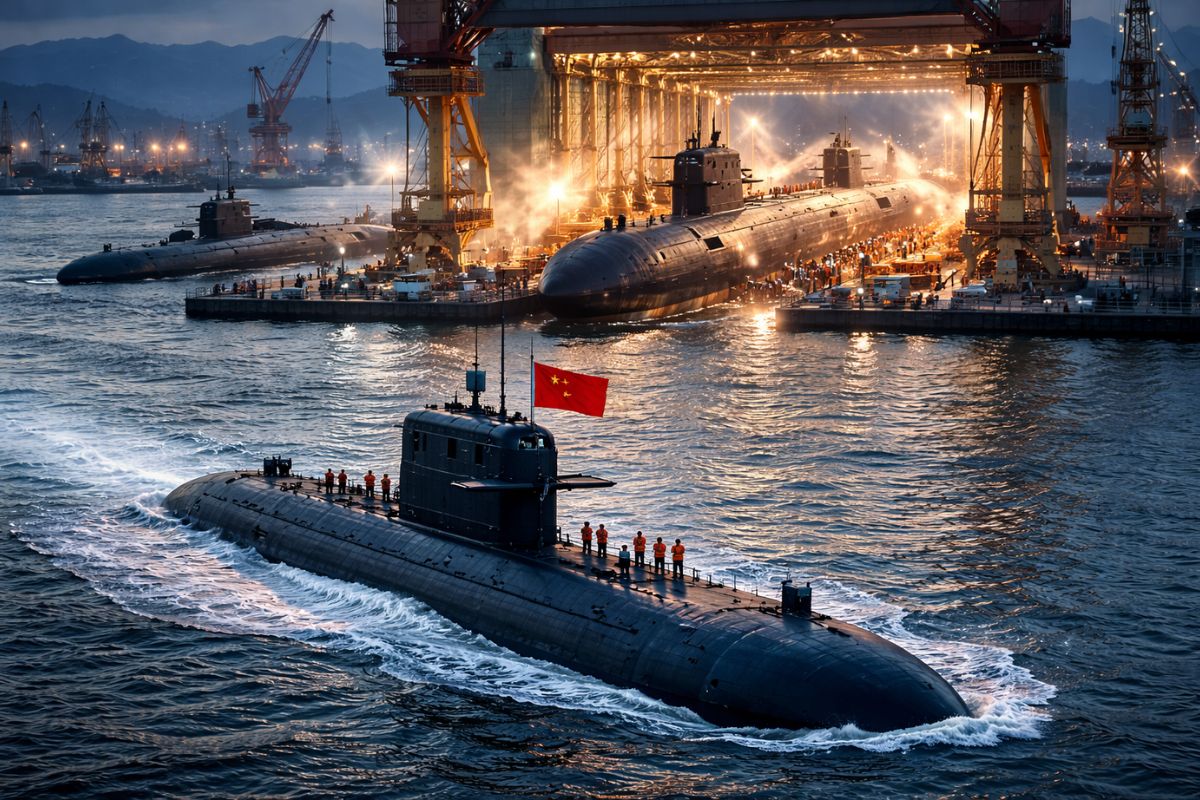
Nuclear-Powered Submarines Enter The Center Of The Maritime Dispute After An Analysis By The International Institute For Strategic Studies Using Satellite Images To Estimate That China Launched 10 Units And 71,667 Tons, Against 7 And 50,348 From The United States, From 2021 To 2025 And Lit Up Washington Alert
Nuclear-powered submarines have become an indirect measure of industrial and military power, and China, which is Brazil’s economic partner, has come under closer scrutiny from the United States after estimates pointed to a jump between 2021 and 2025 in launches and tonnage.
What changes the conversation is the method and the official silence. Beijing does not disclose complete numbers, and the photograph of shipyards, combined with technical estimates, has started to fill the space previously occupied by mere speculation and discourse.
A Race Measured By Images And Estimates

The cited analysis attributes to the International Institute for Strategic Studies the effort to transform visual cues into comparable numbers.
-
Motorola launched the Signature with a gold seal from DxOMark, tying with the iPhone 17 Pro in camera performance, Snapdragon 8 Gen 5 that surpassed 3 million in benchmarks, and a zoom that impresses even at night.

-
Satellites reveal beneath the Sahara a giant river buried for thousands of kilometers: study shows that the largest hot desert on the planet was once traversed by a river system comparable to the largest on Earth.

-
Scientists have captured something never seen in space: newly born stars are creating gigantic rings of light a thousand times larger than the distance between the Earth and the Sun, and this changes everything we knew about stellar birth.

-
Geologists find traces of a continent that disappeared 155 million years ago after separating from Australia and reveal that it did not sink, but broke into fragments scattered across Southeast Asia.

The base is simple and uncomfortable at the same time: when a country does not detail its fleet, it’s left to observe shipyards, docks, and construction phases, and then infer launches and tonnage, especially in nuclear-powered submarines.
This type of reading is not a perfect X-ray.
Satellite images help to see the pace but do not reveal everything about the quality, readiness, and mission of each hull.
Even so, when the images repeat and the patterns accumulate, they become a thermometer that pressures both sides.
The Numbers That Put China Ahead
Between 2021 and 2025, China is estimated to have launched 10 nuclear-powered submarines, compared to 7 from the United States.
The same timeframe also suggests an advantage in total tonnage: 71,667 tons attributed to the Chinese, against 50,348 tons attributed to the Americans.
There is an additional contrast that makes the trend clearer: between 2016 and 2020, China reportedly launched only three units totaling 23,000 tons, while the United States launched seven with 55,500 tons.
The jump in launches and the shift in tonnage serve as a line that separates two moments.
Why Submarines Matter More Than They Seem
Nuclear-powered submarines are not just fast vessels.
They combine prolonged autonomy, the ability to remain submerged for extended periods, and the possibility of operating far from their bases, which alters the calculus of presence and deterrence at sea.
The analysis mentions that the Chinese fleet now includes both ballistic missile submarines and attack submarines.
This matters because it defines different roles: some sustain the logic of strategic deterrence, while others support surveillance, area denial, and pressure on maritime routes, with impacts that can reverberate even outside their immediate surroundings.
What The United States Admit When They Speak Of Turbulence
The American discomfort is not only evident in graphs.
In a hearing at the House of Representatives, the U.S. Secretary of the Navy, John Phelan, described the country’s shipbuilding as a period of turbulence and cited delays and budget overruns, a statement that gained weight coming from within.
When one side acknowledges delays and costs above expectations, it hands over a piece of the problem without needing to mention the adversary.
This also explains why launches and tonnage become an obsession: it’s not just about counting hulls, but measuring the capacity to sustain pace, maintenance, and replenishment over time, including in the nuclear-powered submarine supply chain.
Brazil In The Middle Of The Board And What Remains Open
Calling China Brazil’s partner describes an economic relationship, not a military alliance.
Nevertheless, the growth of nuclear-powered submarines in any major power eventually enters the global strategic conversation, as it reshapes priorities, budgets, and alliances of other actors.
For the Brazilian reader, the practical question is where this intersects with daily life.
The most honest answer is indirect: tension between China and the United States could pressure trade chains, elevate risks in routes, and increase competition for influence.
And when the dispute grows at sea, it usually first appears in costs and then in the news.
The Limit Of The Data And The Questions That Remain
Even with satellite images, there are missing pieces.
What is not detailed is the degree of readiness, the specific characteristics of each project, the maintenance rate, and the ability to operate in networked environments, points that sometimes matter more than tonnage.
There is also no official confirmation from Beijing in the presented material that closes the account.
Therefore, the result needs to be read as a well-founded estimate, not as a certificate.
Even so, when launches and tonnage change levels, the trend ceases to be noise and becomes a signal.
When looking at nuclear-powered submarines and how China and the United States compete for launches and tonnage, which aspect concerns you the most: the lack of transparency, the industrial acceleration, or the chance of this type of race spilling over into Brazil through the economy and daily costs? And do you trust official numbers more or satellite images when a country does not disclose data?








-

-

4 pessoas reagiram a isso.