





 Portuguese
  English
  Spanish
  5 min of reading
  1 comment


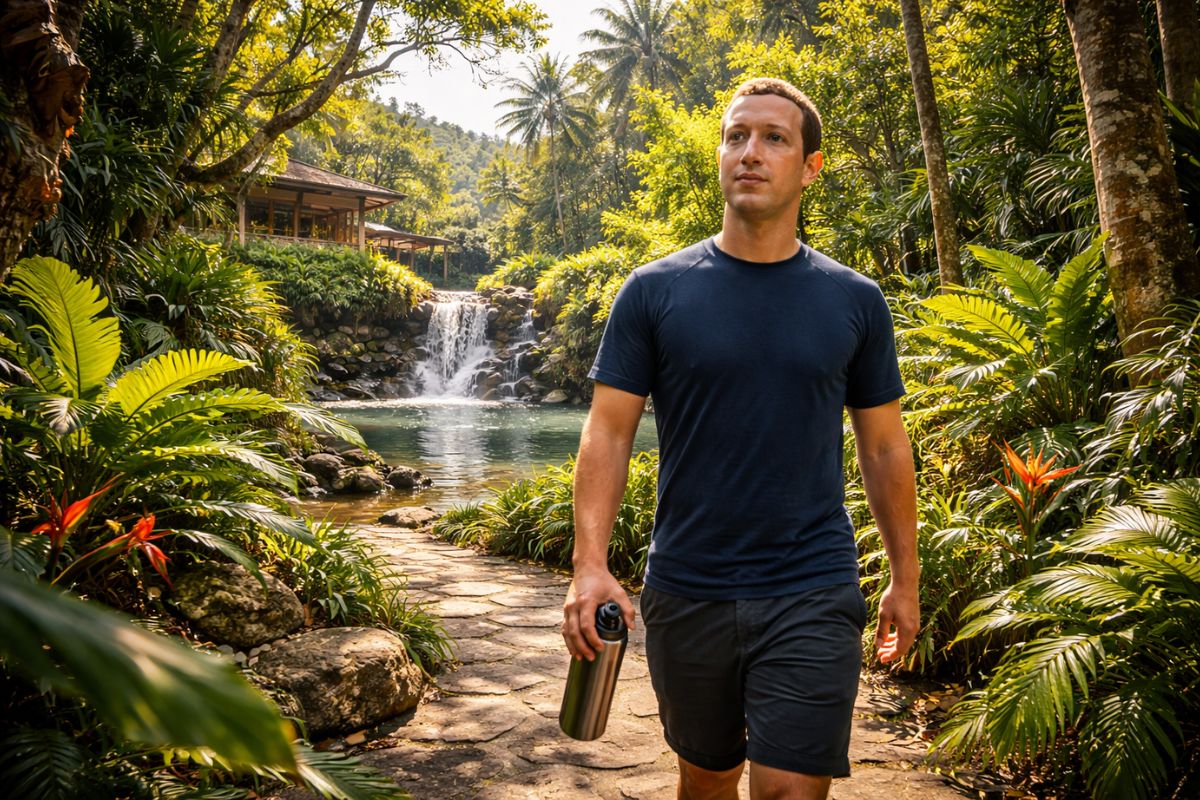


Koʻolau Ranch Complex In Hawaii Uses A 180-Hectare Forest As A Green Belt For Environmental Control To Reduce Stress, Ensure Self-Sufficiency And Optimize Decision-Making In Critical Scenarios
At first glance, the 180-hectare forest surrounding Mark Zuckerberg’s home in Kauai seems just like another billionaire’s exaggeration wanting maximum privacy on a paradise island. Trees on all sides, restricted access, enhanced security, and a setting reminiscent of an isolated retreat from the rest of the world.
But, looking closely, it becomes clear that it’s not just about hiding or aesthetics. The forest was designed as part of a larger system: a self-sufficient billion-dollar complex, prepared for crises and designed to control the physical environment around the Facebook founder, reducing stimuli, lowering stress, and creating ideal conditions for high-impact decisions.
A Mega Billion-Dollar Complex Prepared For Crises
In Kauai, Hawaii, Mark Zuckerberg is erecting one of the largest private residential projects in the world, known as Koʻolau Ranch.
-
Friends have been building a small “town” for 30 years to grow old together, with compact houses, a common area, nature surrounding it, and a collective life project designed for friendship, coexistence, and simplicity.

-
This small town in Germany created its own currency 24 years ago, today it circulates millions per year, is accepted in over 300 stores, and the German government allowed all of this to happen under one condition.

-
Curitiba is shrinking and is expected to lose 97,000 residents by 2050, while inland cities in Paraná such as Sarandi, Araucária, and Toledo are experiencing accelerated growth that is changing the entire state’s map.

-
Tourists were poisoned on Everest in a million-dollar fraud scheme involving helicopters that diverted over $19 million and shocked international authorities.


The land is about 500 hectares and includes two large residences connected by an underground tunnel, leading to a bunker of approximately 500 square meters with explosion-resistant doors, supplies, and independent systems.
The complex is designed to operate autonomously. It combines self-generated energy, water supply, and agricultural areas, in addition to enhanced security and tightly controlled access.
The idea is simple yet powerful: if something goes wrong in the external world, the internal system continues to function.
More than luxury, the project follows the logic of a home prepared for disasters, capable of withstanding natural disasters and global crises.
This type of construction aligns with the so-called prepper culture among technology executives, where resilient properties act as a form of “physical insurance” against extreme scenarios.
The 180-Hectare Forest As An Environmental Control Machine

Within this design, the 180-hectare forest around the buildings is not just a beautiful detail of the project.
It serves as a green belt programmed to perform multiple functions simultaneously: protection, isolation, landscape, and regulation of the sensory environment.
Koʻolau Ranch includes preservation areas, reforestation with native species, and agricultural spaces blended with the vegetation.
Part of the land has been allocated for environmental recovery, forming an ecological barrier around the main residence. At first glance, it seems that Zuckerberg just wants to live “in the middle of nowhere.”
In practice, the goal goes beyond that. The billionaire aims to control the surrounding nature, not just coexist with it. The forest has been organized to create an environment with less noise, less visual interference, and greater sensory predictability.
The vegetation helps filter external sounds, stabilize the landscape that reaches the windows, and maintain a constant pattern of light, shadow, and natural ventilation.
The result is a scenario where abundant natural light, constant ventilation, and a sea of greenery around the house are not just comfort but part of a strategy to reduce tension and facilitate concentration on complex decisions.
How Other Billionaires Are Redesigning Their Environments

Zuckerberg is not alone in this logic of using nature and architecture as performance tools.
Other technology billionaires have been following similar paths, each in their own way, but with the same central idea: shaping the physical environment to influence mental state and cognitive performance.
Elon Musk, for example, has been redesigning spaces related to SpaceX with greater integration to green areas and natural light, bringing work facilities closer to a less industrial and more organic aesthetic.
Jeff Bezos has created the famous Amazon spheres in Seattle, three glass domes with internal vegetation, designed to replicate a natural microclimate within the corporate environment.
In all these cases, nature does not appear as a random adornment. It comes as part of the decision engineering: reducing stress, increasing focus, improving the quality of attention, and making work journeys more sustainable and responsible at extreme levels.
What Science Says About Nature, Stress And Focus
The strategy behind the 180-hectare forest aligns with what research in environmental psychology and neuroarchitecture has been indicating.
Studies show that the physical environment directly interferes with cognitive functions such as sustained attention, working memory, and decision-making.
A study published in Frontiers in Cellular Neuroscience indicates that environments with good natural lighting and adequate ventilation contribute to lower levels of cortisol, a hormone associated with stress, and better performance in tasks requiring prolonged concentration.
This means that seemingly simple details, such as large windows and airflow, can directly impact how the brain responds to pressure.
Another study, this time in Scientific Reports, indicates that contact with natural elements, even in indoor environments, through gardens, organic materials, or visual simulations of nature, stimulates creativity and increases cognitive efficiency after intense periods of mental effort.
You don’t need to be in an isolated forest to feel the effect, but an entire forest dedicated to this takes the concept to the extreme.
The 180-Hectare Forest As A Long-Term Decision-Making Tool
In Mark Zuckerberg’s case, the physical isolation, the self-sufficiency of Koʻolau Ranch, and the green belt around the property form a strategic tripod.
Security, resilience, and cognitive performance go hand in hand within a private territory designed almost like a mini-country infrastructure.
The 180-hectare forest serves as a central piece on this board. It does not only serve to keep onlookers away or create a postcard-like setting.
It functions as a filter between the external world and the mind of those who need to make high-impact decisions, reducing variables, stabilizing the environment, and decreasing the amount of physical and mental noise that reaches everyday life.
Ultimately, it’s as if the space around the house was designed for this: lowering stress levels, increasing environmental predictability, and creating the best possible context for clear thinking in difficult situations.
And you, would you live in a 180-hectare forest designed to control the environment and boost focus, or do you think this level of isolation is too excessive?









Amei essa reportagem! Como não sou bilionária, rsrsrs, após o período de isolamento social na Pandemia/2020 decidi mudar minha residência de um apto em área central para um imóvel que chamo de “chácara urbana”, por ser um micro ecossistema com árvores frutíferas crescendo e outras quecaprnas embelezam o local. Pequrna horta que me permite plantar os vegetais necessários em muitos tons de verde e cores. Construí uma pequena residência de 59 m2 totalmente funcional. A casa se integra ao ambiente com janelas grandes de vidro. Escuto pássaros o dia todo. Há 5 anos e aos 73 de idade, vejo a cada dia a natureza desabrochar. Não tive sequer um resfriado ou outros adoecimentos nestes últimos anos, sem contar a calma e paz interior. Tenho academia próxima, onde preservo a funcionalidade do corpo comércio farto e a sociabilidade necessária de vizinhos antigos da região. Ou seja resgate simples do que é necessário para bem viver! Abaixo a verticalização das cidades e oque representam como destruição do planeta e aquecimento global.