





 Portuguese
  English
  Spanish
  8 min of reading
  0 comments


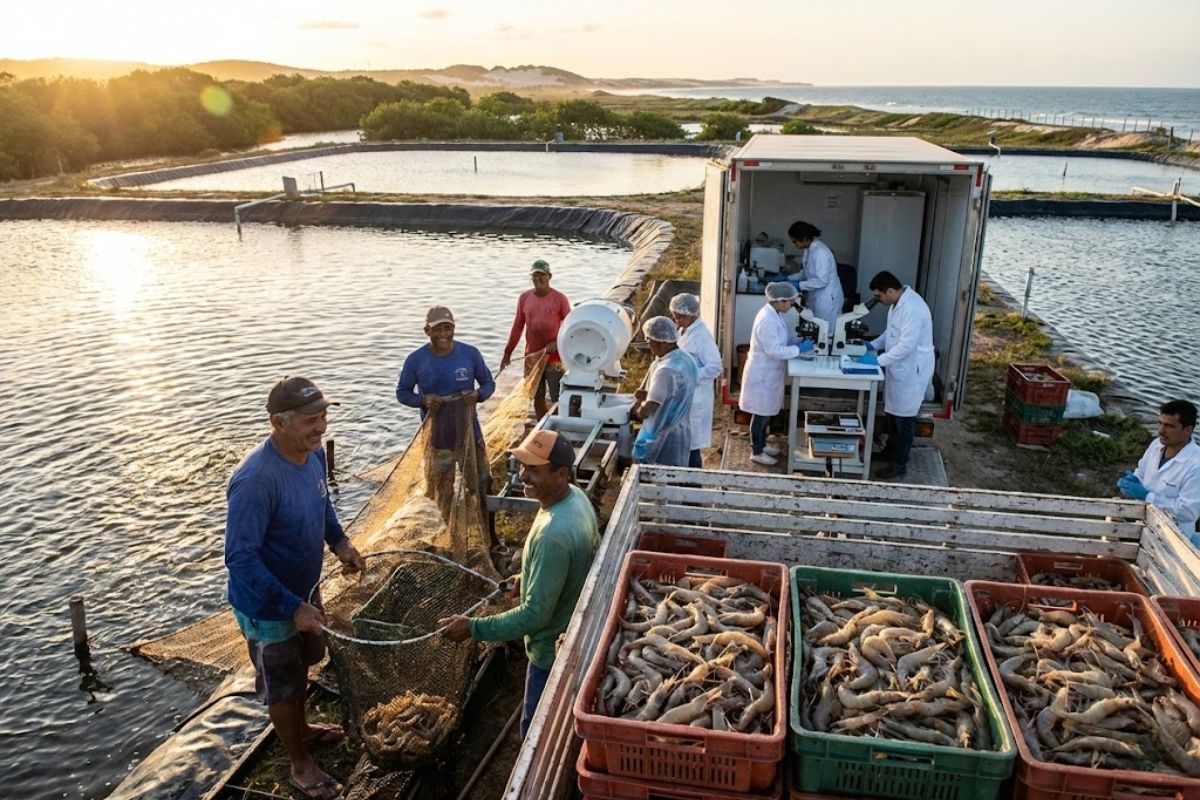
In Guaraíras Lagoon, in Tibau do Sul, small shrimp producers report increased income after a laboratory offered 100% national genetics and reduced genetic testing costs previously sent abroad. The startup invested R$ 2 million, serves Brazil, Mexico, and Saudi Arabia, and projects a boost in family aquaculture by 2026.
An innovation created in Rio Grande do Norte has begun to appear as a direct income factor in family farms in the Guaraíras Lagoon region, in Tibau do Sul. Small shrimp producers reported higher earnings after gaining local access to genetic tests that had previously been contracted abroad, which made animal selection more expensive.
The change is associated with a laboratory that offers 100% national genetics, structured to identify the best shrimp families for farming and to guide management decisions based on biological information. The bet is already exporting services and could reshape family aquaculture in 2026, in a state that contains the largest share of family farms in the country.
Where the Turning Point Began and Why It Became a Topic in RN

On the shores of Guaraíras Lagoon, shrimp farming had already been part of the economic daily life before any debate on genomics.
-
They said no to 26 million dollars and would do it all over again: mother and daughter from Kentucky reject a million-dollar offer from a mysterious company that wants to build the largest data center in the state on more than 2,000 acres of rural land.

-
While corn requires rain and is expensive, sorghum produces almost the same volume per hectare at a cost up to 80% lower and uses less water, and it is revolutionizing dairy farming in the Triângulo Mineiro, where producers save hundreds of reais per hectare.
-
A rural producer from Urubici cries as he shows 50 tons of plums thrown on the ground because no one wanted to buy them, and in desperation, he records a video asking anyone to come to the property to pick the fruits before they rot.
-
Unable to pass through Hormuz, Brazil activated a plan B that uses Turkey as a gateway to the Middle East: the route through Gibraltar and the Mediterranean is longer and more expensive but ensures that chicken, beef, and corn continue to reach Arab markets.


What changes now is the scale of information access: small shrimp producers have begun to incorporate decision-making routines that previously relied on foreign laboratories and high costs for conducting genetic tests.
The scenario described in Tibau do Sul is not a substitution of field experience but an addition of a technical layer.
The laboratory operates as a diagnostic service to guide the selection of more resistant and productive animals, increasing the likelihood of more predictable results in a sector where variations in water quality and health can impact batch performance.
Who Are the Entrepreneurs Behind the Laboratory and What Was the Path to the Company
The technology was created by three entrepreneurs from Rio Grande do Norte: Roseli Pimentel, Luciana Menollilanza, and Daniel Lanza.
Roseli had previously coordinated a genetic improvement program at the largest shrimp producer in Brazil, and from this experience, identified a practical bottleneck: genetic tests were conducted abroad, at a high cost, which restricted the use of this resource by small shrimp producers.
Daniel Lanza works as a professor at the Federal University of Rio Grande do Norte, UFRN, and describes the proposal as a bridge between science and field.
The project’s logic is to transform genetic knowledge into an operational tool, reducing external dependency and shortening the time between information collection and decision-making on the farm.
What Does 100% National Genetics Mean in Practice and How Did Genetic Tests Become More Accessible
The term 100% national genetics, in the presented context, refers to technology developed in the state itself to identify shrimp families more suitable for farming.
The focus is not an abstract promise, but a method for comparing lineages, selecting animals with greater resistance and productivity, thereby generating more profit for the producer, according to the explanation attributed to Daniel.
At the economic stage, the central effect is cost.
When genetic tests depended on foreign services, the price was a barrier for many small shrimp producers.
By offering the service locally, with operations in Rio Grande do Norte, the laboratory reduces a barrier that hindered the use of biological data as a management tool for production.
The Case of a Family Farm and the Numbers That Illustrate Gains in the Field
Hailton Alves Marinho is mentioned as one of the 28 family producers cultivating shrimp in the region who saw their production evolve with the arrival of the service.
At the farm, he reports the combination of productivity and appreciation of the final product: the technology allows for raising larger and healthier shrimp, and the larger size gains market value.
The reported figures show the scale of this routine.
At the property, the declared production is 3,000 kilograms per month, with a cost of R$ 30,000 and a net profit of R$ 6,000 monthly.
The presented reading is straightforward: producing less and earning more, when the batch performs better and is of higher value, is a consistent effect with a more efficient selection based on genetic testing and decisions guided by information.
The producer is also investing in solar energy and in rigorous water quality control.
This detail matters because it defines a technical point: 100% national genetics works better when the farm environment is under control, reducing stress and enhancing the productive potential of the selected animals.
Investment, Financing, and Revenue: The Economic Design of the Bet
The reported initial investment to get the laboratory off the ground was R$ 700,000.
With support from the company where they worked and public resources, the entrepreneurs opened their own laboratory and reached a total investment of R$ 2 million.
The operation already serves producers from Brazil, Mexico, and Saudi Arabia, and registers annual revenue of R$ 390,000.
These figures indicate a company that, although still with revenue below the total accumulated investment, already operates as a service provider and gains relevance by exporting a type of knowledge that was previously imported through genetic testing abroad.
Why Rio Grande do Norte Is Strategic for Family Aquaculture and How It Affects Local Income
Rio Grande do Norte is presented as responsible for 80% of the national shrimp production in family farms, generating approximately R$ 450 million per year.
This weight alters the significance of any efficiency gains, even when starting on a small scale: if small shrimp producers begin to reduce costs and increase productivity, the aggregate effect tends to be felt throughout the local chain.
In the context of family aquaculture, the main consequence is to shorten the distance between technology and producer.
When information becomes accessible, decisions such as matrix selection and cycle planning no longer rely solely on trial and error but begin to incorporate genetic testing as a technical parameter.
The “Productivity Turn” and What It Changes in the Daily Life of the Farm
The term productivity turn appears as a summary of what happens when genetics becomes a routine tool and not an occasional, expensive, external service.
For small shrimp producers, the change translates into three fronts.
The first is selection. With genetic testing, the producer has a basis for choosing more resistant and productive families, increasing the chance of a more uniform batch with better performance.
The second is economic predictability: more consistent batches help to plan costs and revenue.
The third is integration with management practices, such as water quality control, which in this case is treated as part of the professionalization package.
International Market: How Exporting Service Changes the Game for a Local Technology
The laboratory already serves clients abroad, with customers in Mexico and Saudi Arabia.
This fact is relevant for two reasons. First, because it confirms that the service is not just a regional solution; it finds demand in external markets.
Second, because it reinforces the inversion of the dependency flow: whereas before genetic tests were outsourced abroad, now a service structured in Rio Grande do Norte exports genetic analysis.
For family aquaculture, the consequence is indirect but concrete.
Exporting service tends to strengthen the company, expand service capacity, and stabilize revenue, which could keep prices more affordable for small shrimp producers in the domestic market.
Cited Entities and the Map of Sector Actors
In addition to the producers and entrepreneurs, two references related to the subject appear: the Brazilian Association of Shrimp Farmers – ABCC and the company Genaptus Laboratory Services and Training in Genetic Analysis Ltda, associated with the laboratory and the provision of genetic testing services with 100% national genetics in Rio Grande do Norte.
The presence of these actors indicates an ecosystem that combines production in family farms, sector organization, and provision of specialized services, with the potential to reinforce family aquaculture in 2026.
What Could Change in 2026 and What Are the Technical Limits of Advancement
The projection for 2026, according to the description of the topic, is that the dissemination of 100% national genetics and the decrease in genetic testing costs could reshape family aquaculture.
The reshaping, in this context, means increasing productivity and income based on animal selection, information, and more assertive decision-making.
However, there are implicit limits in the narrative itself.
The gain is more likely when the producer controls management variables, such as water quality, and invests in monitoring routines.
The technology does not eliminate risk, but reduces uncertainty by improving animal selection and guiding the production cycle.
Facts and Numbers That Summarize the Story
The set of available information allows for organizing the main points objectively:
• Reference location: Guaraíras Lagoon, Tibau do Sul, Rio Grande do Norte
• Target audience: small shrimp producers in family farms, with mention of 28 family producers in the region
• Central change: local access to genetic tests with 100% national genetics, previously dependent on foreign services
• Investment: initial R$ 700,000 and total investment of R$ 2 million
• Market served: Brazil, Mexico, and Saudi Arabia
• Reported annual revenue: R$ 390,000
• Example of production: 3,000 kilograms per month, cost of R$ 30,000, and net profit of R$ 6,000 monthly
• State economic weight: Rio Grande do Norte with 80% of national production in family farms and approximately R$ 450 million per year
What is happening in Guaraíras Lagoon points to a change based on a clear technical basis: small shrimp producers have gained access to genetic tests with 100% national genetics within Rio Grande do Norte, reducing costs and converting information into management decisions.
The numbers from the mentioned farm and the company’s market data show a service that is already operational, exporting, and may consolidate the productivity turn in family aquaculture by 2026.
In practice, the next step for those working in family farms is to treat data as an input, combining water quality management, control routines, and the use of genetic tests to select animals and stabilize results throughout the cycle, without relying on foreign resources for every technical decision.
Do you believe that small shrimp producers will be able to scale this productivity turn in family aquaculture by 2026, or will the adoption of genetic testing still be concentrated in a few farms?









-

-

-

-

-

9 pessoas reagiram a isso.