





 Português
  Inglês
  Espanhol
  5 min de leitura
  0 comentários



Discover How the Job Market Perspectives Have Evolved Over Time and Understand What to Expect from the Professional Future Based on Social, Historical, and Technological Transformations.
Throughout the centuries, the job market has undergone profound transformations, influenced by historical, social, economic, and technological factors. With that, understanding the job market perspectives means looking at the present carefully, recognizing the past, and preparing for the future.
In this context, we will explore clearly and accessibly how these changes occurred, what they mean today, and what possible directions lie ahead in the coming years.
From Handicrafts to the Industrial Revolution
Firstly, to understand the current job market perspectives, it is necessary to look back in time. For much of history, especially in the Middle Ages, work was centered around artisanal and rural activities.
-
Employee Fired After Accumulating 114 Days of Medical Leave in One Year, Labor Court Upholds Company’s Decision

-
Employee Fired While Treating Depression Wins in Court and Vale Is Required to Rehire Him Following Decision Based on the CLT and INSS Benefits

-
Workers Should Be Aware! March 6 Will Be The Fifth Business Day Of March And The Final Deadline For Companies To Pay Salaries According To The CLT

-
2026 FGTS Anniversary Withdrawal Is Released According to Birth Month, Sets Amounts by Balance Range, Establishes Deadlines for March and April, and Changes Rules in Case of Dismissal


During that period, workers learned trades from masters and spent their entire professional lives connected to a single activity, usually in small groups or within their own families.
However, with the Industrial Revolution, which began in the 18th century, the scenario changed drastically. Machines began to perform functions previously done manually, and work migrated from the fields to factories.
As a result, new professions emerged, the concept of working hours took shape, and the organization of companies began to take the model we know today. According to Harvard University (2021), the Industrial Revolution was a milestone for the modernization of industries and a turning point in work dynamics.
It is worth noting that this revolution also brought new challenges: labor exploitation, lack of labor rights, and income concentration. However, it also propelled urban growth and the appreciation of technical knowledge.
The Influence of Technology and Globalization
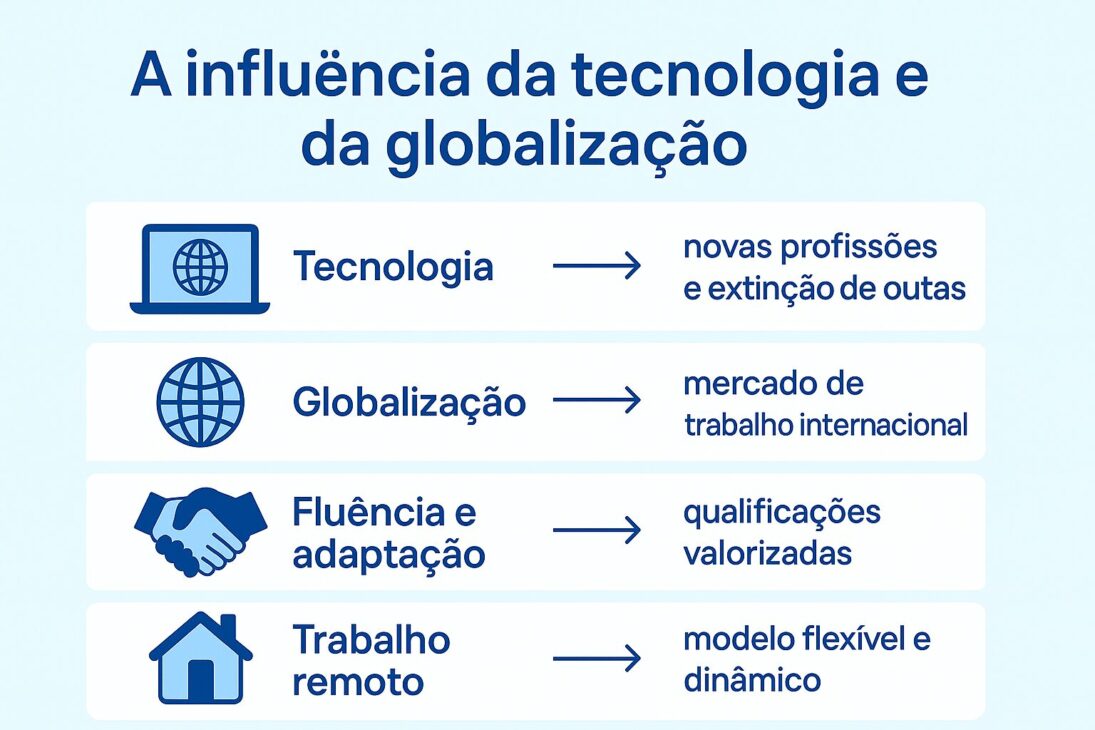
Throughout the 20th century, especially from the second half onwards, technology began to advance at an accelerated pace. Computers, the internet, and the first automated systems started to transform the way people worked again.
This did not mean just the emergence of new professions but also the extinction or reduction of several others.
In addition, at the same time, globalization intensified commercial and cultural exchanges between countries, making the job market no longer just local.
Consequently, companies began seeking talent from various parts of the world, and professionals started to compete on a global scale. Proficiency in languages, mastery of technologies, and adaptability became essential skills.
As a result, new forms of work emerged, such as freelancing, home office, and more recently, full-time remote work.
This means that the idea that physical presence is necessary to produce has been replaced by a more flexible and dynamic model. According to data from the Brazilian Institute of Geography and Statistics (IBGE) (2020), the COVID-19 pandemic accelerated this change, with a significant increase in the number of remote workers.
The Impact of Changes in the 21st Century
In the 21st century, the job market perspectives continued to evolve. The digital economy and constant innovations brought new opportunities as well as new challenges.
Therefore, professions related to technology, such as programmers, data analysts, developers, and cybersecurity specialists, have become increasingly sought after.
In addition, areas once seen as traditional, such as education, commerce, and health, have also undergone transformations. Distance learning has become popular, e-commerce grew rapidly, and telemedicine became a reality.
Thus, all of this directly impacts the way we work and what the market expects from professionals.
As a consequence, today, more than diplomas and fixed positions, what is valued is the ability to learn continuously. The concept of lifelong learning is increasingly prevalent, as demands change constantly. According to the Organization for Economic Cooperation and Development (OECD) (2019), more than 40% of workers’ skills may change in the next 15 years due to technological innovations.
New Skills and Professional Profiles
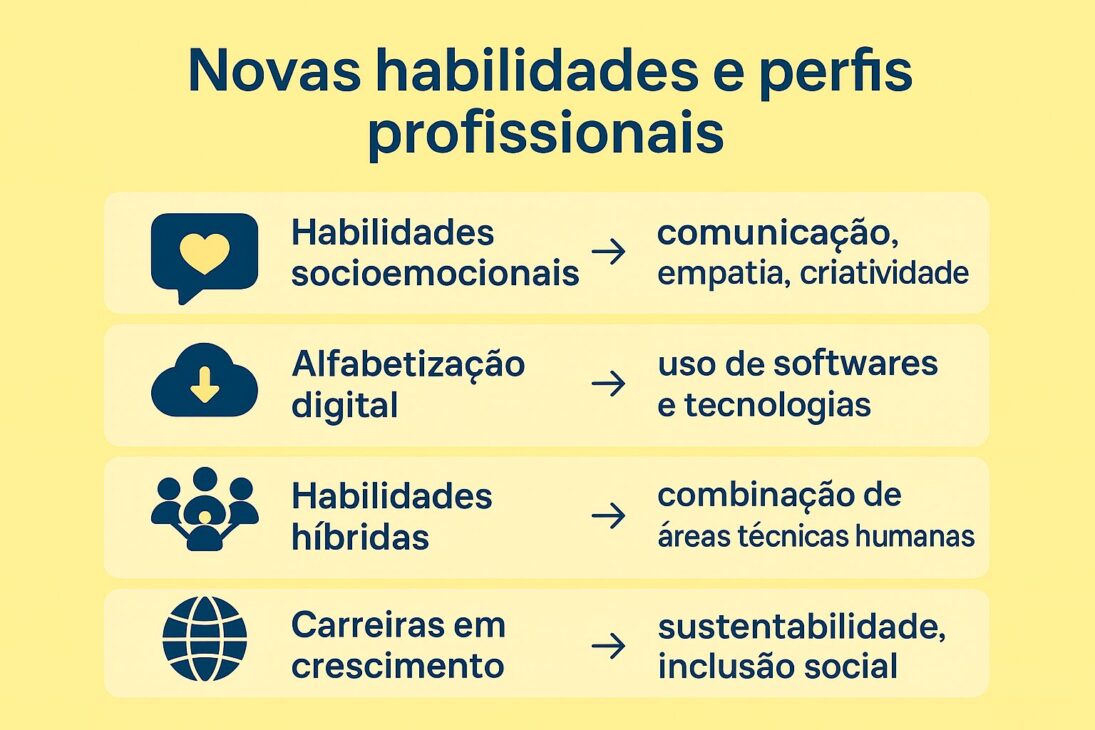
Still, despite all the uncertainties, some trends point to promising paths. The job market perspectives indicate an increasing appreciation for soft skills, such as communication, empathy, creativity, and critical thinking.
This happens because, even with the presence of machines and artificial intelligence, certain human traits are still irreplaceable.
Moreover, digital literacy has become basic. Knowing how to deal with software, digital platforms, data, and information networks is no longer a differential but a necessity. Hybrid professions, which combine technical knowledge with human skills, have gained traction and are expected to grow in the coming years.
Another important point is the growth of careers focused on sustainability, mental health, and social inclusion. Society has been seeking more ethical, responsible, and balanced solutions, and the job market reflects this demand.
Inequalities and Challenges Still Present
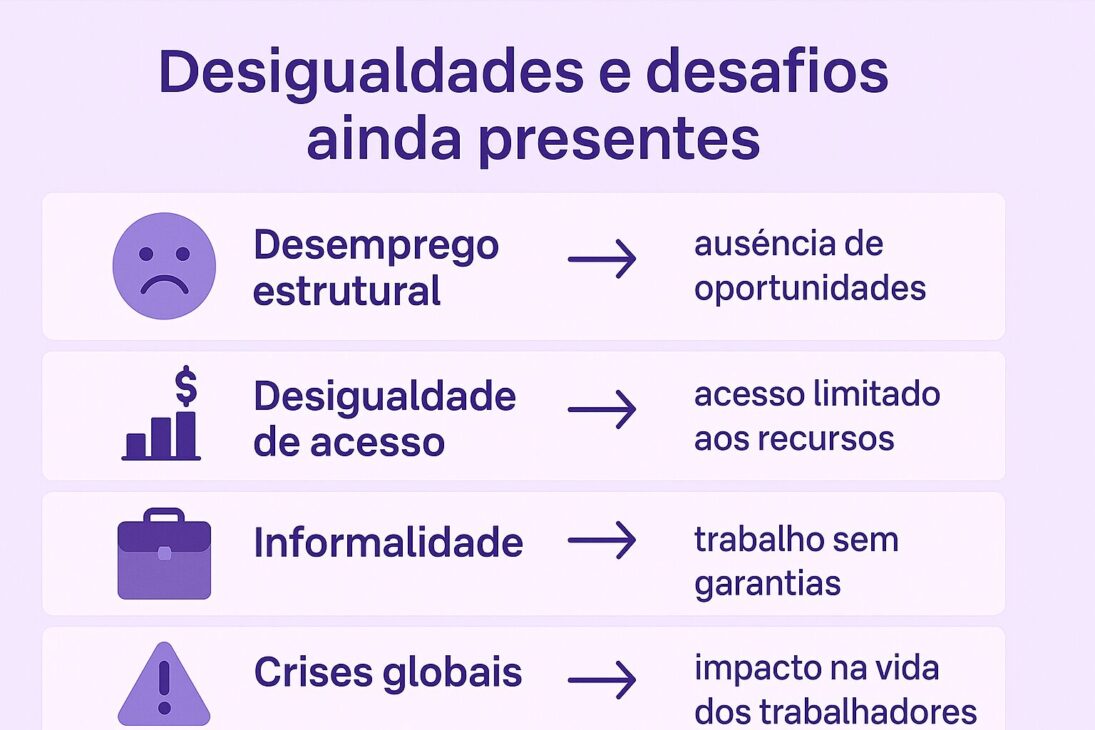
Despite all this progress, the job market still faces significant challenges. Structural unemployment, inequality of access to opportunities, and informality are problems that affect millions of people around the world.
Even with available technologies, not everyone can adapt or access resources to keep up with the demands of the new era.
Furthermore, economic crises and global events, such as the COVID-19 pandemic, show that the market is sensitive to sudden changes.
Therefore, the resilience of workers and companies becomes essential in times of instability, and the ability to reinvent oneself is one of the most sought-after skills. According to the World Economic Forum (2021), structural challenges are most evident in emerging economies, where disparities in opportunities are even broader.
Possible Paths for the Professional Future
In light of all this, how can we think about the job market perspectives moving forward? The answer involves multiple factors. Technology will continue to shape new scenarios.
However, education will need to continuously renew itself to keep up with market demands. Additionally, companies are likely to become more flexible, and professionals will need to take an active role in their own careers.
Thus, the notion of a linear career, with a start, middle, and end within a single organization, is being replaced by diverse trajectories, often involving changes in area, function, and even purpose.
This may seem challenging, but it also offers freedom and new possibilities.
Therefore, understanding the job market perspectives is not about predicting the future with accuracy, but rather staying alert to changes, developing relevant skills, and being willing to learn and adapt.
Undoubtedly, it is this attitude that will ensure not just a job but a significant professional trajectory aligned with a constantly transforming world.
The job market perspectives are the result of a long historical transformation process. From manual labor to digital, from stability to flexibility, everything has evolved — and continues to evolve.
More than trying to fit into a ready-made model, the challenge is to build, based on knowledge, adaptability, and self-awareness, a unique and sustainable path.
Those who understand the market movement, value continuous learning, and develop both human and technical skills have great chances of thriving — no matter what changes the future may bring.










Seja o primeiro a reagir!