





 Portuguese
  English
  Spanish
  6 min of reading
  0 comments


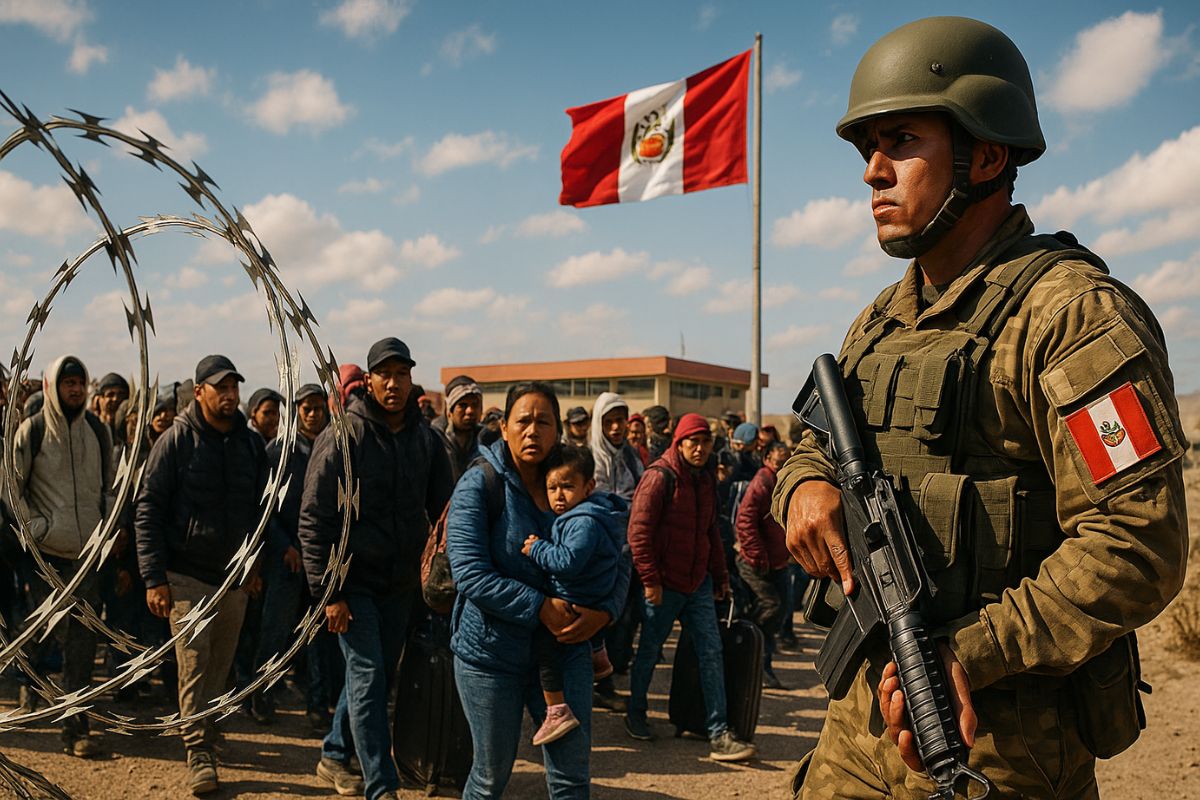
Fearing a Sudden Influx of Migrants Leaving Chile Before a Possible Right Turn, Peru Declares a 60-Day State of Emergency in Tacna, Reinforces the Border with Military Support and Promises Stricter Controls Against Illegal Migrants, While Citing the Combat Against Organized Crime.
Peru has placed its border with Chile under a state of emergency for 60 days in the Tacna region, in the far south of the country, amid fears of an influx of migrants trying to cross into Peruvian territory. The decision, formalized in a decree, authorizes the immediate deployment of the Armed Forces in support of the National Police, focusing on migration control, customs surveillance, and the repression of crimes associated with the irregular flow of people.
At the center of the government’s concern is the possibility of a sudden increase in migrants leaving Chile, motivated by the political environment and promises from far-right candidate José Antonio Kast, the favorite in the polls for the presidential runoff. The assessment in Lima is that a victory for Kast, who advocates for the mass expulsion of illegal migrants, could turn the border into a critical transit corridor for Venezuelans and other groups currently living in Chilean territory.
State of Emergency in Tacna and Border Districts

The state of emergency announced by Peru applies to three border districts in the Tacna region in the south of the country: Palca, Tacna, and La Yarada Los Palos.
-
A new Brazilian shopping center worth R$ 400 million will be built in an area equivalent to more than 4 football fields, featuring 90 stores, 5 cinemas, a supermarket, a college, and parking for 1,700 cars, potentially generating 3,000 jobs.

-
Larger than entire cities in Brazil: BYD is building a 4.6 km² complex in Bahia with a capacity for 600,000 vehicles per year, but the discovery of 163 workers in conditions analogous to slavery has shaken the entire project.

-
With an investment of R$ 612 million, a capacity to process 1.2 million liters of milk per day, Piracanjuba inaugurates a mega cheese factory that increases national production, reduces dependence on imports, and repositions Brazil on the global dairy map.

-
Brazilian city gains industrial hub for 85 companies that is equivalent to 55 football fields.


In these areas, the government has decided to reinforce the military presence at sensitive points along the border, without formally removing the National Police’s responsibility for maintaining internal order.
The decree establishes that the Police remain in charge of security operations but will now have the direct support of the Armed Forces in surveillance, patrolling, and blocking illegal access points.
The declared objective is twofold: to contain the entry of irregular migrants and, at the same time, to confront the advance of organized crime and other forms of violence associated with clandestine routes.
According to the Ministry of the Interior, the state of emergency at the border with Chile will last for 60 days starting from November 29, during which the government aims to calibrate its operational response to the evolving migration flow.
The measure is regarded in Lima as preventive, but with room for escalation if the volume of migrants leaving Chile increases rapidly in the coming weeks.
Army at the Border and Reinforcement of the Santa Rosa Post
The Peruvian Minister of the Interior, Vicente Tiburcio, traveled to Tacna to personally oversee the start of the operation at the border.
He detailed that fifty soldiers from the Army would be immediately deployed to the Santa Rosa border post, the main official crossing point between Peru and Chile in the region.
In the first days of December, another fifty military personnel are expected to join the contingent in Santa Rosa, raising the number of Army personnel specifically designated to reinforce border control to one hundred.
These military personnel will work in close coordination with the National Police in establishing barriers, conducting vehicle inspections, and approaching groups of migrants attempting to cross without fulfilling legal entry requirements.
In addition to the formal post, the operational plan includes surveillance of secondary routes used by coyotes and human trafficking networks.
The deployment of the Army aims to increase Peru’s response capacity in a vast and difficult-to-monitor border area, especially in scenarios of rapid and disorderly migration.
Pressure from Chile and Blocking Migrants at the Border Line
On the Chilean side, the government acknowledged a buildup of migrants in the border region with Peru.
The Chilean Minister of Security, Luis Cordero, stated that there is a concentration of people wanting to leave the country and facing difficulties entering Peruvian territory, although he did not disclose official numbers.
Images aired by local radio Radio Tacna show migrants with children in their arms walking along the highway leading to the border post, illustrating the humanitarian tension in the region.
For Peruvian authorities, the challenge is to balance the tightening of control at the Chilean border with the need to avoid the collapse of local services and situations of extreme vulnerability among migrants stuck at the border line.
The partial militarization of the corridor between Tacna and Chile clearly indicates that Peru is betting on a strategy of containment and filtering, attempting to prevent the route from becoming a free passage point for irregular migrants without documentation or legal means to remain in the country.
Kast, Mass Expulsions, and the Domino Effect on Migrants
In the political calculation underpinning the state of emergency, there is concern over the possibility of victory for ultraconservative José Antonio Kast in the second round of the Chilean elections, scheduled for December 14.
Kast promises to expel about 330,000 illegal immigrants, mostly Venezuelans, whom he blames for the rise in insecurity in Chile.
The reading in Lima is that a movement of this scale, even if gradual, could push some of these migrants northward, reconfiguring the region’s migration map and directly pressuring Peru’s border.
A sudden tightening of rules in Chile is likely to shift pressure to neighboring countries that maintain some degree of permeability or are perceived as transit corridors to other destinations.
In this context, Peru is attempting to preempt a possible wave of migrants who would use Tacna as an exit from Chile and an entry into new routes, whether formal or clandestine, through Peruvian territory.
By declaring a state of emergency at the border, the government seeks to signal that it is not willing to absorb, uncontrolled, a massive flow originating from political decisions made in Santiago.
Crime, Clandestine Routes, and the Limit of State Capacity
Although the immediate trigger for the measure is linked to the movement of migrants crossing the border between Chile and Peru, the decree also mentions combating crime and other acts of violence in the Tacna region.
Routes used by irregular migrants are often exploited by smugglers and human trafficking networks, which increases the risk of crime in border areas with low state presence.
By combining a state of emergency, reinforced borders, and the use of the Army in support of the Police, Peru is attempting to utilize all available instruments to restore control in a sensitive territory that has historically been porous.
For local communities, militarization is expected to bring changes to daily routines, with more barriers, inspections on roads, and a constant military presence.
At the same time, humanitarian organizations and migrant rights advocates are likely to closely monitor developments, attentive to potential abuses and the treatment of families caught between Chile and Peru.
Regional Reconfiguration and Geopolitical Opportunity
Peru’s decision to declare a state of emergency at the border with Chile connects with a broader trend in South America, where migration flows have begun to directly influence internal security policies and electoral debates.
In the case of Peru, the Tacna region serves as a thermometer for a crisis that has been shifting across the continent, following the trajectory of Venezuelans and other groups in search of opportunities or refuge.
In geopolitical terms, how Chile and Peru coordinate or tension their border policies in response to migrant pressure could reshape alliances, public narratives, and even bilateral negotiations over security and human mobility.
For Lima, the southern border has become a real risk management laboratory, where decisions made in Santiago produce direct impacts on the Peruvian state’s response capabilities.
In the short term, the success or failure of the state of emergency in Tacna will be measured by Peru’s ability to prevent the collapse of its border, contain the advance of criminal networks, and at the same time avoid turning migrants into scapegoats for a problem that crosses borders and governments.
In your opinion, should Peru prioritize more security at the border with Chile or humanitarian protection for migrants trapped between the two countries?







-

-

4 pessoas reagiram a isso.