





 Portuguese
  English
  Spanish
  6 min of reading
  0 comments


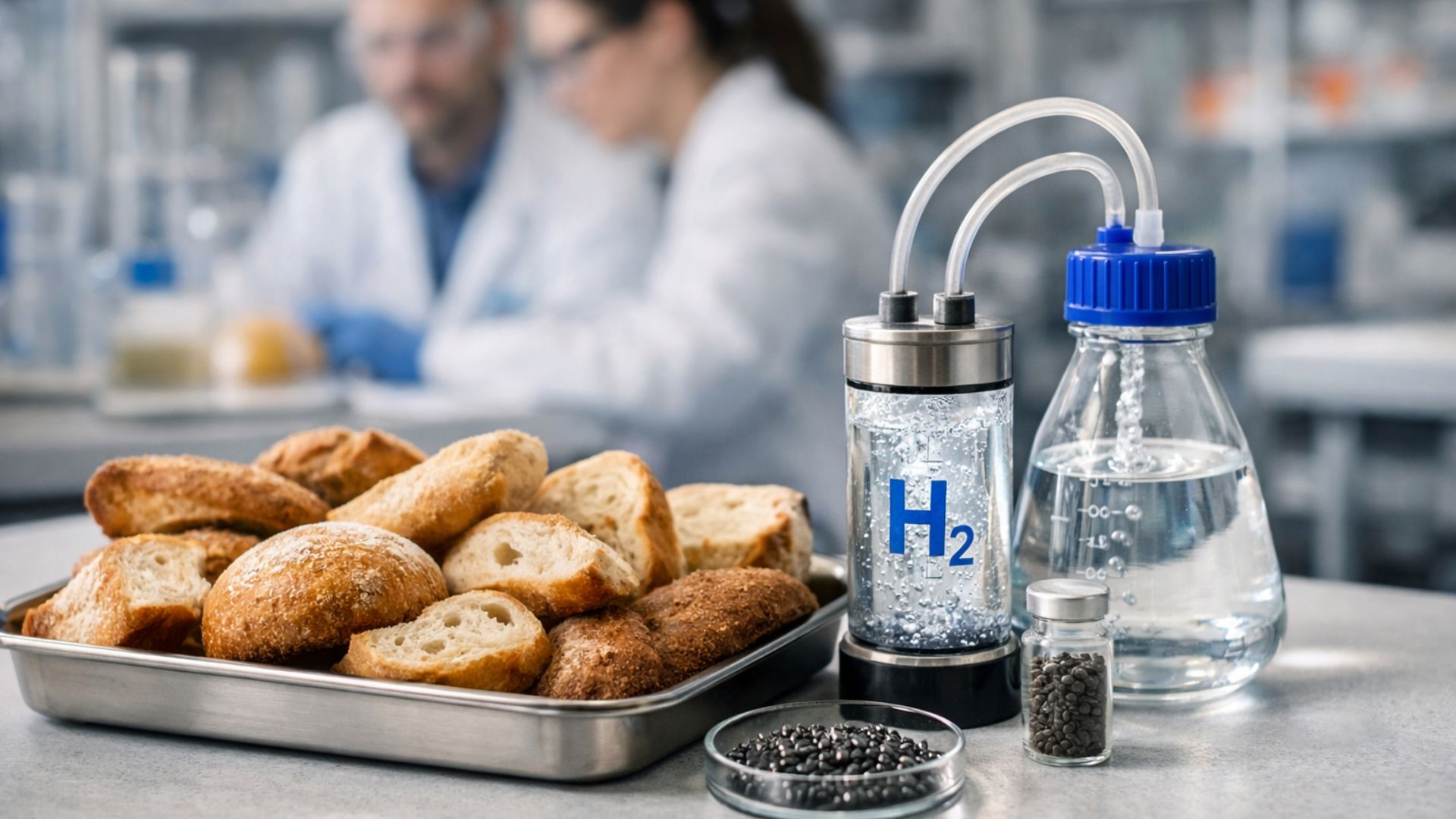
Scientific Study Published in Nature Chemistry Shows How Stale Bread Can Be Reused to Produce Hydrogen Sustainably, Reducing Dependence on Fossil Fuels and Environmental Impact.
A new study conducted by scientists from the University of Edinburgh in Scotland revealed that the use of stale bread can generate microbial hydrogen capable of replacing conventional methods used in industrial hydrogenation. The study was published in the journal Nature Chemistry on Monday (23) and describes a strategy that can reduce dependence on fossil fuels and decrease the environmental impact associated with traditional hydrogen production.
The discovery is relevant because, although hydrogen is not a fossil fuel, its current production requires a large amount of energy and is heavily associated with the use of natural gas. By proposing the reuse of food waste, the research presents an alternative that unites biotechnology, circular economy, and industrial sustainability.
At the core of the study is the possibility of turning waste into energy input, with potential for large-scale application in the chemical, pharmaceutical, and materials industries.
-
A “silent skill” is allowing Brazilians to earn up to R$ 22,000 per month without a degree and become indispensable for companies that rely on millions of data to survive.

-
Researchers at the Toyota Research Institute found that if a human uses robotic arms to flip a pancake 300 times in an afternoon, the robot learns to do it on its own the next morning, and this is currently the most promising method to solve the biggest bottleneck in modern robotics.

-
Goodbye iron: a common item in households is starting to lose space to technology that smooths clothes in minutes without an ironing board and with less energy consumption.

-
Antarctica reveals an unusual clue high in the Hudson Mountains, and what appeared to be just an isolated rock began to expose a secret hidden under the ice for ages.


University of Edinburgh Shows How Stale Bread Can Generate Hydrogen in an Innovative Way
The research revisited the natural fermentation process of stale bread, known for involving symbiotic colonies of lactic acid bacteria, such as Lactobacillus, and wild yeasts. These microorganisms, during fermentation, release gases such as carbon dioxide (CO₂).
In the experiment described in the study, scientists fed a strain of the bacterium Escherichia coli with sugars extracted from discarded bread. The culture was maintained in the absence of oxygen, a condition under which the bacteria naturally produced gaseous hydrogen.
According to Stephen Wallace, a researcher at the University of Edinburgh, living cells can provide this hydrogen directly, using waste as raw material, in a process that can be, in fact, carbon-negative. This occurs because the substrate used is a waste that would otherwise be disposed of in landfills or incinerated.
The process occurs in a single sealed vessel at room temperature. This characteristic significantly reduces the energy demand compared to conventional industrial methods.
How Microbial Hydrogen Can Replace Routes Tied to Fossil Fuels
Hydrogen is widely used in hydrogenation reactions. These reactions are essential in the manufacturing of processed foods, pharmaceuticals, plastics, and various chemical compounds. Traditionally, the gas used in these processes is produced through steam reforming of methane, a technology that directly depends on fossil fuels.
Although hydrogen is not classified as a fossil fuel, both its production and use require high energy. Most global production still relies on natural gas, resulting in significant carbon dioxide emissions.
In the new research, the scientists demonstrated that hydrogen generated by the bacteria can be applied directly in hydrogenation when combined with a small amount of palladium (Pd) catalyst. This metal accelerates chemical reactions and allows microbial hydrogen to replace the conventional source.
The team also assessed the possibility of using other metals, such as nickel (Ni) or platinum (Pt), with the aim of making the process more accessible and economically viable.
Stale Bread, Circular Economy, and Reduction of Industrial Environmental Impact
The use of stale bread as raw material places the technology within the concept of circular economy. By reusing food waste, the method helps to reduce waste and the associated environmental impact from disposal.
When food is sent to landfills, anaerobic decomposition occurs, generating methane. This gas has a high global warming potential. Therefore, using waste as a chemical input prevents indirect emissions.
The team itself highlighted that the process can only be considered “carbon negative” when using stale bread, precisely because it prevents the food from being discarded in systems that enhance the release of greenhouse gases.
This approach broadens possibilities for integrating waste management policies with industrial innovation. In addition to reducing emissions, it creates a new value chain based on materials previously considered waste.

Research Expands Perspectives for Sustainable Fuels and Low-Carbon Hydrogen
While the study focuses on chemical hydrogenation, its implications reach the broader debate on sustainable fuels. Hydrogen is a strategic component in the production of synthetic fuels, such as e-fuels and green ammonia.
By developing alternative production routes, the research contributes to diversifying low-carbon hydrogen sources. Instead of relying exclusively on water electrolysis powered by renewable energy or carbon capture associated with natural gas, a third path based on biotechnology emerges.
This possibility is particularly relevant for industries that use hydrogenation as an intermediate production step. By reducing dependence on fossil fuels in hydrogen supply, the method can lower energy costs and associated emissions. Although the study is at the laboratory stage, it demonstrates technical feasibility under controlled conditions and with low energy consumption.
Technical Details of the Method and Challenges for Large-Scale Application
The experiment showed that, under anaerobic conditions, Escherichia coli fed with sugars from stale bread produces sufficient amounts of hydrogen to drive specific chemical reactions.
The hydrogenation occurs in the same vessel where the gas is generated. This eliminates the need for hydrogen storage and transportation, steps that traditionally require robust infrastructure and high costs.
However, for industrial application, some challenges remain. It is necessary to scale up the process, ensure stability of microbial cultures, and reduce dependence on noble metals like palladium.
The researchers are already investigating different microbial hosts to develop strains capable of dispensing with palladium or substituting it with more abundant metals. This advancement could be decisive in making the technology competitive against conventional methods.

Environmental Impact and Industrial Implications of Research with Stale Bread and Hydrogen
The research highlights that the ability to conduct reactions using microbial hydrogen opens up new possibilities for large-scale sustainable manufacturing. Hydrogenation is used across various sectors, including pharmaceuticals, fine chemicals, and materials.
By integrating waste such as stale bread into the production process, a model is created that reduces the environmental impact both at the stage of hydrogen generation and in urban waste management.
The method also operates under milder conditions, with room temperature and low energy consumption. This characteristic can represent significant savings compared to processes that require high pressure and elevated temperatures.
If adapted for industrial scale in the future, the system could complement energy transition strategies and reduce structural dependence on fossil fuels in certain production chains.
A New Frontier Between Biotechnology, Waste, and Low-Impact Fuels
The discovery presented by the University of Edinburgh demonstrates that innovative solutions can arise from the combination of basic science and waste reuse.
Transforming stale bread into a source of hydrogen is not just a scientific curiosity. It represents an advancement that connects waste management, reduction of carbon-intensive fuels, and decrease of environmental impact in industry.
The research published in Nature Chemistry indicates that living cells can replace complex energy-intensive steps with controlled biological processes. Although technical challenges need to be overcome, the potential for application is broad.
By proposing a system that uses waste as input and operates under gentle conditions, the scientists reinforce the importance of sustainable innovation. The study shows that the energy transition does not depend solely on large infrastructures but also on smart solutions capable of turning environmental problems into industrial opportunities.






-

-

-

-

4 pessoas reagiram a isso.