





 Portuguese
  English
  Spanish
  4 min of reading
  0 comments



A New Scientific Study Indicates That Global Warming Is Affecting The Earth’s Rotation. The Accelerated Melting Of The Polar Ice Caps Redistributes Mass Across The Oceans, Slightly Slowing The Planet And Making Days A Little Longer At The Fastest Pace Observed In At Least 3.6 Million Years.
The global warming is causing a silent transformation in the physical functioning of the planet. Scientists are now warning that the increase in global temperatures is not only melting ice and raising sea levels but is also slightly altering the Earth’s rotation.
According to a recent study published in the scientific journal Journal of Geophysical Research: Solid Earth, days are getting longer due to global warming, at a pace that has not been observed for at least 3.6 million years. Although the change is extremely small when measured in milliseconds, it reveals the profound impact that climate transformations are already having on the planet.
How Ice Melting Affects The Earth’s Rotation
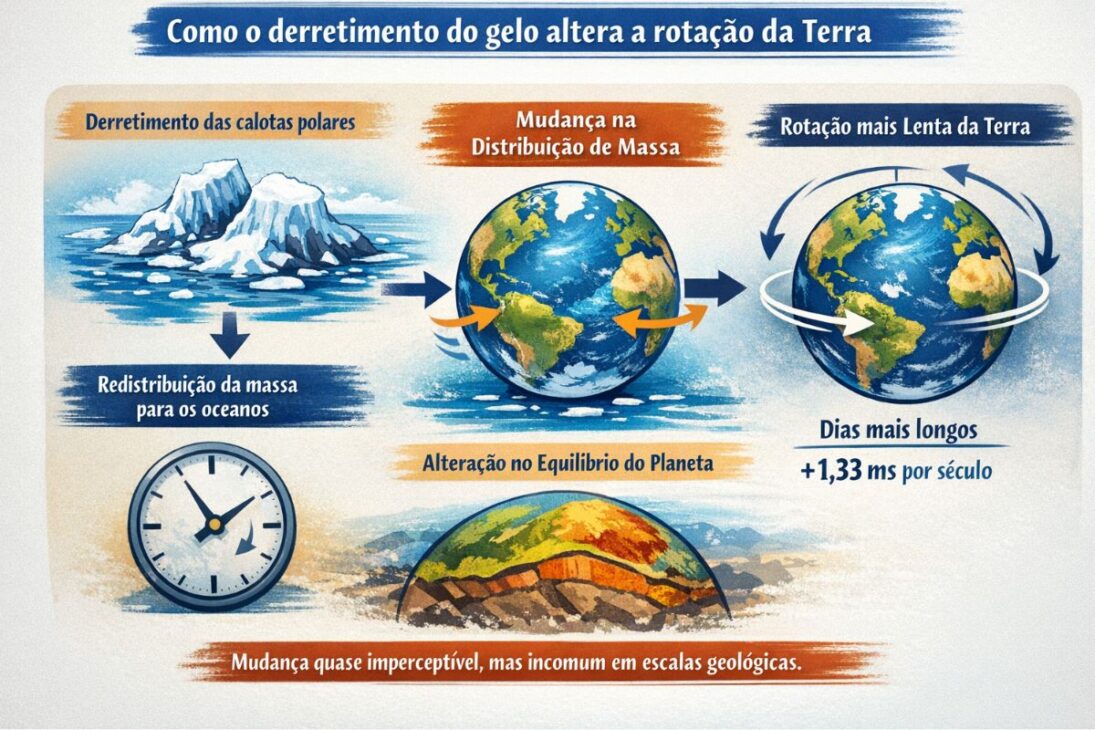
The mechanism behind this change involves a basic principle of physics: mass distribution influences the rotation of a body.
-
A “silent skill” is allowing Brazilians to earn up to R$ 22,000 per month without a degree and become indispensable for companies that rely on millions of data to survive.

-
Researchers at the Toyota Research Institute found that if a human uses robotic arms to flip a pancake 300 times in an afternoon, the robot learns to do it on its own the next morning, and this is currently the most promising method to solve the biggest bottleneck in modern robotics.

-
Goodbye iron: a common item in households is starting to lose space to technology that smooths clothes in minutes without an ironing board and with less energy consumption.

-
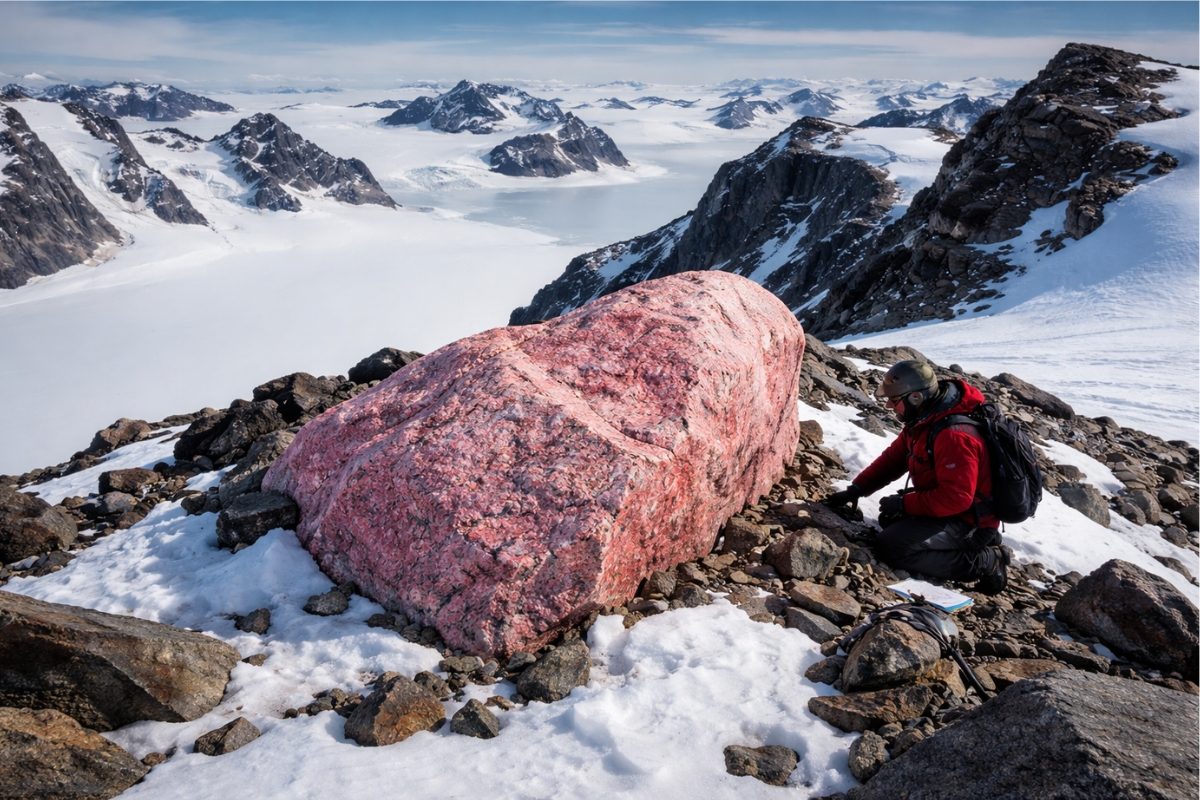
Antarctica reveals an unusual clue high in the Hudson Mountains, and what appeared to be just an isolated rock began to expose a secret hidden under the ice for ages.

As global warming speeds up the melting of polar ice caps and large glaciers, huge volumes of water that were previously concentrated in polar regions begin to spread across the oceans. This redistribution of mass slightly alters the planet’s balance.
This displacement of water causes the Earth to rotate a little more slowly, almost imperceptibly increasing the length of each day. Currently, researchers estimate that days are becoming about 1.33 milliseconds longer per century.
It may seem insignificant, but on geological scales, this rate of change is considered unusual.
Evidence From Microscopic Fossils
To understand how the current global warming compares to natural changes of the past, scientists have turned to a surprising source of information: fossils of microscopic marine organisms called benthic foraminifera.
These organisms leave chemical records in their shells that allow researchers to reconstruct ancient sea level variations. From this information, researchers have been able to estimate how the Earth’s rotation has changed over millions of years.
The analyzed data shows that over the last 2.6 million years, periods of growth and melting of large ice sheets have already altered the length of the day at different times.
However, the current rate of change associated with global warming is exceptional. According to scientists, there has only been a rate close to what is observed today about 2 million years ago—and even then it did not exceed it.
Climate Models And Reconstructions Of The Past
To make estimates more reliable, researchers combined fossil data with computational models capable of reconstructing sea level evolution over time.
These models can analyze large volumes of climatic information and handle the natural uncertainties present in ancient geological records. With this, scientists were able to calculate how changes in water volume and distribution affected the Earth’s rotation.
The results indicate that current global warming is producing a change in the planet’s rhythm at a rate rarely observed in Earth’s recent history.
The Role Of Human Activities In The Changes
Researchers state that the phenomenon observed today is strongly associated with human activities that drive global warming.
The emission of greenhouse gases intensifies the rise in global temperatures, accelerating the melting of glaciers and polar ice sheets. This process not only raises sea levels but also redistributes huge amounts of liquid mass across the planet.
According to projections presented by scientists, by the end of the century, the impact of climate change on the Earth’s rotation could even surpass the gravitational effect of the Moon, which is normally the primary natural factor responsible for gradually slowing the planet’s spin.
Small Changes With Important Impacts
Although the change in the duration of days is minimal when measured in fractions of milliseconds, these variations can have relevant implications for modern technologies.
Systems relying on extremely precise measurements of time and the Earth’s position may be affected. Among them are satellites, space navigation systems, high-precision geolocation technologies, and global communication networks.
The more a system depends on absolute time precision, the greater the impact these small changes in the Earth’s rotation may have.
A Sign Of The Accelerated Pace Of Climate Changes
For scientists, the discovery reinforces an important message: global warming is already influencing fundamental processes on the planet.
The change in the length of days may seem small in human terms, but it represents a clear indicator that the Earth’s climate system is changing at an unusual speed on a geological scale.
This type of evidence helps researchers better understand the scale of current climate transformations and assess how they may affect different natural and technological systems in the future.
Changes of milliseconds may seem imperceptible, but reveal how global warming is affecting deep processes of the planet.
In your opinion, do discoveries like this help broaden the perception of the impact of climate change, or do they still seem distant from daily reality?
Share your thoughts in the comments and join the conversation.







-

Uma pessoa reagiu a isso.