





 English
  Francês
  Alemão
  Italiano
  Japonês
  Norueguês
  Portuguese
  Spanish
  3 min of reading
  1 comment


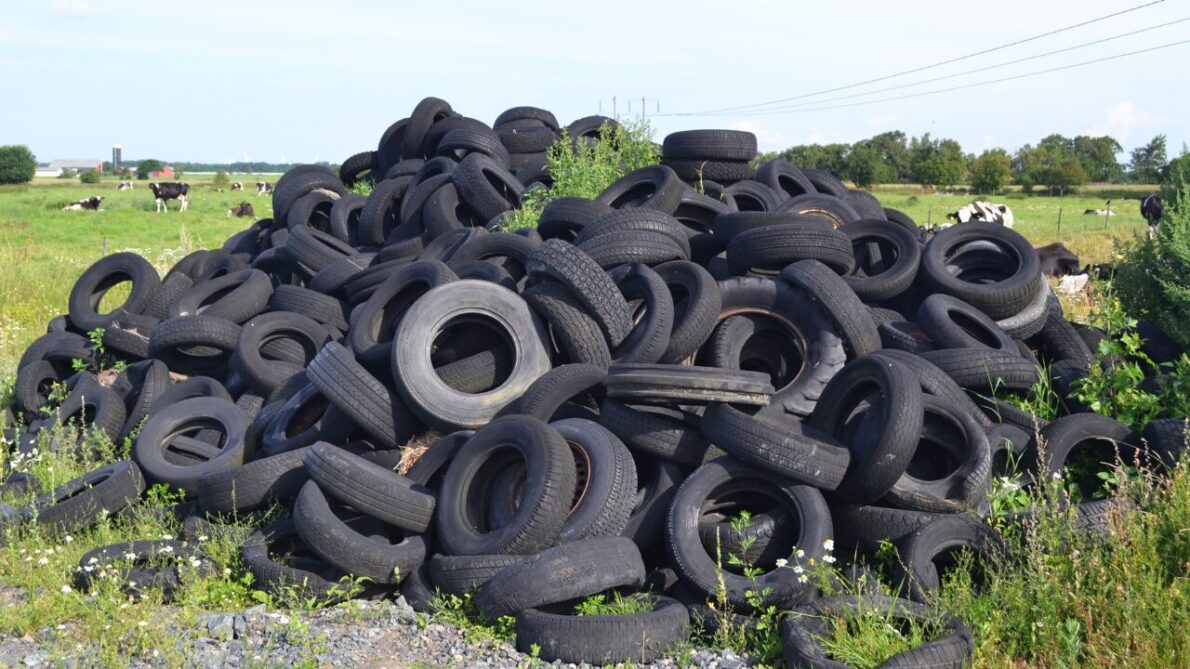


Sustainable Concrete: Researchers Discover Revolutionary Use for Discarded Tire Rubber.
A recent discovery made by engineers at RMIT University in Melbourne, Australia, could forever change the way concrete is produced. The researchers developed an innovative method that allows for 100% of the conventional aggregates used in concrete manufacturing to be replaced with discarded tire rubber. This discovery not only offers a sustainable solution for tire recycling but also promises to significantly boost the circular economy.
A New Era for Concrete: Greener and More Sustainable
The concrete developed by the team at RMIT University, dubbed “greener concrete,” utilizes discarded tire rubber as a substitute for gravel and crushed stone, materials traditionally used as aggregates in construction.
In addition to meeting rigorous building codes, the new concrete is lighter, which could considerably reduce manufacturing and transportation costs.
-
A “silent skill” is allowing Brazilians to earn up to R$ 22,000 per month without a degree and become indispensable for companies that rely on millions of data to survive.

-
Researchers at the Toyota Research Institute found that if a human uses robotic arms to flip a pancake 300 times in an afternoon, the robot learns to do it on its own the next morning, and this is currently the most promising method to solve the biggest bottleneck in modern robotics.

-
Goodbye iron: a common item in households is starting to lose space to technology that smooths clothes in minutes without an ironing board and with less energy consumption.

-
Antarctica reveals an unusual clue high in the Hudson Mountains, and what appeared to be just an isolated rock began to expose a secret hidden under the ice for ages.


Although small amounts of tire rubber have already been used as a partial substitute for aggregates in concrete, this is the first time researchers have managed to replace all aggregates with rubber without compromising the quality of the material.
The study, published in the prestigious journal Resources, Conservation and Recycling, brings new perspectives to the construction industry.
Overcoming Limitations
Ph.D. Mohammad Momeen Ul Islam, the lead author of the study and a researcher at RMIT’s School of Engineering, commented that the findings contradicted a long-standing popular theory about the use of large quantities of recycled rubber in concrete.
“We demonstrated with our precise molding method that this perceived limitation over decades can now be overcome,” Islam stated.
The technique developed by the team involves the use of newly designed casting molds that compress the coarse rubber aggregate into fresh concrete, improving the material’s performance.
This advancement not only opens new possibilities for the use of tire rubber in concrete but also represents an important step toward more sustainable construction practices.
Environmental and Economic Benefits of Concrete with Tire Rubber
Professor Jie Li, co-author of the study and team leader, emphasized that the developed manufacturing process is beneficial both environmentally and economically.
“Since most typical concrete is made up of coarse aggregate, replacing all of that with used tire rubber can significantly reduce the consumption of natural resources and also address the major environmental challenge of what to do with used tires,” Li explained.
In addition to contributing to the conservation of natural resources, the new concrete could lower construction costs, especially in low-cost housing projects in rural and remote areas, not only in Australia but also in other countries around the world.
Expansion and Next Steps
According to Islam, the team’s manufacturing process can be economically scaled in a precast concrete industrial setting, both in Australia and abroad.
Following successful tests in the workshop, the team is now focused on analyzing how the reinforced concrete can perform in structural elements, with the goal of validating and further expanding the applicability of this revolutionary innovation.







Tenho interesse