





 Portuguese
  English
  Spanish
  4 min of reading
  0 comments


Technology Aims to Reduce Pollution and Noise in Small and Medium-Sized Vessels, Focusing on Sustainability and Efficiency
Scientists claim to have created a system capable of replacing traditional diesel engines in ferries with pneumatic propellers, promising energy efficiency and a lower environmental impact.
The new model, according to the study’s authors, has generated enough power to operate a vessel on a round trip within Finland’s maritime transport system.
Replacement of Conventional Diesel Engines
The experiment involved replacing two diesel engines with two air engines, each with a capacity of 250 kW.
-
China accelerates global science and may surpass the United States in 2 years with increased public investment, continuous growth, and direct impact on the global technological competition.

-
Scientific studies indicate that drought may be strengthening a much greater silent threat: more resistant superbugs.

-
Man builds functional 5-meter submarine in his garage using gas cylinders, PVC pipes, and a refrigerator motor, and navigates with the vessel on a lake in Colombia.
-
Millions of people have been eating yam for centuries without knowing that this humble tuber contains a compound called diosgenin, which scientists have now discovered can improve memory and help control blood sugar levels.


This power was sufficient to complete the route defined by the researchers. The study was published in the journal Energy Conversion and Management and focused on assessing the technical and economic feasibility of replacing the current propulsion system of ferries.
According to the authors, “pneumatic propulsion, although unconventional, is promising as a sustainable and energy-efficient alternative to conventional marine engines, especially for short-distance ferry operations.”
Currently, diesel engines are widely used due to their reliability and robustness. However, besides requiring large volumes of fuel, they are noisy and responsible for significant pollutant emissions.
The researchers argue that pneumatic engines offer a cleaner and quieter solution.
Operation of the Pneumatic System
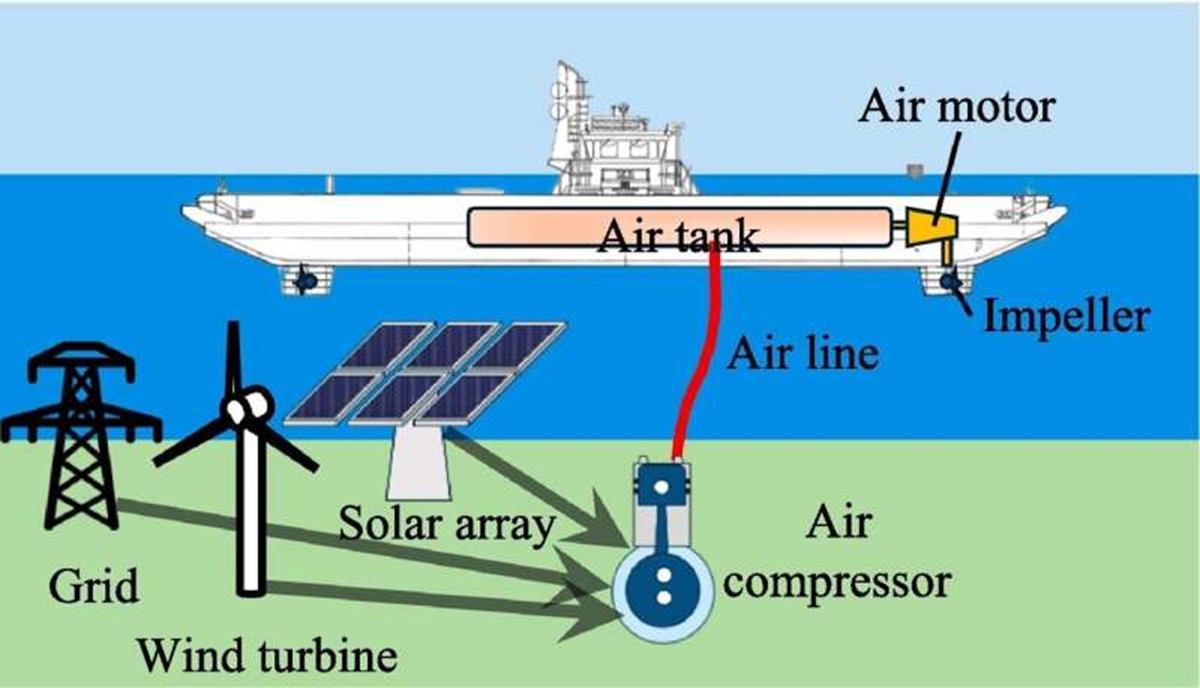
The pneumatic propellers operate by using compressed air stored in high-pressure tanks.
This air is then released in blade engines, which drive the marine propellers. The idea is to replace the use of fossil fuels with compressed air as a source of mechanical energy.
Professor Abdul Hai Alami, the lead author of the study and a lecturer at the University of Sharjah, explains that air engines can be integrated into the structure of the ferry itself, using the hull to store air or adapting auxiliary tanks. “This also increases the vessel’s buoyancy,” he noted.
The team’s methodology was based on experimental results and calculations based on polytropic relations, which describe the behavior of air from compression to its use in generating movement.

Energy Conversion and Management (2025). DOI: https://doi.org/10.1016/j.enconman.2025.119613
Application in Real Ferry and Practical Results
The study did not remain solely theoretical. The researchers applied the technology to a ferry built in 1985 that was still operating with diesel engines.
The vessel was modernized with the new pneumatic engines, and the proposed route was successfully completed.
Kaj Jansson, co-author of the study and a ferry manufacturer at K. J Marineconsulting Ab, oversaw the entire replacement and testing process of the new system. “Pneumatic propulsion is the future of navigation on fixed routes,” he stated.
Jansson emphasizes that ferries operate with predictable loads, destinations, and rhythms, making it easier to adopt alternative systems like air engines.
He believes that, besides being cleaner and quieter, these systems are less susceptible to fluctuations in oil prices, which brings economic advantages.

Technical Performance and Environmental Impact
According to the study, the pneumatic engines demonstrated performance equivalent to diesel engines, meeting the operational requirements of the vessel.
Additionally, the modular design allows the system to be adapted for different operational needs, addressing the demand for more flexible and eco-friendly transport.
From an environmental perspective, the replacement brings significant gains. The impact generated by the ferry’s operation dropped significantly, and operational costs also showed reduction.
The authors also conducted a life cycle analysis of the modernized vessel. The conclusion was that the pneumatic system is more economically advantageous, especially considering savings on fuel and reduced maintenance needs, thanks to the simpler structure of the engines.
Economics and Financial Return
The research indicates an estimated savings of US$ 73,000 with the engine replacement, considering the complete life cycle of the vessel. The required investment is expected to have a return in approximately eight years.
Professor Alami considers this estimate conservative, as the most optimistic scenarios were not applied in the simulations. He is confident that the maritime industry will pay attention to the new system.
“We believe that the development of pneumatic blade engines will allow the use of even more advanced materials, resulting in more powerful and efficient engines,” he stated.
In addition to being more sustainable, the system can easily adapt to ferries already in operation, thereby broadening its reach and reducing barriers to implementation.
If the results are replicated on a large scale, maritime navigation could undergo a significant transformation, aligning with stricter environmental and economic goals.
This advancement opens up space for new technical solutions that prioritize energy efficiency and commitment to the environment.








Seja o primeiro a reagir!