





 Portuguese
  English
  Spanish
  3 min of reading
  0 comments


The Volcano That Cooled The Planet In 1831 Has Been Discovered! One Of The Greatest Climate Issues In History Finally Has An Answer
In 1831, a catastrophic event altered the global climate. An unknown volcano erupted, spewing ash that darkened the sky and lowered the temperature in the Northern Hemisphere. Crops failed, famine spread, and the location of the volcano remained a mystery for nearly two centuries.
Now, scientists led by volcanologist William Hutchison from the University of St. Andrews in the UK have confirmed that the culprit was the Zavaritskii volcano, located in Simushir in the remote Kuril Islands between Russia and Japan.
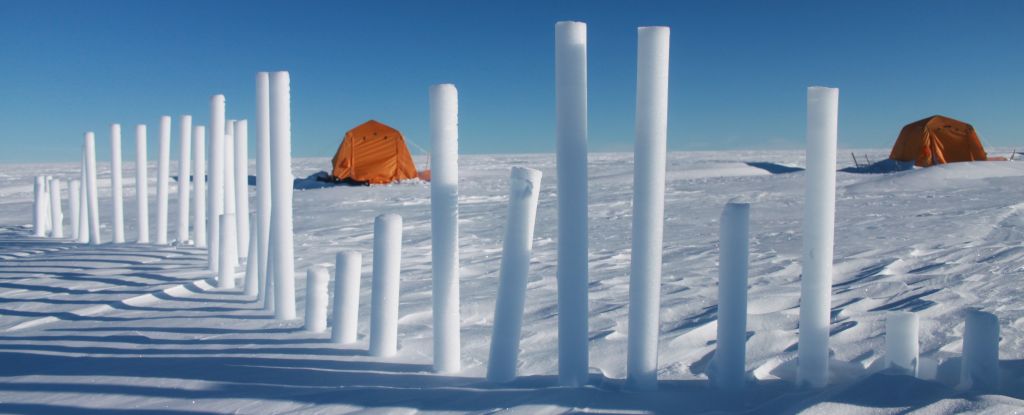
The discovery was made possible through the analysis of ash preserved in ice cores from Greenland, which perfectly matched samples from the Zavaritskii caldera.
-
Motorola launched the Signature with a gold seal from DxOMark, tying with the iPhone 17 Pro in camera performance, Snapdragon 8 Gen 5 that surpassed 3 million in benchmarks, and a zoom that impresses even at night.

-
Satellites reveal beneath the Sahara a giant river buried for thousands of kilometers: study shows that the largest hot desert on the planet was once traversed by a river system comparable to the largest on Earth.

-
Scientists have captured something never seen in space: newly born stars are creating gigantic rings of light a thousand times larger than the distance between the Earth and the Sun, and this changes everything we knew about stellar birth.

-
Geologists find traces of a continent that disappeared 155 million years ago after separating from Australia and reveal that it did not sink, but broke into fragments scattered across Southeast Asia.


Oleg Dirksen
)
The Discovery Of The Volcano
According to Hutchison, identifying the volcano was a landmark moment. “It took years of collaboration with colleagues from Japan and Russia, who sent samples collected decades ago from these remote volcanoes,” he reported.
The analysis revealed that the ash from the ice cores was identical to that from Zavaritskii, solving the historical puzzle.
The highly explosive eruption left a massive volcanic caldera – the remnant of its destructive force. It is estimated that the event released enough material to cool the global climate by up to 1 °C, an impact comparable to the eruption of Mount Pinatubo in the Philippines in 1991.
Debunked Theories And New Advances
Before the discovery, other hypotheses attempted to explain the 1831 phenomenon. The first suggested the Babuyan Claro volcano in the Philippines, but recent analyses disproved this idea. Another possibility was Graham Island in the Strait of Sicily, but the chemical composition of the ash also did not match the ice samples.
Based on the sulfur characteristics and the chemistry of the ash, Hutchison’s team concluded that the 1831 eruption occurred in the Northern Hemisphere and exhibited characteristics of a Plinian eruption, similar to that of Vesuvius in AD 79.
Microscopic fragments of volcanic glass preserved in the ice confirmed the match with Zavaritskii.

NASA )
Impacts And The Alert For The Future
Events like this highlight the ongoing risk posed by remote and under-studied volcanoes. Hutchison warns that these volcanoes could erupt again, causing global impacts. “We need to monitor isolated volcanoes more closely,” he emphasized.
He also highlighted the need for internationally coordinated responses to mitigate the damage from future catastrophic eruptions.
Additionally, the research underscores the importance of investigating lesser-known volcanoes. Although the impact of the 1831 eruption was devastating, much can still be learned about these events to aid in preparedness for future natural disasters.
The Importance Of Modern Science
In 1831, humanity lacked sophisticated tools to monitor volcanic activity, such as global seismic sensors or satellites. This explains why such a large-scale event went unnoticed for so long.
Today, technological advances make it possible to identify even the most remote volcanoes, but much still remains to be done.
The complete research was published in the journal Proceedings Of The National Academy Of Sciences, marking a significant advance in the study of historical volcanic events.








-

Uma pessoa reagiu a isso.