





 Portuguese
  English
  Spanish
  3 min of reading
  0 comments


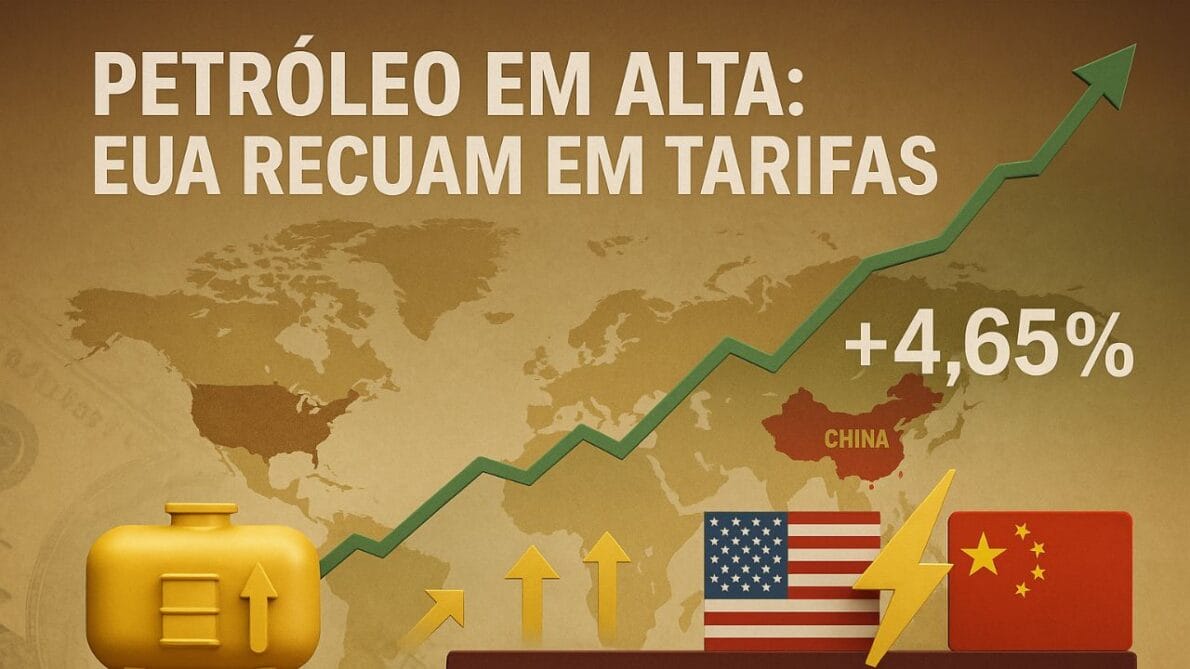
U.S. Decision to Suspend Tariffs for 90 Days Injects Optimism in Markets, But Trade War Continues Pressuring Commodities
The oil market reacted strongly on Wednesday (04/09) after the U.S. government’s announcement regarding the temporary suspension of import tariffs for most countries. According to information from Eixos, only China still faces high rates, keeping the market on alert. Brent closed up 4.23%, priced at US$ 65.48 a barrel, while WTI rose 4.65%, to US$ 62.35.
U.S. Temporary Measure Eases Pressure on Commodities
According to an analysis published by Valor Econômico, Washington’s decision to temporarily reduce tariffs to 10% provided immediate relief to the oil market. The measure, which is valid for 90 days, was taken after pressure from over 75 countries that maintain trade relations with the United States.
As highlighted by Reuters, this relaxation interrupted a five-week streak of declining oil prices. However, experts consulted by CNN Brasil warn that the scenario remains fragile since tariffs against China remain at 125%, keeping the risk of an escalation in the trade conflict alive.
-
Offshore industrial demand in Macaé skyrockets with the recovery of oil and gas and could grow by up to 396% by 2026 in the Campos Basin.
-
Offshore industrial demand in Macaé surges with the recovery of oil and gas and could grow by up to 396% by 2026 in the Campos Basin.
-
Brazilian giant expands borders in the Southeast: Petrobras confirms new oil discovery in ultra-deep waters in the pre-salt of the Campos Basin.
-
Alert in the global energy market: Severe tropical cyclone hits the coast and disrupts gas production at major plants in Australia, threatening global supply.

China as a Determinant Factor for Global Oil Demand
Data from the latest OPEC report, cited by Eixos, shows that China accounts for about 14% of global oil consumption. This dependence means that any sign of a slowdown in the Chinese economy has a direct impact on international commodity prices.
A recent study by the World Bank, reproduced by Valor Econômico, projects that the continuation of the trade war could reduce global growth by up to 0.5% in 2025. This outlook has led investors to shift part of their resources to assets considered safer, such as gold and government bonds, as pointed out by Reuters analysts.
Reactions in the Energy Sector: Brazil Maintains Projects, U.S. Revises Production
In an official statement released on Tuesday (04/08), Petrobras stated that it is maintaining all its oil exploration projects, including those in the pre-salt layer. As reported by Valor Econômico, the state-owned company is working with a minimum price of US$ 28 a barrel in its viability calculations, which would keep it competitive even in adverse scenarios.
On the other hand, Bloomberg highlighted in its latest analysis that American shale producers are already beginning to revise their plans. With an average production cost of around US$ 62 a barrel, many companies may be forced to cut back on activities if prices fall below this level again.
Outlook for the Coming Months: Between Hope and Caution in the Oil Market
Goldman Sachs experts, in a report cited by CNN Brasil, project that Brent could reach US$ 70 by the end of the year if advances are made in trade negotiations. However, they emphasize that this scenario is directly dependent on a possible agreement between the U.S. and China.
JP Morgan analysts, in material published by Eixos, maintain a more cautious outlook. They argue that even with the temporary suspension of tariffs, political and trade uncertainty is likely to keep prices fluctuating between US$ 60 and US$ 68 at least until the third quarter.









Seja o primeiro a reagir!