





 Portuguese
  English
  Spanish
  5 min of reading
  0 comments


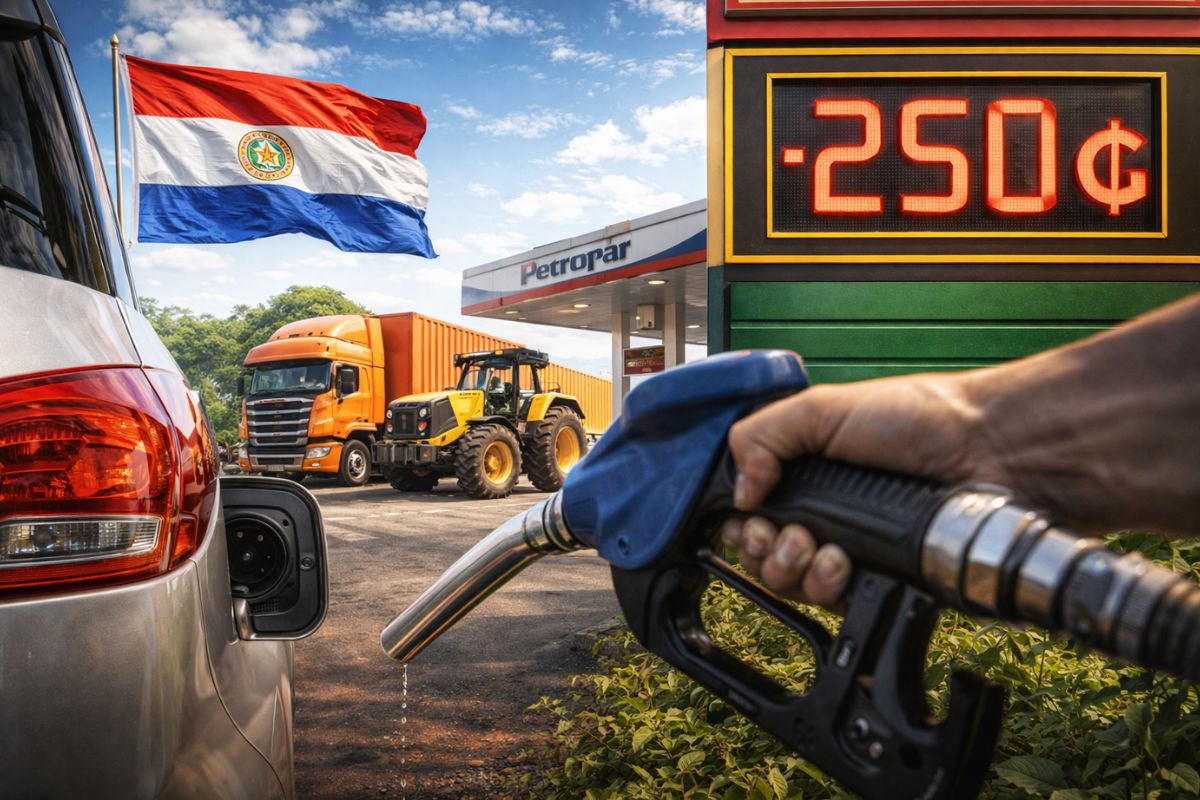
Petropar’s Reduction in Gasoline and Diesel Is the Third Cut Since 2023 Under Peña’s Government, Easing Costs for Families and the Productive Sector and Reinforcing the Response Strategy to Drops in International Oil Prices
The state company Petróleos del Paraguay (Petropar) announced a new price reduction in gasoline and diesel, cutting 250 guaranis per liter across all types of fuels sold at its service stations. The measure has been in effect since this Wednesday and represents another relief movement in a scenario where fuel prices heavily impact the cost of living and economic activity. This is the third cut applied since Santiago Peña took office in 2023 and is part of an adopted strategy to intervene when international oil prices fall.
In practice, the decision does not completely eliminate the pressure of fuel prices on the budgets of families and companies, but it provides concrete relief for those who rely on gasoline and diesel in their daily lives. Private drivers, workers who use vehicles for work, transportation companies, commerce, logistics, industry, and the agricultural sector directly feel the impact. At the same time, Petropar’s recent strong financial performance, with operational surplus and stricter cost management, gives the company the breathing room to maintain the new prices at least until March 2026, when a new evaluation is scheduled.
How Much the Price Drops at the Pump and How Long Will the Reduction Last

Petropar implemented a 250 guaranis per liter cut in all gasoline and diesel sold at its service stations.
-
Brazilian city bets on the business environment to generate jobs and attract investments in the energy sector — secretary reveals strategy at Macaé Energy 2026.

-
50 viaducts, 4 tunnels, 28 bridges, and 40 kilometers of bike paths: BR-262 in Espírito Santo will receive 8.6 billion reais for the largest engineering project in the state’s history, inspired by the Immigrant Highway in São Paulo.

-
Brazil produces too much clean energy and doesn’t know what to do with it: over 20% of solar and wind capacity was wasted in 2025 while investors flee and 509 renewable generation projects were abandoned in the last year.

-
Piauí will produce a new fuel that replaces diesel without needing to change anything in the truck’s engine and reduces pollutant gas emissions by half: truck drivers from all over the Northeast are already celebrating the news that will arrive later this decade.


The decision was made in light of the recent decline in international oil prices, which opened up the possibility to pass part of this movement onto the Paraguayan consumer.
According to the state’s chief of staff, Adalberto Acuña, the new gasoline and diesel price table should remain in effect at least until March 2026, when the company will conduct a general review of the scenario.
Until then, Petropar intends to monitor three central variables: the behavior of the oil barrel in the international market, internal costs of purchase, logistics, and distribution, and the company’s financial health, which needs to remain solid to support any pricing policy.
Direct Relief for Families’ Budgets and Productive Sector Costs
Even though the 250 guaranis per liter cut in gasoline and diesel is not a revolution, it comes at a sensitive point in the budget.
Families that depend on their cars to work, take children to school, or travel in cities with limited public transportation immediately feel the difference at the pump.
For those who refuel frequently, small successive cuts end up adding up to a significant impact by the end of the month.
In public and freight transportation, the effect is amplified. Bus companies, truck drivers, fleet operators, logistics providers, small merchants, industries, and rural producers deal with fuel as a basic input.
Any reduction in gasoline and diesel helps contain rising costs and decreases the pressure for price passing on to the final consumer, whether in freight, food, industrial products, or daily services.
In a country heavily reliant on the agricultural sector and road transportation, this connection between fuel prices and the real economy is direct.
Third Cut Since 2023: The Strategy of Peña’s Government


The current reduction is not an isolated movement. This is the third cut made by Petropar since Santiago Peña took office in 2023, which shows a clear line of action: respond to international fluctuations with internal adjustments whenever there is room.
This policy has two main objectives. First, to partially protect citizens’ purchasing power by returning part of the benefit to the consumer when oil prices drop.
Second, to provide minimal predictability to the productive sector, which depends on gasoline and diesel to plan freight, harvests, inventories, and investments.
Instead of holding onto all the gains to strengthen cash reserves, the state company uses part of the leeway to intervene in the market and mitigate the exposure of the Paraguayan economy to external fluctuations.
Petropar’s Financial Performance Allows More Intervention
A key point in understanding why the company can reduce the price of gasoline and diesel is the recent strong financial performance of Petropar.
The state company registered operational surplus, resulting from a combination of better management, stricter cost control, and strategic planning.
This more efficient management has strengthened the company’s ability to act as a buffer in the market, opening up space for cuts without compromising its sustainability.
When a state fuel company is in the red, any price reduction directly impacts public accounts; when it is in the black, there is room for more flexible pricing policies, as is the case now.
The goal is to balance fiscal responsibility, competitiveness, and consumer protection in a context of strong sensitivity to fuel prices.
Sufficient Relief or Timid Measure? The Debate Remains Open
With the new gasoline and diesel prices already displayed at the pumps, the public debate revolves around the same question: is this reduction of 250 guaranis per liter sufficient to actually relieve the cost of living and the operation of the productive sector, or is it still insufficient given the weight of fuel in the economy?
For many families, any cut makes a difference, especially when combined with other measures in the same direction. For business owners and producers, the reduction is welcome but may be seen as a starting point, still far from an ideal scenario.
At the same time, some argue for caution, pointing out that more aggressive reductions in gasoline and diesel without a solid basis could compromise the health of the state company and create opportunities for future instability.
What do you think? Is this reduction in gasoline and diesel by Petropar sufficient to ease the burden on Paraguayans and the costs for the productive sector, or is it still far from what is needed?







-

Uma pessoa reagiu a isso.