





 Portuguese
  English
  Spanish
  4 min of reading
  0 comments


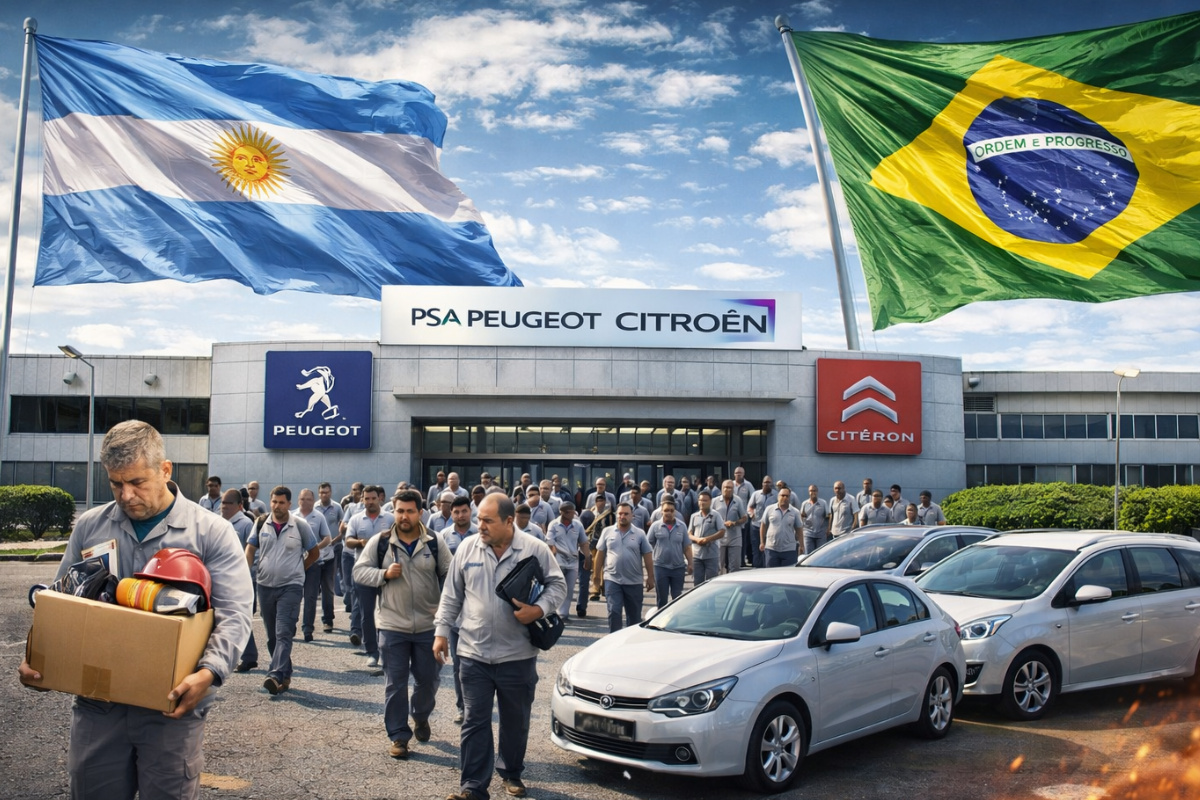
Stellantis confirmed that the El Palomar unit in Buenos Aires will operate with only one shift starting in May. Voluntary layoffs will be offered to the staff amid a sharp decline in exports to the Brazilian market.
The multinational Stellantis announced a package of measures that includes voluntary layoffs and drastic production cuts at its factory located in El Palomar, in the province of Buenos Aires. The decision directly affects the assembly line of Peugeot and Citroën vehicles produced in Argentina and is set against the backdrop of declining sales to Brazil, the largest trading partner of the automotive industry in the neighboring country.
The plant currently employs more than 2,000 workers, and the voluntary layoff program is expected to be formalized in April, with execution scheduled for May. The company has not yet disclosed how many employees will be able to join the plan, but the reduction of an entire shift indicates a significant shrinkage of the workforce and the production capacity of the unit.
What changes at the El Palomar factory
The main measure announced by Stellantis is the closure of one of the shifts, which effectively halves the volume of vehicles produced at the factory. The unit will now operate with only one shift, a change that reflects the decline in demand for the models manufactured on-site.
-
A Brazilian city gains a factory worth R$ 300 million with the capacity to process 200 thousand tons of wheat per year, a mill of 660 tons per day, silos for 42 thousand tons, and an industrial area of 276 thousand m².
-
Havan will leave the shopping mall in Blumenau to inaugurate something the chain has never done before: a megastore in half-timbered style in the Historic Center of the city, which is expected to be ready in May and change the landscape of local retail.

-
Unemployment rises again to 5.8% at the beginning of 2026, raising alarms about the end of temporary positions and its impact on the Brazilian job market.

-
Document organization can cut invisible costs in small businesses, a simple step that prevents waste, rework, and losses in daily operations.

In addition to the production reduction, the automaker confirmed the implementation of a voluntary layoff program.
In practice, this is a strategy where the company offers financial incentives and additional benefits for employees to voluntarily terminate their employment contracts. This model is used by large corporations when they need to reduce costs and teams without resorting to forced layoffs, which tend to generate greater legal and union strain.
Which models are produced at the factory
The El Palomar unit is responsible for assembling four models from the Peugeot and Citroën brands: the Citroën Berlingo, the Peugeot 208, the Peugeot 2008, and the Peugeot Partner. Some of these vehicles maintain relevant performance within the Argentine domestic market, but the volume of domestic sales has not been sufficient to offset the drop in exports.
The central problem is that the factory was sized to meet both and primarily external demand. With the decline in Brazilian purchases, the financial equation of the operation no longer adds up, and Stellantis found itself forced to adjust production to the new market reality.
Why Brazil is a key piece in this crisis
Brazil is historically the largest buyer of vehicles manufactured in Argentina. The trade relationship between the two countries in the automotive sector is governed by bilateral agreements that facilitate the flow of exports and imports.
When the Brazilian market slows down or reduces its purchases, the impact on Argentine factories is immediate and severe.
In the first months of 2026, sector data shows a significant retraction in the registration of Argentine models in Brazil.
The Peugeot 208 recorded a drop of approximately 30% between January and February, falling off the list of the 50 best-selling cars in the country.
Meanwhile, the Peugeot 2008 showed a decline of 17% in the same period, with even worse performance in the annual comparison. These numbers help explain why Stellantis decided to act so decisively with layoffs and production cuts.
Signs of crisis had already been accumulating
The announcement of layoffs and the reduction of shifts did not come as a surprise to those following the sector. In the previous months, Stellantis had already been adopting palliative measures to try to balance operations in El Palomar.
Among the actions were technical stoppages on the production line, anticipation of collective vacations, and gradual reduction of industrial pace.
These measures, although less drastic, already indicated that the factory was struggling to maintain the previous level of activity.
The formalization of the voluntary layoff program and the cut of one shift represent the admission that targeted adjustments were not enough to contain the effects of the decline in exports.
What to expect from here on
The situation at the El Palomar factory can serve as a thermometer for the rest of the Argentine automotive industry, which heavily depends on the Brazilian market. If demand for Argentine vehicles in Brazil does not recover in the coming months, new rounds of layoffs and production adjustments may affect other automakers operating in the neighboring country.
For the more than 2,000 workers at the unit, the scenario is one of uncertainty. The voluntary layoff program offers a negotiated exit, but those who choose to stay will face a reduced work environment and no guarantees that production will return to previous levels in the short term.
Stellantis’s decision highlights how the interdependence between the automotive markets of Brazil and Argentina can turn a drop in demand into a real employment crisis.
With information from the portal NDMAIS.
And you, what do you think about the situation? Do you believe that the Argentine automotive industry can recover, or is the dependence on the Brazilian market too great? Leave your opinion in the comments.









Seja o primeiro a reagir!