





 Portuguese
  English
  Spanish
  4 min of reading
  0 comments


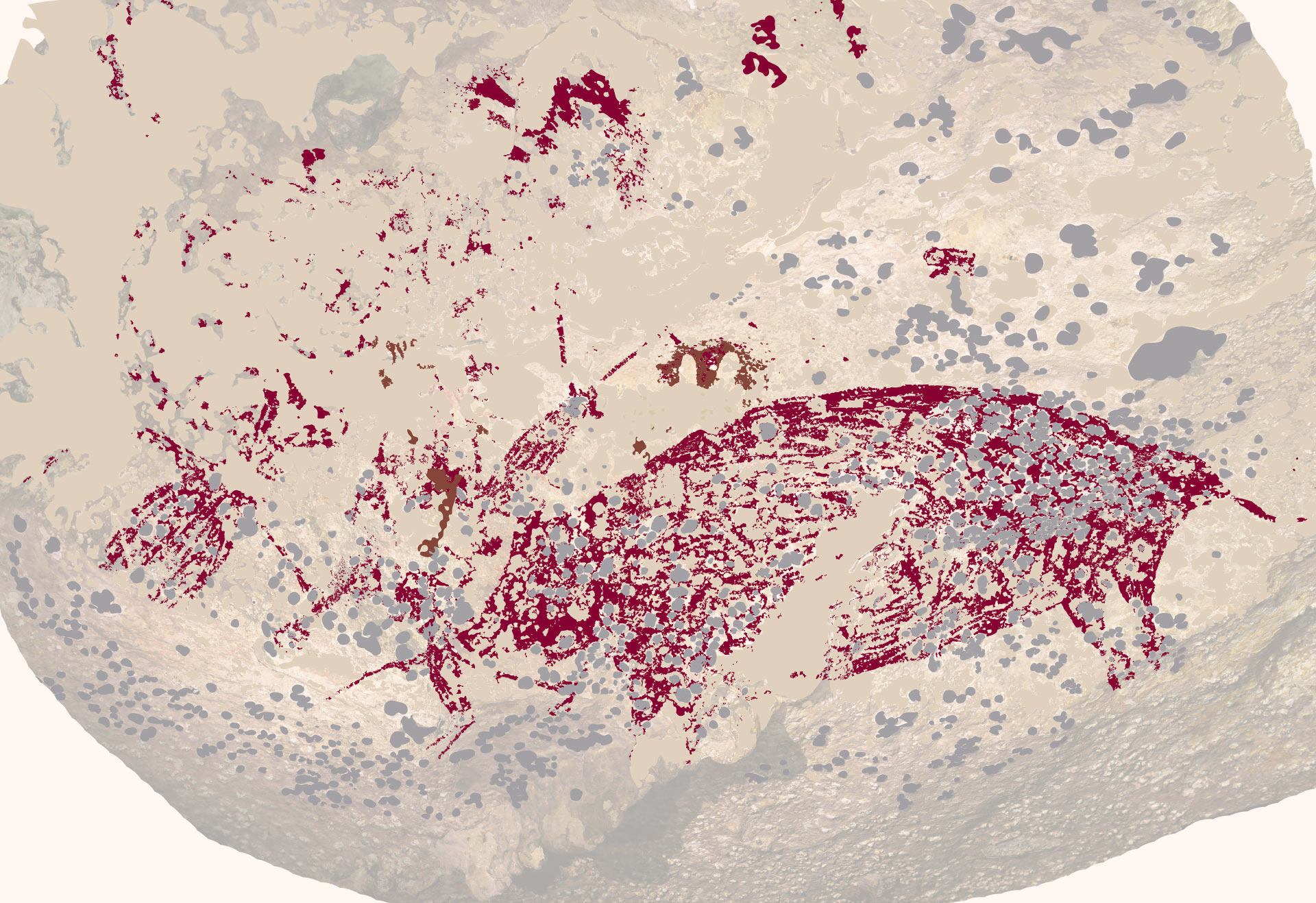
Prehistoric Work Shows Interaction Between Figures and Reveals That Primitive Humans Already Told Complex Stories More Than 50,000 Years Ago
Using a new dating technique called (U-Th series), archaeologists have redefined the age of some of the oldest rock art in the Maros-Pangkep region of South Sulawesi, Indonesia.
This discovery revealed that the compositions are even older than previously believed, changing the current understanding of the origins of human narrative art.
A Revolutionary Discovery
At the archaeological site of Leang Bulu’ Sipong 4, a famous hunting scene had previously been dated at least 43,900 years ago.
-
Motorola launched the Signature with a gold seal from DxOMark, tying with the iPhone 17 Pro in camera performance, Snapdragon 8 Gen 5 that surpassed 3 million in benchmarks, and a zoom that impresses even at night.

-
Satellites reveal beneath the Sahara a giant river buried for thousands of kilometers: study shows that the largest hot desert on the planet was once traversed by a river system comparable to the largest on Earth.

-
Scientists have captured something never seen in space: newly born stars are creating gigantic rings of light a thousand times larger than the distance between the Earth and the Sun, and this changes everything we knew about stellar birth.

-
Geologists find traces of a continent that disappeared 155 million years ago after separating from Australia and reveal that it did not sink, but broke into fragments scattered across Southeast Asia.

With the new laser ablation technique, scientists found that the painting is actually even older, with a minimum age of 50,200 years, with a margin of error of approximately 2,200 years. This means that the work is at least 4,040 years older than previously thought.
Additionally, at another archaeological site in the same region, Leang Karampuang, a new composition was studied.
This art, depicting human figures interacting with a pig, has been dated to a minimum age of 53,500 years, also considering the margin of error of 2,300 years.
It is estimated that it was painted at least 51,200 years ago, thus becoming the oldest known example of representational and visual narrative art in the world.
Importance of the New Technique
Dating prehistoric rock art has always been a significant challenge for archaeologists. Traditional methods, such as the U-series solution analysis, had allowed for important advances in recent decades, being applied in various regions such as Western Europe, Island Southeast Asia, and Siberia.
In Spain, for example, a hand stencil was dated to at least 64,800 years ago, attributed to Neanderthals.
However, when it came to figurative art, the oldest evidence until now was of a naturalistic painting of a warty pig in Sulawesi, dated at least 45,500 years ago.
According to Professor Maxime Aubert from Griffith University, senior author of the new study, the U-Th series technique represents a significant leap in the accuracy of these datings. “This allows us to date the earliest layers of calcium carbonate formed in the art and get closer to the moment when the art was created. This will revolutionize the dating of rock art,” he stated.
Detailed Layer Maps
Professor Renaud Joannes-Boyau from Southern Cross University, co-author of the study, highlighted another benefit of the new technique. “This capability allows us to identify and avoid regions affected by natural diagenesis processes, which arise from complex growth histories,” he explained.
Thus, age determinations become more robust and reliable, providing greater security for archaeological interpretations.
The Impact of the New Dates
The discovery of the painting at Leang Karampuang, at least 51,200 years old, has brought new implications for the understanding of the origin of ancient art. The study’s first author, Adhi Agus Oktaviana from the National Research and Innovation Agency in Jakarta, emphasized that these new dates are surprising.
According to him, none of the famous Ice Age arts in Europe is as old as this, except for some controversial discoveries in Spain. This is also the first time that rock art dates from Indonesia exceed the 50,000-year mark.
Even Older Hunting Scene
Researchers also redated the famous hunting scene from Leang Bulu’ Sipong 4, which depicts beings interpreted as therianthropes (creatures that are part human, part animal) hunting warty pigs and dwarf buffaloes. The work, previously dated at least 43,900 years, is now attributed to a minimum age of about 48,000 years using the new technique.
According to Professor Adam Brumm from Griffith University and co-author of the study, the importance of this discovery lies in the fact that these older artworks are narratives. That is, they show humans and animals interacting in a way that suggests the existence of a story being told, differing from the previous academic view that early figurative rock art consisted only of isolated figures.
Storytelling as Part of Culture
Professor Brumm emphasized that the presence of recognizable scenes in such ancient paintings sheds new light on the role of narrative in the history of art. “This was an innovative discovery because the academic view of early figurative rock art has long been that it consisted of panels of single figures,” he explained.
According to him, these new discoveries indicate that the ability to tell stories was already a crucial part of early human artistic culture in Sulawesi, more than 51,000 years ago.
Adhi Agus Oktaviana also commented that, although humans likely have been telling stories for much longer, as words do not fossilize, the only direct evidence available is pictorial representations.
In this sense, the art of Sulawesi represents, so far, the oldest known evidence of visual narrative in archaeology.
The discoveries, which represent an important advancement in the study of human prehistory and the evolution of art, were published in the scientific journal Nature.








Seja o primeiro a reagir!