





 Portuguese
  English
  Spanish
  3 min of reading
  8 comments


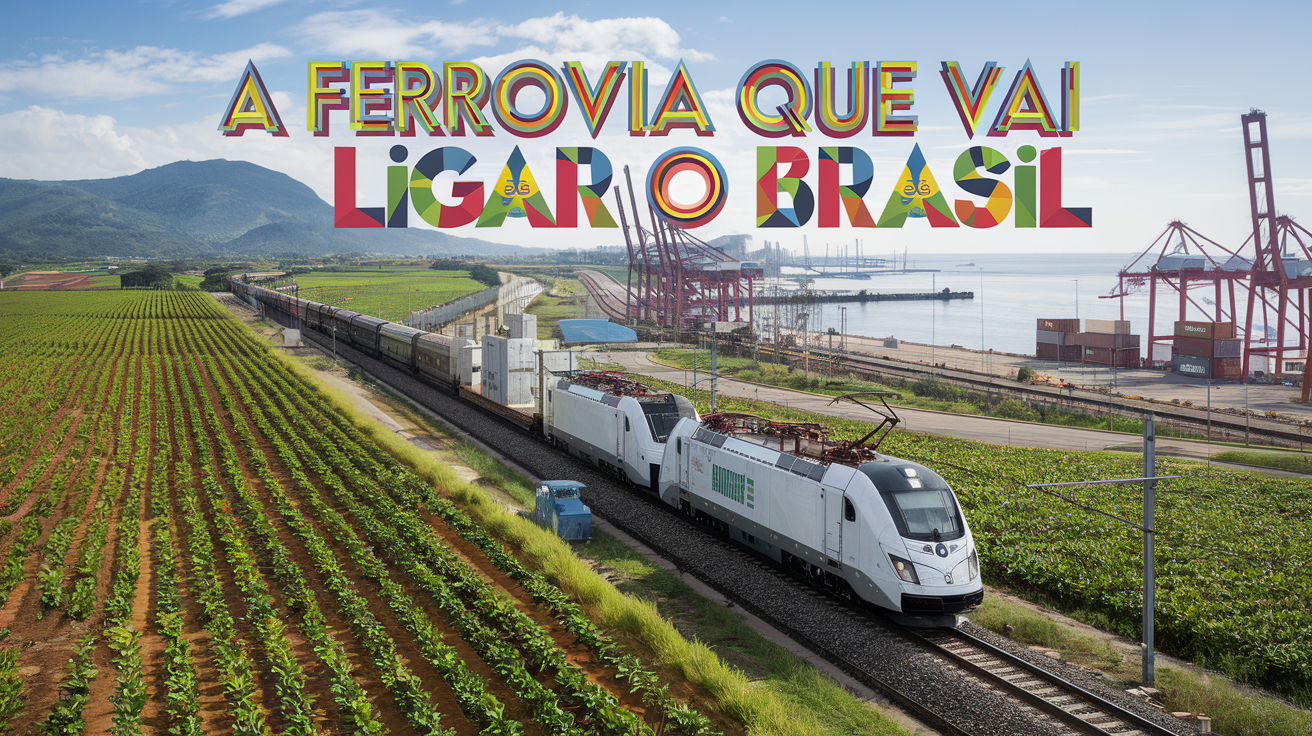


Government Advances A Plan To Revolutionize Brazilian Logistics With A 2,400 Km Railway. Connecting Mato Grosso To Bahia, The Project Promises To Reduce Transport Costs, Increase Efficiency In The Flow Of Grains And Minerals, And Boost The National Economy. Will This Ambitious Plan Finally Come To Fruition?
A railway capable of transforming the national economy is about to take shape.
Behind technical discussions, financial negotiations, and routing adjustments, the federal government is working on a monumental railway project that promises to revolutionize transport in Brazil.
However, many challenges and critical decisions still surround the implementation of this infrastructure, which could redefine the large-scale flow of agricultural and mineral products.
-
50 viaducts, 4 tunnels, 28 bridges, and 40 kilometers of bike paths: BR-262 in Espírito Santo will receive 8.6 billion reais for the largest engineering project in the state’s history, inspired by the Immigrant Highway in São Paulo.

-
Brazil produces too much clean energy and doesn’t know what to do with it: over 20% of solar and wind capacity was wasted in 2025 while investors flee and 509 renewable generation projects were abandoned in the last year.

-
Piauí will produce a new fuel that replaces diesel without needing to change anything in the truck’s engine and reduces pollutant gas emissions by half: truck drivers from all over the Northeast are already celebrating the news that will arrive later this decade.

-
A new Brazilian shopping center worth R$ 400 million will be built in an area equivalent to more than 4 football fields, featuring 90 stores, 5 cinemas, a supermarket, a college, and parking for 1,700 cars, potentially generating 3,000 jobs.


According to Folha de S. Paulo, the Ministry of Transport is preparing a concession package that will integrate two major railway projects: the Central-West Integration Railway (Fico) and the West-East Integration Railway (Fiol).
Combined, these two railways will form a corridor of over 2,400 kilometers, connecting Lucas do Rio Verde in Mato Grosso to the port of Ilhéus in Bahia.
The merger will pass through the North-South Railway corridor, an important system already in operation that connects the interior of São Paulo to Maranhão.
A Concession To Connect Brazil
The technical and economic studies, conducted by the state-owned Infra S.A., are in their final phase and are expected to be presented to the National Land Transport Agency (ANTT) later this month.
According to Rafael Vitale, director-general of ANTT, the agency plans to initiate a public consultation by the end of January 2025 to discuss the concession model and receive suggestions from the private sector and civil society.
One of the most discussed points is the possible change in the routing of Fiol.
Initially, the railway was supposed to end in Figueirópolis, Tocantins, but the new plan suggests that it will end in Mara Rosa, Goiás.
This change promises to facilitate direct integration with Fico and optimize the connection with the North-South Railway. If approved, the change would reduce costs and increase the logistical efficiency of the project.
Advancements And Challenges Of The Works
Although the project brings expectations, the current scenario of the works reflects the challenges faced. In Fiol, which has a total of 1,022 kilometers planned, only 171 kilometers have been completed between Ilhéus and Caetité.
The mining company Bamin, responsible for this stretch, is in the process of returning the concession due to financial difficulties.
To avoid delays, the government is seeking to transfer the contract to another company, with Vale emerging as a potential interested party.
Meanwhile, Fico is progressing with more certainty.
The mining company Vale, responsible for the construction of 383 kilometers between Mara Rosa (GO) and Água Boa (MT), has already begun work as a counterbalance for the early renewal of the concession for the Vitória-Minas Railway.
This stretch is expected to be included in the concession package, ensuring its continuity.
Economic And Environmental Impact
The potential impact of this railway project is huge.
With infrastructure capable of connecting grain and mineral producing regions to the coast, the flow of Brazilian production should gain efficiency and competitiveness in the international market.
Additionally, reducing dependence on highways will lower logistical costs and carbon emissions, making transport more sustainable.
Experts point out that the creation of this railway network will bring development to the regions it traverses.
Municipalities along the route are expected to experience a significant increase in job creation
and local commerce, boosting the regional economy.
Next Steps And Expectations
The success of the project depends on strategic decisions and cooperation between the government and the private sector.
The public consultation scheduled for 2025 will be a crucial moment to adjust details of the concession model and solidify the interest of potential investors.
However, bureaucratic hurdles and the need for financial feasibility remain major challenges.
Defining new routes, transferring contracts, and completing pending sections are issues that must be resolved quickly to avoid even greater delays.
Will this megaproject railway finally come to fruition and transform logistics in Brazil?








Em toda Europa, Ásia e América do Norte este transporte é extremamente utilizado. Transporte de eficiência e excelência. Não entendo como aqui no Brasil foram todas ferrovias destruídas. E nenhum governo fez nada até hoje.
O projeto da transposição do Rio São Francisco, também era do Brasil império, e não saiu do papel. Só lançar projeto não adianta nada.
Já estava acontecendo nós últimos anos, mas por alguma razão, escolheram não abordar o assunto, agora apresentam como novo, sqn.
O projeto da transposição do Rio São Francisco, também era do Brasil império! Só projeto não adianta nada!!! Quando saiu do papel?