





 Portuguese
  English
  Spanish
  6 min of reading
  0 comments


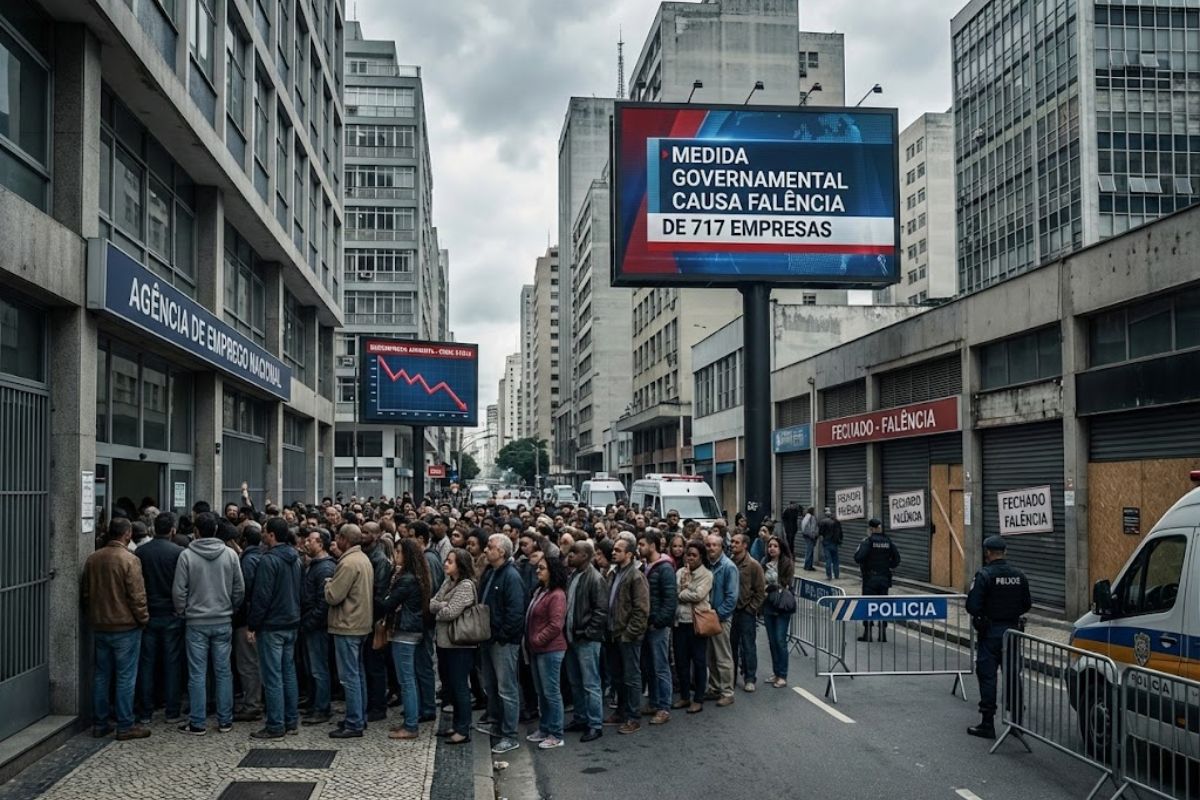
Data from S&P Global Market Intelligence Cited by The Washington Post on 12/29/2025 Show 717 Business Bankruptcies by November 2025 in the United States. Tariffs Raise Inputs, Squeeze Margins, and Freeze Credit. Manufacturing, Construction, and Transportation Sectors Concentrate 110 Cases, with Over 70,000 Jobs Affected in This Cycle.
Data from S&P Global Market Intelligence Released by The Washington Post Indicated 717 Business Bankruptcies Registered by November 2025 in the United States, in a Scenario Attributed to the Impact of Tariff Policies on Costs and Credit. The Number Consolidates a Jump in Corporate Insolvencies in 2025.
In the Sector Breakdown, Manufacturing, Construction and Transportation Accounted for 110 Bankruptcy Filings by November 2025, While the Impact on the Job Market Surpassed 70,000 Affected Jobs. In Parallel, Personal Bankruptcies Grew 8% in the Year, Reaching About 41,000 Cases in the Same Period, Expanding the Social Reach of the Economic Shock.
What the 2025 Numbers Show About Business Bankruptcies
The Central Data from the Survey is Clear: 717 Business Bankruptcies by November 2025.
-
Piauí will produce a new fuel that replaces diesel without needing to change anything in the truck’s engine and reduces pollutant gas emissions by half: truck drivers from all over the Northeast are already celebrating the news that will arrive later this decade.

-
A new Brazilian shopping center worth R$ 400 million will be built in an area equivalent to more than 4 football fields, featuring 90 stores, 5 cinemas, a supermarket, a college, and parking for 1,700 cars, potentially generating 3,000 jobs.

-
Larger than entire cities in Brazil: BYD is building a 4.6 km² complex in Bahia with a capacity for 600,000 vehicles per year, but the discovery of 163 workers in conditions analogous to slavery has shaken the entire project.

-
With an investment of R$ 612 million, a capacity to process 1.2 million liters of milk per day, Piracanjuba inaugurates a mega cheese factory that increases national production, reduces dependence on imports, and repositions Brazil on the global dairy map.


The Base Attributes the Advance to the Link Between Tariff Policies, Rising Production Costs, and Credit Difficulty, a Combination That Pressures Both Large Companies and Small Businesses.
The Breakdown of 110 Filings in Manufacturing, Construction, and Transportation Reinforces That the Problem was Not Limited to a Single Sector.
When Costs Rise and Credit Becomes More Expensive or Scarce, Bankruptcy Ceases to Be an Isolated Event and Becomes a Trend.
This Mechanism Also Tends to Accelerate Closures in Companies That Were Already Operating with Tight Margins.
In Addition to the Volume, the Base Text Indicates a Visible Effect on Employment: Over 70,000 Jobs Affected.
This Metric Serves as a Thermometer of Real Impact, as It Converts Accounting Statistics into Direct Consequences for Families and Consumption.
How Tariff Policies Raise Costs and Freeze Credit
The Base Describes Tariff Policies as the Engine of the Shock, with a Practical Result: Inputs and Components Become More Expensive, Production Costs Rise, and the Ability to Pass Prices onto Consumers Finds Limits in a Weaker Consumption Environment.
This Movement Reduces Margins and Pushes Companies to the Point Where Delays and Renegotiations Are No Longer Sufficient.
At the Same Time, the Text Points Out “Credit Difficulties” as Part of the Context.
Operationally, When Credit Freezes, Companies Lose the Working Capital Bridge That Supports Inventory, Payroll, and Timelines with Suppliers.
Without Credit, the Company Pays Today and Receives Later, Until the Cash Flow No Longer Balances.
The Result of This Double Shock, Higher Costs and More Difficult Credit, Is the Increase in Bankruptcy Filings Throughout 2025, with Relevant Concentration in Industries That Are Input, Labor, and Logistics Intensive.
Why Manufacturing, Construction, and Transportation Appear at the Top
The Base Highlights That Manufacturing, Construction, and Transportation Gathered 110 Bankruptcy Filings.
These Sectors Have Characteristics That Make Them More Exposed in a Tariff and Credit Restriction Scenario: Dependence on Materials and Parts, Long-Term Contracts, Logistical Costs, and the Need for Ongoing Financing.
In Manufacturing, Tariffs Can Raise Component and Raw Material Costs, Squeezing Margins When Demand Does Not Grow at the Same Rate.
In Construction, the Impact Appears in Material Costs and Sensitivity to Credit, as Projects Depend on Financing and Cost Predictability.
In Transportation, Cost Increases and Consumption Retraction Can Reduce Volume, While Operational Expenses Remain Rigid.
The Sum of These Factors Helps to Understand Why Business Bankruptcies Are Concentrated in Sectors That Carry “High Fixed Costs” and Little Flexibility When the Economy Slows Down.
The Effect on Employment and the Pressure on Consumption
The Base Text Records Over 70,000 Jobs Affected.
In Macroeconomic Terms, This Number Indicates Two Lines of Impact at the Same Time: Loss of Labor Income and Reduction in Consumption, Which Reinforces the Drop in Sales, Especially in Retail and Services Related to the Middle Class.
When Jobs Are Cut, Consumption Falls, and the Drop in Consumption Comes Back as Pressure on Companies, Mainly Those That Rely on Recurring Demand.
The Base Also Highlights the Burden on Small Family Businesses, the So-Called Mom and Pop Businesses, Which Tend to Have Less Cash and Less Access to Credit in Periods of Financial Stress.
In This Environment, the Cycle of Business Bankruptcies Can Cease to Be Point-In-Time and Become a Contagion Phenomenon: Less Consumption, More Difficulty Selling, More Cuts, More Defaults, More Bankruptcy Filings.
Mom and Pop Businesses, Subchapter 5, and the Search for Recovery
The Base Text Draws Attention to the Vulnerability of Small Family Businesses, Which Face Declining Consumption and Rising Costs.
This Type of Business Usually Operates with a Lean Structure, Few Reserves, and High Dependence on Daily Revenue, Which Increases Sensitivity to Short-Term Shocks.
The Base Also Reports That Small Businesses Are Turning to Subchapter 5, Cited as a Form of Judicial Recovery.
The Data Is Relevant Because It Indicates That Part of the Market Is Trying to Restructure Debts Instead of Immediately Closing Operations, Signaling an Environment Where Survival Depends on Formal Renegotiation.
This Movement, In Itself, Does Not Eliminate Risk.
It Reveals That Stress Has Reached the “Base” of the Productive Fabric, Not Just Large Corporations, and That the Insolvency System Has Started Being Used as a Tool for Reorganization in 2025.
Personal Bankruptcies Rise 8% and Reach About 41,000 Cases
In Addition to Companies, the Base Reports That Personal Bankruptcies Grew 8% in the Year, Totaling About 41,000 Cases by November 2025.
This Data Expands the Scenario Beyond the Corporate Environment: It Shows That Families Also Faced Financial Deterioration During the Same Period.
The Joint Reading Is Direct: Business Bankruptcies and Personal Bankruptcies Go Hand in Hand When the Cost of Living and Credit Are Under Pressure, and When the Job Market Absorbs the Shock.
The Economy Does Not “Break” Only at the CNPJ, It Also Breaks in the Household Budget.
The Jump in Personal Bankruptcies Reinforces the 2025 Scenario as a Period of Broad Stress, with Simultaneous Impact on Employment, Consumption, and Payment Capacity.
Retail as a Showcase of the Crisis: At Home, 260 Stores and a Plan to Close 20
In Retail, the Base Text Cites At Home as an Example of a Company That Sought Judicial Recovery.
The Chain Has 260 Stores in Operation and, According to the Base, Plans to Close About 20 Units, in a Context of Rising Tariffs and Declining Consumer Spending.
The Case Illustrates the Transmission Channel of the Crisis to Retail: When Consumption Declines and Costs Rise, Chains with a Large Physical Footprint Start Cutting Losses, Streamlining Operations, and Reevaluating Less Profitable Stores.
Closing Stores Is Often the Last Step Before a Deeper Restructuring, and Tends to Affect Jobs and Local Suppliers.
By Including This Example, the Base Signals That the Problem Was Not “Hidden” in Industrial Sectors. It Also Appeared on the Frontline of Consumption, Where the Decline in Spending Is Quickly Felt.
What the Text Indicates for 2026 and Why the Risk Remains
The Base Concludes That, With the Maintenance of Tariff Policies and Persistence of Economic Uncertainties, the Horizon for 2026 Presents Additional Risks of Business Insolvency.
The Central Point Is That the Situation Is Not Described as Resolved in November 2025, but as a Cycle That May Prolong Itself.
If Costs Remain High and Credit Continues Difficult, Companies Will Have Little Room for Maneuver.
And If Consumption Does Not React, Retail and Services Maintain Pressure, Which Reinforces the Risk of New Business Bankruptcies in 2026.
In Other Words, 2025 Closes with High Numbers and 2026 Begins with Alerts on the Continuation of the Conditions That Pushed Companies into Insolvency.
The 717 Business Bankruptcies by November 2025, Attributed in the Base to the Effect of Tariff Policies on Costs and Credit, Reflect a Cycle of Economic Stress in the United States with Sectoral Impact on Manufacturing, Construction, and Transportation, Direct Effect on Over 70,000 Jobs, and an Advance of Personal Bankruptcies to About 41,000 Cases.
If You Follow the Economy and Labor Market, It Is Worth Observing Three Practical Signals in the Coming Months: Evolution of Credit for Companies, Consumption Pace in Retail, and New Bankruptcy Filings in the Most Exposed Sectors. These Indicators Tend to Anticipate Whether the Scenario of Business Bankruptcies Will Diminish or Extend into 2026.
In Your View, Did the Greater Burden for Business Bankruptcies in 2025 Come from Rising Costs Due to Tariffs or from the Difficulty of Credit to Maintain Company Cash Flow?






-

-

-

4 pessoas reagiram a isso.