





 English
  Francês
  Alemão
  Italiano
  Japonês
  Norueguês
  Portuguese
  Spanish
  5 min of reading
  0 comments


Inside The Set That Moves The BYD Compact, Clues Emerge About Efficiency, Durability, And Why Some Repairs Can Become A Challenge
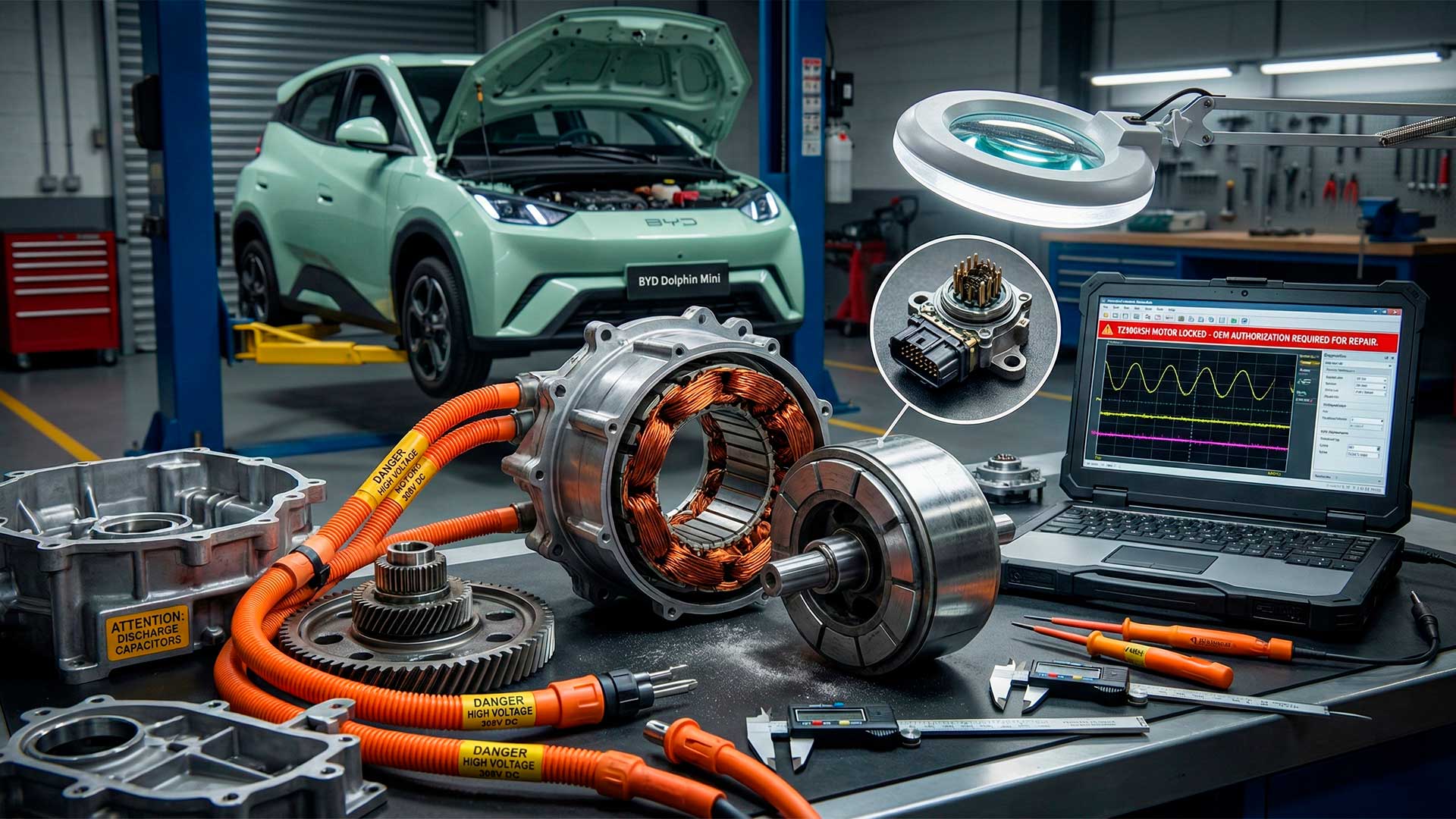
On the outside, the BYD Dolphin Mini gives the impression of being a straightforward electric car, small, urban, and promising practicality. However, the story changes when the drive unit appears “naked,” with rotor, stator, differential, and sensors exposed.
What catches immediate attention is the contrast between the idea of “fewer parts” and the reality of a system that relies on high voltage, power electronics, and precision fittings. It is here that the electric vehicle ceases to be just a motor and becomes an ecosystem.
In Brazil, the technical specifications released by the manufacturer place the Dolphin Mini as a model with 75 hp, a maximum torque of 135 Nm, a 38 kWh Blade LFP battery, and an Inmetro range of 280 km, in addition to DC charging from 30 to 80 percent in 30 minutes.
-
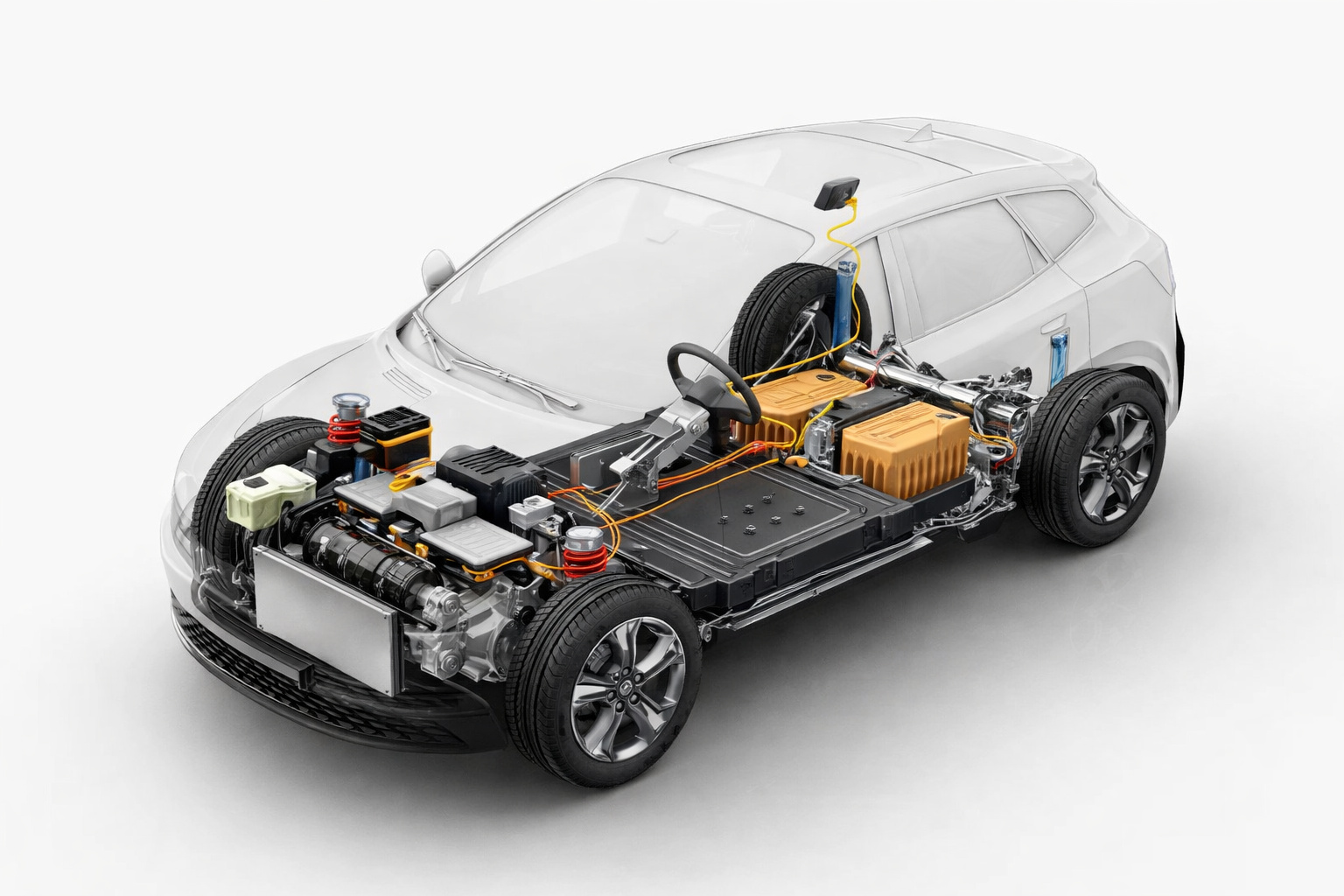
China Surprises Automotive Industry With Battery That Promises Electric Car Able to Run Up to 1,000 km Without Recharge
-
Why BYD Grew So Fast in Brazil and How Blade Batteries, Electric Cars, and Industrial Incentives Shaped This Expansion in the National Automotive Sector
-
Electric Cars Make Progress in Brazil in 2026 and Promise to Reduce Drivers’ Costs with Cheaper Energy, While Infrastructure Grows Slowly Across the Country

-
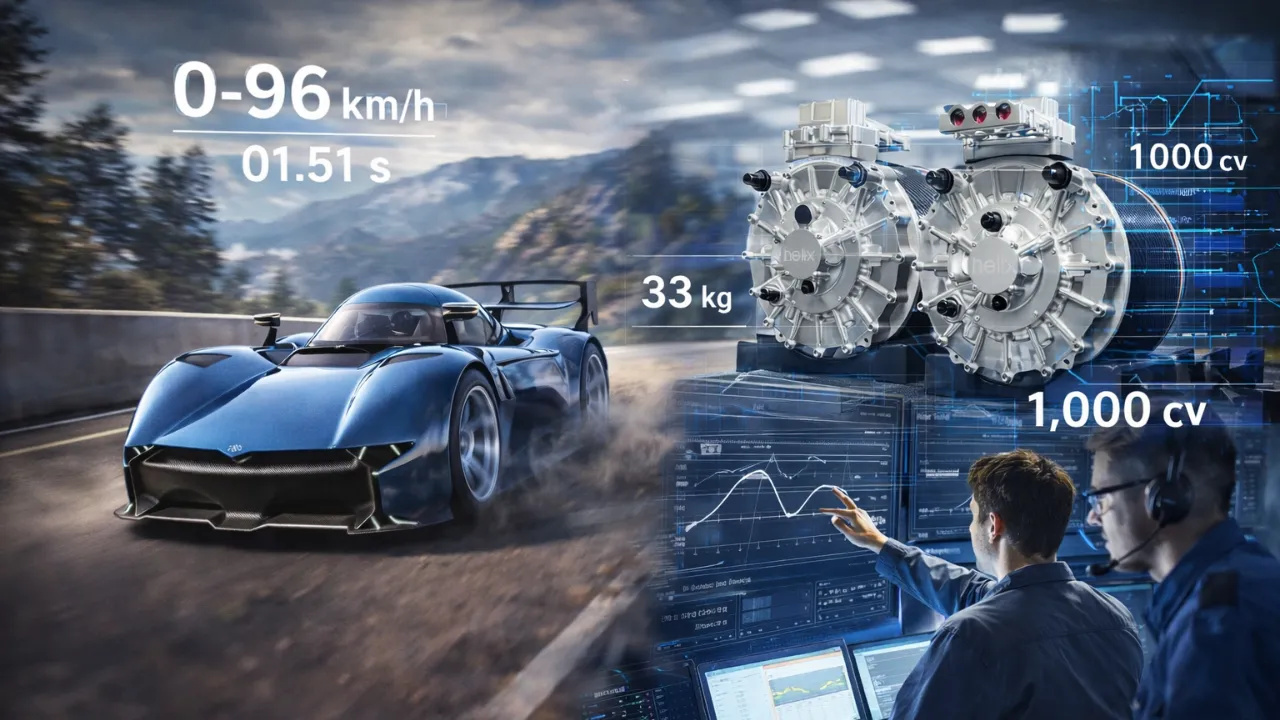
This Helix Electric Motor Weighs Only 33 Kg and Turns the McMurtry Spéirling Into a Compact 1,000 Hp Missile That Takes Just 1.5 Seconds to Reach 100 Km/H

The disassembly of the unit helps explain why these numbers do not depend solely on the battery. It reveals engineering decisions that favor efficiency and robustness but also create new barriers for those considering maintenance outside of dealership standards.
Numbers Of The Dolphin Mini Help Understand What Is At Stake In The Electric Motor
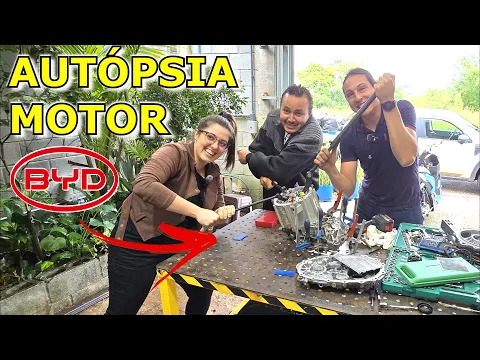

The drive motor of the Dolphin Mini is associated with specifications that are common in modern electrics, power in the range of 55 kW, high rotations, and torque available from low RPMs. In BYD’s documentation, the Dolphin Mini unit is described as a permanent magnet synchronous motor, and the mentioned model is the TZ180XSH.
The technical sheet of the car in Brazil reinforces the “urban package” with front-wheel drive and performance geared towards daily use, which aligns with a torque of 135 Nm and a top speed advertised at 130 km per hour.
A curious point is that the electric motor operates at very high rotations compared to conventional motors. In practice, this shifts part of the workload to gear reduction, and there the differential and the mechanical assembly become just as important as the motor itself.
This type of architecture helps explain why the car can be efficient in urban driving. It also helps understand why noise, vibration, and fine torque control depend on adjustments that are not “mechanical,” but electronic instead.
Why 308 Volts And High Rotation Change The Discussion About Control And Efficiency
One of the most relevant details is the system’s voltage. During disassembly, there is a reference to a set operating around 308 V, which fits the automotive electric drive logic, high voltage to reduce current and losses in wires and components.
The practical consequence is that the motor does not have a “fixed frequency” like an industrial three-phase motor designed for 60 Hz. In an electric car, the inverter modulates the power supply and varies frequency and amplitude to control torque and rotation precisely, and this completely changes how to “command” the motor.
This difference appears when discussing waveform reading and how rotation alters the system’s electrical frequency. It is not a motor to plug into an outlet; it is a motor designed to work in tandem with power electronics and software.
This marriage explains the smooth performance and immediate torque felt by the driver. It also explains why, without the right control and position signals, the same motor can become a “dead weight” outside of the car.
The Rotor Position Sensor Becomes A Kind Of Technology Lock
Upon opening the unit, a component that is often decisive in traction motors emerges. The rotor position sensor, which informs the electronic control exactly where the rotor is to synchronize the magnetic field and deliver torque from zero.
In automotive applications, the use of resolver is common, a sensor that provides sine and cosine signals and allows robust position reading in environments with vibration and temperature. In technical notes, this type of reading appears as a basis for controlling synchronous motors and for correct commutation in the inverter.
The implication is direct for maintenance and adaptations. If the sensor, inverter, and software do not “talk” perfectly, the motor may not operate as it should, limiting reuse outside the original assembly.
This is where the controversy of right to repair in the electrical world arises. The motor may be durable, but access to parameters and compatibilities may be restricted to those who have the tools, firmware, and authorization.
Sealing, Cooling Channels, And The Differential In The Same Assembly
Another finding is the concern with sealing and protection against water and contaminants. In electric cars, this is not just “fussing,” as electronics, bearings, and electrical insulation need a controlled environment to maintain reliability.
The aluminum casing and the internal cooling pathways show a common strategy to remove heat from the unit without directly exposing windings, using the motor body as a “thermal bridge.” This helps keep the temperature under control without relying on improvised solutions.
The disassembly also highlights how part of the powertrain is integrated. The differential, gears, and motor are positioned closely, and the precision of fitting the parts becomes a requirement to reduce losses and noise over time.
This integration aligns with the proposal for a platform dedicated to electrics. BYD claims that the Dolphin Mini uses the e Platform 3.0, developed for purely electric vehicles focused on efficiency, safety, and driving experience.
The upside is predictable: less waste, better packaging, and potential durability. The downside is that when something goes wrong, the repair may involve electronic diagnosis and specific parts, not just the replacement of a mechanical component.
When The Battery Enters The Discussion, The Risk Is No Longer Theory
The disassembly of the traction unit usually leads to an inevitable question. If the motor is robust, then where does the danger and cost lie in the long term.
Part of the answer lies in the battery and the high-voltage system. In the Dolphin Mini, the technical sheet indicates the Blade LFP battery, a chemistry associated with greater thermal stability compared to other lithium-ion solutions.
BYD also promotes the Blade Battery highlighting safety testing and the proposal to reduce the risk of severe thermal events.
Still, high voltage does not forgive mistakes. An accidental short can generate an electrical arc, extreme heat, and even metal vaporization, so procedures and protections are exclusively for trained professionals, with PPE and industrial protocols.
In the end, disassembly does not “scare” the electric vehicle; it merely puts things in their place. The motor may be simple in concept, but the entire system is sophisticated, and maintenance tends to migrate from mechanical to electronic.
What do you find more concerning about the electric car, the promise of lasting a long time without wear or the risk of becoming hostage to software, sensors, and components tied to the manufacturer? Would you purchase a compact electric like the Dolphin Mini thinking about running for many years, or do you think maintenance could become an expensive bottleneck? Leave a comment with your point of view.










-

-

-

-

-

48 pessoas reagiram a isso.