





 Portuguese
  English
  Spanish
  5 min of reading
  0 comments



Understand Why the Solar Energy Career Is Thriving, What Its Professional Advantages Are, and How It Became Fundamental for the Sustainable Future of the Planet.
Currently, the search for cleaner and more sustainable energy sources is gaining increasing ground worldwide.
Among the most promising alternatives, solar energy stands out as one of the main bets to face the environmental and economic challenges of the 21st century.
Therefore, it is important to understand why the solar energy career has become so essential today.
-
Roraima bets on the sun to escape high tariffs: Amid the energy crisis and price hikes, solar energy is growing in Roraima and transforming consumption in the North region.

-
Copel boosts solar energy in Paraná and brings innovation to public schools, promoting savings on electricity bills, energy efficiency, and a direct impact on the quality of education.

-
Brazil reaches historic milestone in solar energy: Sector surpasses 2 million accumulated green jobs and generates billions in the national economy even under market pressure.
-
Minas Gerais takes the lead in renewable energy: State surpasses historic mark of 14 GW in solar energy generation in MG and consolidates dominance in the Brazilian electric sector.


To do this, we need to look at the past, analyze the present, and imagine a future where renewable energy is the protagonist.
Moreover, the increasing demand for energy, especially with technological advancements and the electrification of various sectors, shows that traditional sources can no longer meet the planet’s needs.
Thus, developing a diversified and sustainable energy matrix is an urgent global challenge.
In this context, solar energy, alongside other renewable sources, arises as an effective and viable solution.
According to the International Renewable Energy Agency (IRENA) report from 2023, the solar energy sector has grown globally at an average annual rate of 20% over the last decade, reflecting its crucial role in the energy future.
A Brief Look at the History of Solar Energy

In fact, the idea of using sunlight as an energy source is not new. Ancient civilizations, such as the Greeks and Romans, already took advantage of solar heat to warm their homes and environments.
This simple practice was the embryo of what, centuries later, would transform into modern solar energy.
The scientific history of solar energy made a significant advancement in 1839 when French physicist Alexandre Edmond Becquerel discovered the photovoltaic effect — the phenomenon that allows sunlight to be transformed into electricity.
This discovery, recorded by the National Museum of American History, marked the beginning of scientific research on solar energy.
Later, in 1883, physicist Charles Fritts created the first functional solar cell, using selenium as a semiconductor material.
However, the development of modern solar cells only significantly advanced in the 1950s, thanks to researchers at Bell Labs, who produced the first efficient silicon panels.
For much of the 20th century, solar energy was still seen as an expensive and impractical alternative.
However, starting from the oil crisis of the 1970s, interest in alternative energy sources grew rapidly.
Since then, technological advancements, combined with global environmental policies, have reduced costs and expanded the applications of solar energy.
Additionally, solar thermal energy, which uses solar heat to heat water and environments, also began to be explored more intensively, expanding sustainable use possibilities of this source.
Thus, over the last 200 years, solar energy has evolved from simple concepts to a viable and indispensable technology, as highlighted by institutions such as the National Museum of American History and the International Renewable Energy Agency (IRENA).
Why Is the Solar Energy Career Thriving?

With this accelerated growth, new professional opportunities arise every day.
Thus, the solar energy career has become a promising field that goes beyond the installation of solar panels.
Engineers, technicians, electricians, analysts, consultants, and professionals in the commercial area find space to operate.
Moreover, solar energy allows acting in different fronts: residential, commercial, industrial projects, technological development, research, and innovation.
What makes this career even more interesting is its strong alignment with sustainability.
Professionals in the field contribute directly to reducing environmental impacts, promote energy efficiency, and democratize access to energy.
The demand for qualified labor is growing, and many institutions offer specific technical and vocational courses for this area.
Another factor that highlights the career is the possibility of entrepreneurship. Many professionals open companies for the installation and maintenance of systems, consulting, and the sale of equipment.
This way, each professional can find a niche that aligns with their skills and interests.
Solar Energy and the Future of Work

In a world marked by climate change and pressure on natural resources, the market values professionals linked to sustainability.
Few sectors shape the future of work like solar energy.
The so-called green jobs, focused on preserving the environment, are the fastest growing.
Therefore, a career in solar energy fits perfectly into this trend.
Working with clean energy has ceased to be an alternative choice and has become a market demand.
Additionally, the decentralization of photovoltaic systems, which can be installed in small businesses, homes, and rural areas, fosters local economic development.
According to the International Renewable Energy Agency (IRENA), this model generates local jobs and contributes to social inclusion.
Therefore, a career in solar energy is dynamic, diverse, and challenging, perfect for those seeking constant learning and professional growth.
The Importance for Society
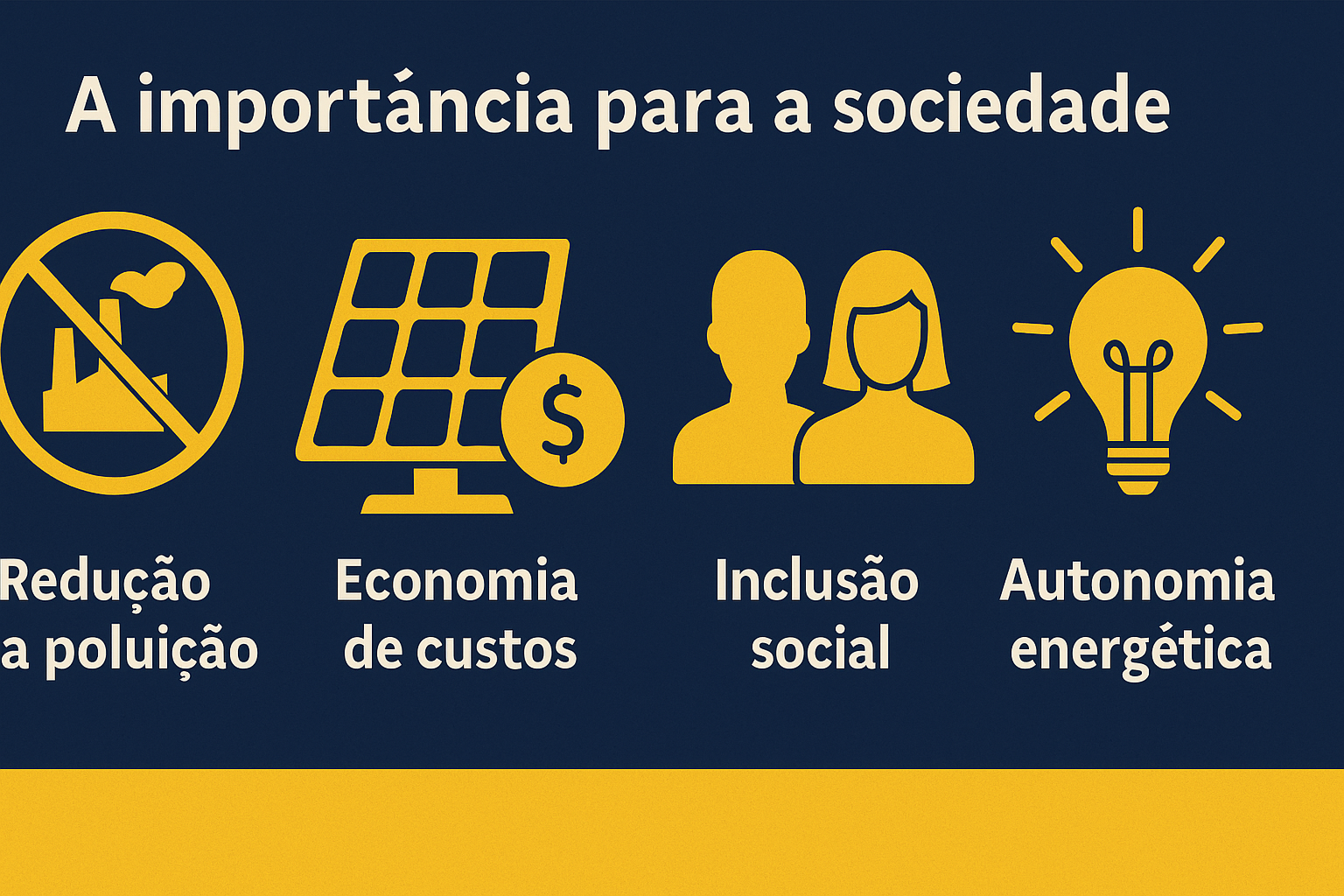
Choosing a career in solar energy means committing to the future of society.
Energy is an essential resource for modern life: it powers cities, industries, hospitals, and homes.
When this energy is generated cleanly andRenewably, everyone benefits.
In addition to pollution reduction and natural resource preservation, solar energy brings direct economic benefits.
It provides savings on electricity bills, reduces dependency on fossil sources, and generates energy autonomy.
The sector is constantly evolving, with technologies that increase panel efficiency, improve storage, and optimize consumption.
Thus, a career in solar energy offers an ideal environment for those seeking challenges and continuous learning.
Furthermore, access to solar energy in remote communities improves quality of life, promotes social inclusion, and economic development.
Why Is This Career Essential?
Thus, the solar energy career is essential today because it unites two needs of the contemporary world: the search for a clean energy matrix and the generation of qualified jobs.
With positive impacts on the environment, economy, and society, this area is one of the most important of our time.
By choosing this career, you participate in a global transformation.
Investing in solar energy means helping to build a fairer, more sustainable, and balanced future.
Few sectors offer such a concrete opportunity for personal success and social contribution.
Therefore, whether you are a young person seeking your first job or someone transitioning careers, solar energy represents a real chance to grow professionally and make a difference on the planet.










-

4 pessoas reagiram a isso.