





 Português
  Inglês
  Espanhol
  5 min de leitura
  0 comentários



Courses in the Labor Market Are Essential for Professional Qualification, Increased Employability, and Adaptation to Market Changes. Invest in Your Training and Open Doors to New Career Opportunities.
The search for a good position in the job market has never been as challenging as it is today. With technological advances and the greater democratization of information, getting a job or advancing in a career requires more and more preparation.
In this scenario, courses in the labor market play an essential role, as they represent a bridge between the theory learned in school or university and the practical demands of the professional world.
To understand why these courses are so important, it is necessary to revisit the history of work and vocational education.
-
Employee Fired After Accumulating 114 Days of Medical Leave in One Year, Labor Court Upholds Company’s Decision

-
Employee Fired While Treating Depression Wins in Court and Vale Is Required to Rehire Him Following Decision Based on the CLT and INSS Benefits

-
Workers Should Be Aware! March 6 Will Be The Fifth Business Day Of March And The Final Deadline For Companies To Pay Salaries According To The CLT

-
2026 FGTS Anniversary Withdrawal Is Released According to Birth Month, Sets Amounts by Balance Range, Establishes Deadlines for March and April, and Changes Rules in Case of Dismissal


Vocational Education and the Impact of the Industrial Revolution
For centuries, professional learning occurred empirically. Knowledge was passed down within families or in workshops through informal apprenticeships.
Starting in the 18th century, with the Industrial Revolution — a historical process initiated in England around 1760 — the scenario changed dramatically.
Machines began to replace part of human labor, and factories required workers with technical skills.
According to UNESCO (United Nations Educational, Scientific and Cultural Organization), the Industrial Revolution was one of the most significant milestones for the establishment of the first technical schools and for the valorization of vocational education as an instrument of economic development.
In that context, theoretical knowledge began to be combined with practical skills, and nations realized that industrial growth directly depended on the qualification of the workforce.
Over time, this requirement became established. By the early 20th century, technical education was incorporated into formal educational systems in various countries.
In Brazil, for example, the establishment of Schools for Apprentice Artisans in 1909, under the government of Nilo Peçanha, represented the first step in structuring public vocational education. These institutions were precursors to the current system of Federal Institutes, according to information from the Federal Government Portal.
The Evolution of the Market and the Emergence of New Demands

With the advancement of the 20th century and the advent of the information age, new paradigms emerged. The globalization of markets and the massive use of technology created a dynamic and competitive environment.
Today, professions related to technology, data, design, communication, and innovation are among the most sought-after — and, to occupy them, workers need constant training.
According to the report “The Future of Jobs 2020”, published by the World Economic Forum, by 2025, more than 50% of workers will need to undergo professional retraining to maintain their employability.
The study also points out that the skills required by companies change frequently, making the practice of continuous learning essential.
The IBGE (Brazilian Institute of Geography and Statistics), in its 2019 labor market survey, had already identified a high demand for professionals in information technology, digital marketing, and specialized services.
This demonstrates how traditional knowledge, by itself, is no longer sufficient. It is necessary to go beyond: learn new tools, stay updated on trends, and develop skills aligned with the present time.
Courses in the Labor Market and Employability
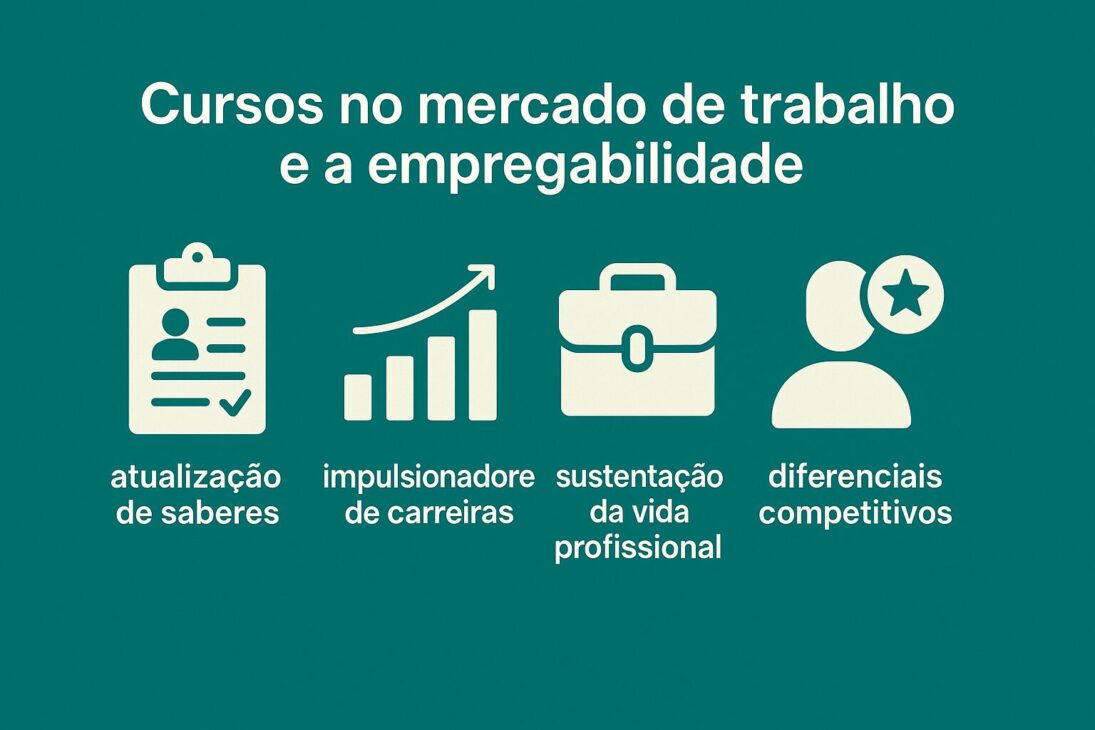
In times of rapid and constant transformations, courses become not just complements but true pillars of support for professional life.
They serve as knowledge updates, career boosters, and competitive differentials.
The National Confederation of Industry (CNI) published, in 2022, a study on the impact of technical training on employability.
The data revealed that 72% of students in technical courses at SENAI were employed within a year of completing their training.
The survey also highlighted that professionals trained by technical institutions tend to have salaries up to 30% higher compared to workers without specific qualifications.
During the COVID-19 pandemic, access to courses became even more intense. The Ministry of Education, through the Avamec platform, made available hundreds of free online courses.
This democratization of access to knowledge expanded opportunities for unemployed individuals, youth seeking their first job, or even professionals in the process of career transition.
The New Required Skills and the Value of Soft Skills
In addition to technical knowledge, the current market demands behavioral skills, known as soft skills.
Skills such as leadership, empathy, emotional intelligence, critical thinking, and effective communication are among the main selection criteria in many companies.
The report “Global Talent Trends 2020”, prepared by LinkedIn, pointed out that 92% of recruitment professionals consider soft skills as important as technical skills.
Courses focused on personal development, group dynamics, and emotional intelligence, therefore, complement technical training and help professionals stand out in corporate environments.
Vocational Education in Brazil: Advances and Challenges
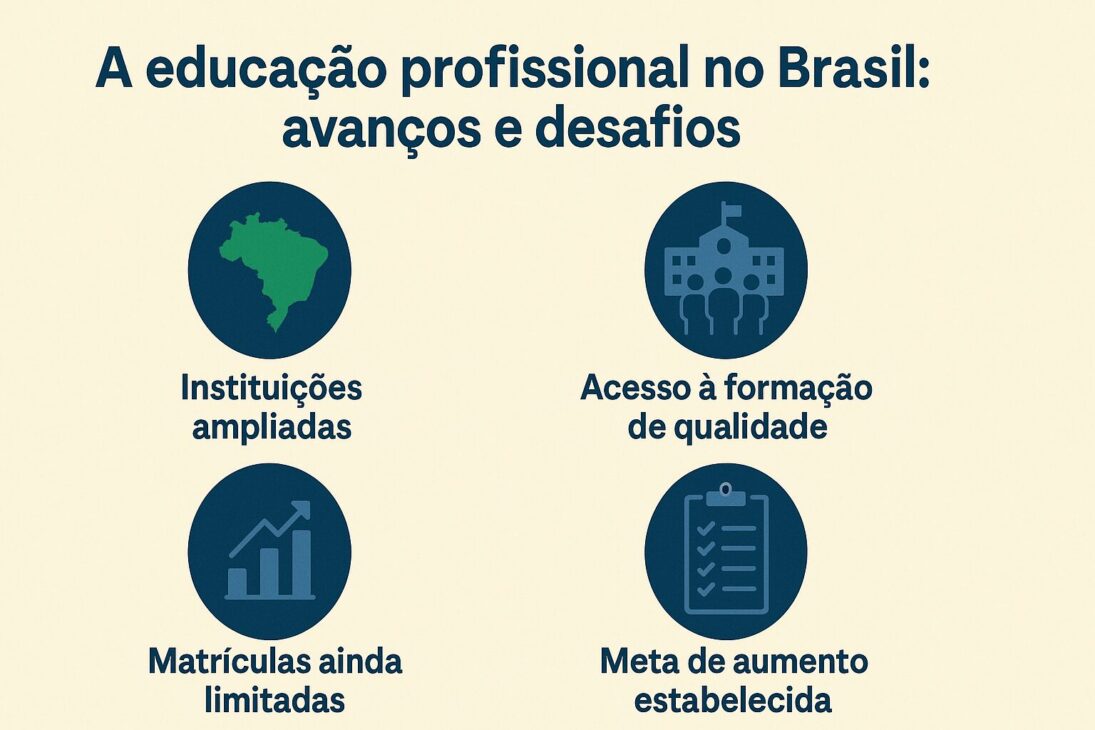
Brazil has made significant strides in terms of access to vocational education. The expansion of places in institutions such as SENAI, SENAC, and the Federal Institutes has allowed thousands of young people to access quality training and, consequently, insertion into the job market.
However, challenges still remain. According to the 2023 School Census, released by INEP (National Institute for Educational Studies and Research Anísio Teixeira), only 10% of high school students are enrolled in technical courses.
This number demonstrates how much the country still needs to grow in terms of offering and valuing technical training.
Even in the face of these obstacles, the outlook is promising. The National Education Plan (PNE), established by federal law, envisions that Brazil significantly increases the number of enrollments in technical education by 2030.
This goal aims to meet the demand for skilled professionals in various fields and strengthen the national productive sector.
Conclusion: Courses as Allies in Professional Transformation
Throughout history, vocational training has always been associated with individual and collective progress. From the times of the Industrial Revolution to the digital age, the need to learn has never ceased to exist.
Today, more than ever, courses in the labor market are indispensable for those who wish to grow, adapt, and prosper.
The evidence presented by organizations such as UNESCO, IBGE, CNI, MEC, and the World Economic Forum confirms that constant training is one of the main paths to professional success.
Moreover, broader access to education — thanks to online platforms and government incentive programs — places knowledge within everyone’s reach.
Therefore, investing in courses is not just a strategic decision, but an act of responsibility for one’s own future. In a world where knowledge transforms rapidly, studying is about reinventing oneself, strengthening oneself, and seizing new possibilities.
And this, without a doubt, makes all the difference.











Seja o primeiro a reagir!