





 Português
  Inglês
  Espanhol
  5 min de leitura
  0 comentários



Understanding The Future Of The Job Market Is Essential To Prepare For The Changes To Come, Ensure Adaptation To New Demands And Stay Relevant In A Scenario Of Constant Transformations.
The world of work is in constant change. Since the Industrial Revolution, which transformed the way people produced and interacted with employment, to the digital age, where technology redefines what it means to work, history shows that no generation has lived without facing significant changes in the job market. However, transformations have never happened as quickly as they do now.
Therefore, reflecting on the future job market is more than a curiosity: it is a real necessity for those who want to remain relevant and prepared for the coming decades.
Talking about the future of work is not about accurately predicting what will happen, but rather understanding the trends, behaviors, and demands that are already shaping how people will perform their professions. Thus, this applies both to those starting their careers and to those with experience who want to adapt to new market requirements.
-
Employee Fired After Accumulating 114 Days of Medical Leave in One Year, Labor Court Upholds Company’s Decision

-
Employee Fired While Treating Depression Wins in Court and Vale Is Required to Rehire Him Following Decision Based on the CLT and INSS Benefits

-
Workers Should Be Aware! March 6 Will Be The Fifth Business Day Of March And The Final Deadline For Companies To Pay Salaries According To The CLT

-
2026 FGTS Anniversary Withdrawal Is Released According to Birth Month, Sets Amounts by Balance Range, Establishes Deadlines for March and April, and Changes Rules in Case of Dismissal


Work Throughout History
Before understanding the future, it is important to remember the past. For example, for centuries, work was directly linked to land and manual production. The emergence of factories in the 18th century, with the Industrial Revolution, gave rise to employment as we know it today: fixed hours, division of tasks, physical presence, and well-defined hierarchy.
With the advancement of technologies over the 19th and 20th centuries, new professions emerged, and others disappeared. Moreover, the telephone, automobile, computer, and internet changed everything. Automation and digitization began to replace repetitive tasks, demanding new skills and more flexibility from professionals. What used to take decades to change can now transform in just a few years or even months.
These transformations have shaped what we understand as the job market to this day. However, the pace of change we have witnessed in recent decades is unparalleled.
Indeed, the acceleration of technology, especially in the 21st century, has irreversibly altered the way we work and how we relate to employment.
The Present In Transition: Accelerated Changes
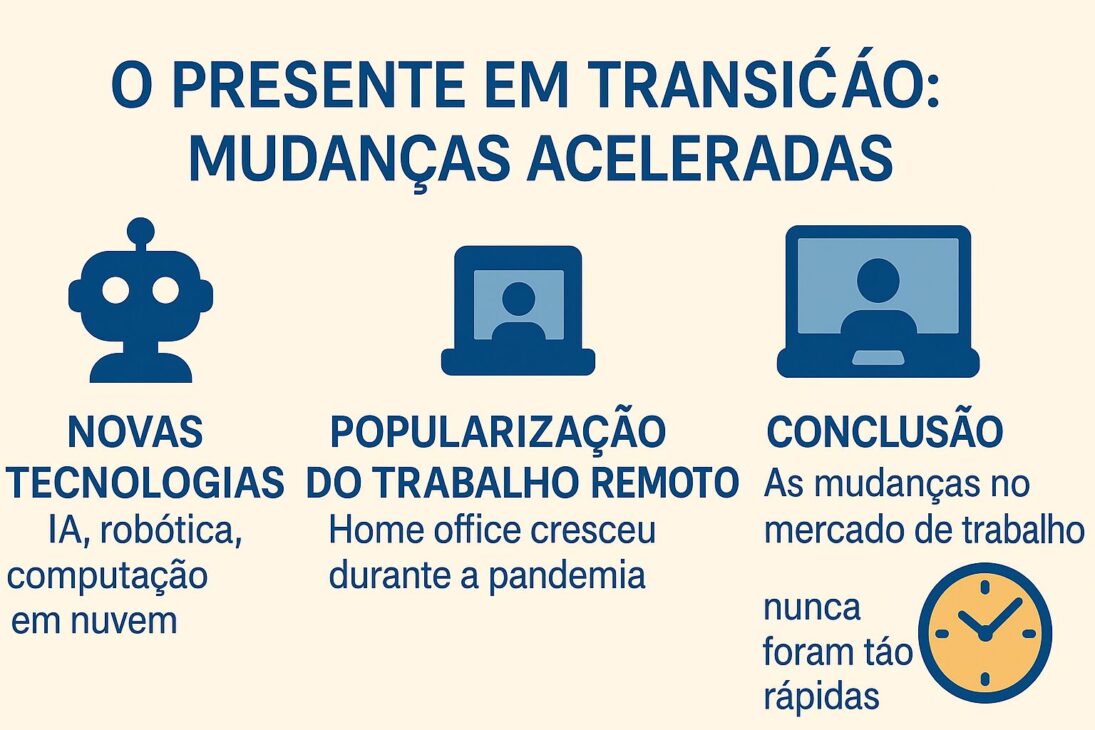
We are currently living in a moment of accelerated transition. First of all, technologies such as artificial intelligence, robotics, cloud computing, and data analysis are already part of the daily life of many companies.
Additionally, remote work has become a feasible and even preferred reality for many professionals. The COVID-19 pandemic, for example, accelerated changes that would take years to happen by several months, according to the International Labour Organization (ILO) in a 2020 report.
In this scenario, companies are increasingly seeking professionals who know how to learn continuously, who have emotional intelligence, adaptability, critical thinking, and mastery of technological tools. Consequently, the so-called soft skills have become as important as technical skills. A degree still has its value, but it is no longer a guarantee of employment.
Furthermore, the concept of career has changed. It was once common to work for decades in the same place. Today, most people change their professions throughout their lives, often in radical ways. Fixed employment is giving way to project-based work, entrepreneurship, and more flexible forms of engagement, such as remote work or the freelancing model.
Future Job Market Trends
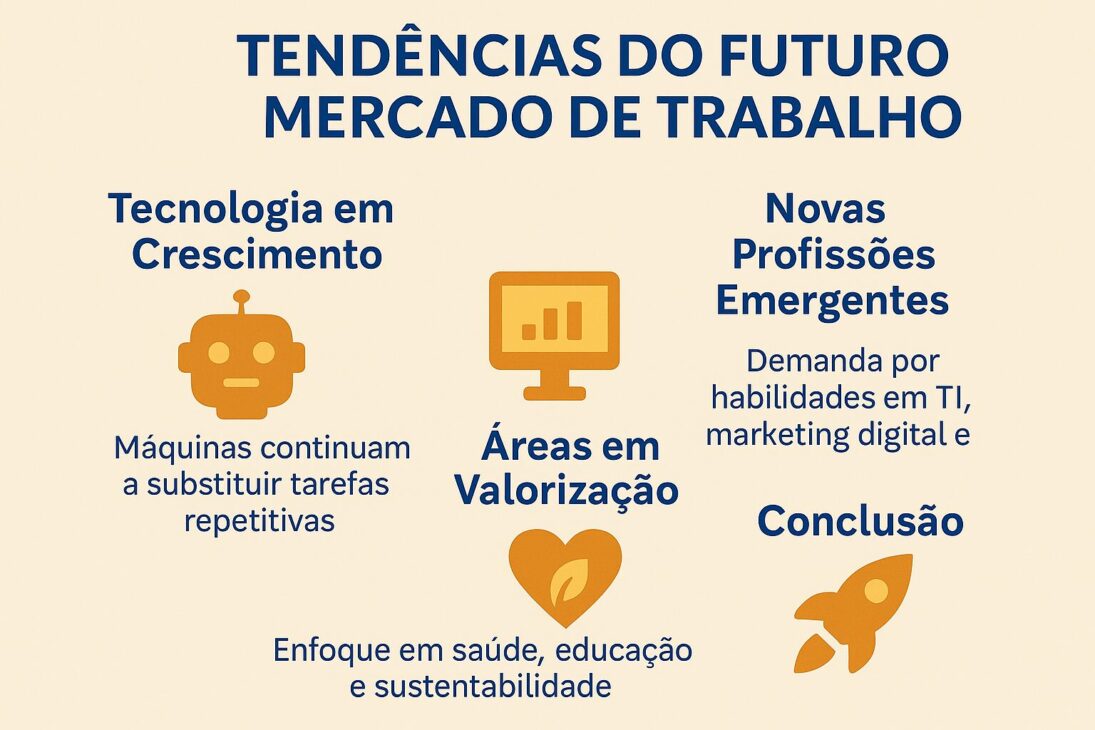
Discussing the future job market means looking at the next steps of these changes. Technology will continue to play a central role.
However, machines will continue to replace repetitive tasks, but at the same time, new professions will emerge, many of which we can hardly imagine today.
The demand for professionals in the fields of information technology, data science, digital marketing, cybersecurity, and artificial intelligence is expected to grow even more, according to the “Future of Work 2025” research conducted by PwC.
Conversely, areas such as health, education, sustainability, and human care are also gaining space, as there are limits to what machines can do. Empathy, creativity, and the ability to solve complex problems will remain exclusively human skills.
Moreover, another strong trend is the personalization of work. People want more than just a salary at the end of the month. They seek purpose, work-life balance, and environments that respect diversity.
Therefore, companies that do not understand this may struggle to attract and retain talent. According to data from the World Economic Forum, published in its 2020 report, 50% of skills required for work in 2025 are new, reinforcing the need for constant adaptation.
Education And Lifelong Learning
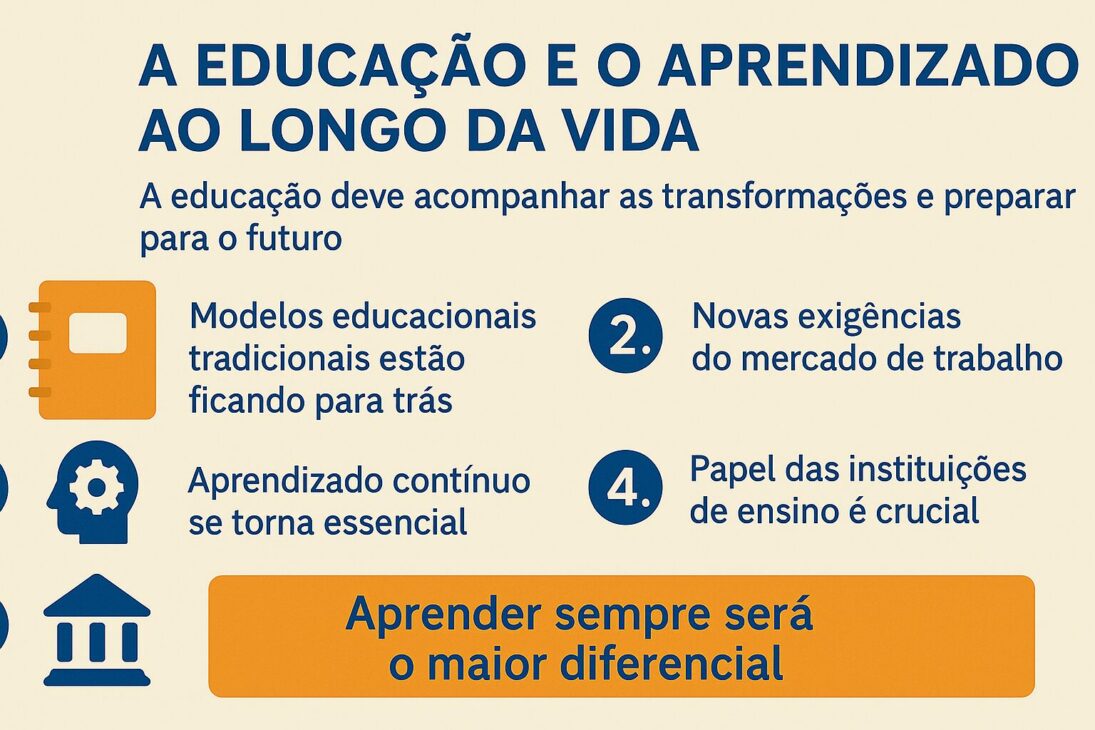
Education also needs to keep pace with these changes. Generally speaking, traditional models, focused solely on technical content and memorization, are no longer sufficient.
Therefore, it is necessary to encourage critical thinking, problem-solving, collaboration, and the use of technologies from an early age. Lifelong learning is no longer a differential — it is a requirement.
Consequently, universities and schools need to adapt, not only by offering updated courses but also by preparing students for the reality of a job market that demands more than just technical knowledge. Institutions must train professionals who know how to reinvent themselves and adjust to new demands while maintaining a curious and continuous learning attitude.
In this sense, skill-based learning, the development of behavioral competencies, and the use of new technologies will be a significant differentiator for professionals who will be ready for the future of work.
Why Does This Matter Now?
It may seem contradictory, but the future job market matters precisely because it is already happening. Thus, ignoring this reality is risking being left behind. Whether you are a student, a professional looking for a new job, or someone who wants to entrepreneur, understanding where the world is heading is essential for making good decisions in the present.
When we talk about the future, we are not just talking about technology. We are talking about people. Human beings remain at the center of everything. No matter how much the world changes, we will still need connections, a sense in what we do, opportunities to grow, and contribute to society. Work is not just a way to earn money — it is also a way to express talents, serve others, and build a better world.
Thinking about the future of work is also a way to consider the kind of society we want to build. A fairer, sustainable, collaborative, and inclusive society needs professionals who are prepared not only technically but also ethically. Professionals who understand their role in the world and who use their knowledge to make a difference.
The Future Of Work Has Already Begun
The future job market has already begun, and it calls us to an active, curious, and constantly learning posture.
Therefore, it does not matter if you are 15, 30, or 60 years old — there will always be room for those willing to adapt, develop new skills, and look to the future with hope and responsibility.
In summary, reflecting on the future of work is essential today. It is a way to prepare for challenges, seize opportunities, and build a professional trajectory aligned with the transformations of the world. The time for change is not tomorrow — it is now.










-

Uma pessoa reagiu a isso.