





 Portuguese
  English
  Spanish
  5 min of reading
  0 comments


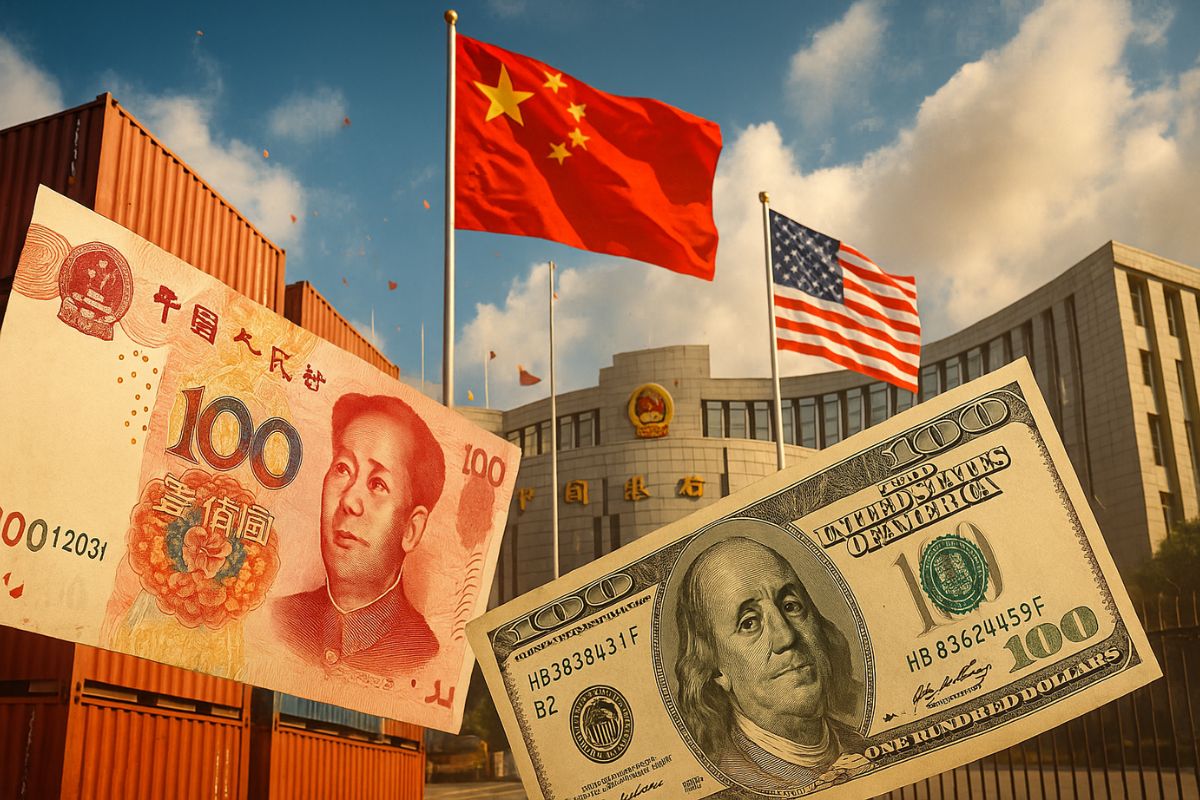
The Chinese Currency Began to Circulate More in Global Trade and Financial Operations Linked to Beijing, but the Yuan Remains Subject to Controls That Prevent the Chinese Currency from Competing with the Dollar. Even with Greater Adhesion from Global South Partners and with the Advancement of Its Own Payment Mechanisms, the Chinese Currency Still Operates in an Environment Managed by Beijing and Distant from the Liquidity Offered by the Dollar.
According to the G1 portal, the Chinese currency gained space in international operations, began to be used in a good portion of Beijing’s foreign trade, and became a piece of economic policy aimed at the Global South. Nevertheless, the Chinese currency still runs into limits imposed by the Chinese government itself and does not meet the conditions that made the dollar the main financial reference on the planet.
The expansion of the use of the Chinese currency began as a response to the vulnerability that China saw in its dependence on the dollar after the 2008 financial crisis and evolved into a long-term strategy that combines trade, credit, payment infrastructure, and bilateral agreements. The central objective is to reduce geopolitical risks and provide more autonomy to Chinese transactions, not to immediately replace the dollar in global reserves or international finance. This logic explains why the yuan is growing, but still does not threaten the American currency.
How China’s Offensive for the Chinese Currency Began
The starting point was a monetary policy decision made in 2009, when Beijing authorized companies to settle foreign trade in Chinese currency.
-
Brazilian city gains industrial hub for 85 companies that is equivalent to 55 football fields.

-
Peugeot and Citroën factory in Argentina cuts production by half and opens a layoff program for more than 2,000 employees after Brazil drastically reduced purchases of Argentine vehicles.

-
A Brazilian city gains a factory worth R$ 300 million with the capacity to process 200 thousand tons of wheat per year, a mill of 660 tons/day, silos for 42 thousand tons, and an industrial area of 276 thousand m².

-
Havan will leave the shopping mall in Blumenau to inaugurate something that the chain has never done before: a megastore in half-timbered style in the Historic Center of the city, which is expected to be completed in May and change the landscape of local retail.


At that time, the People’s Bank of China assessed that total dependence on the dollar left the country exposed to the monetary policy cycles of the United States and to the printing of money by the Federal Reserve. The chosen solution was to create its own track for real transactions, starting with the trade of goods.
Over 16 years, this alternative route has solidified. Today, about one-third of China’s exports and imports of goods can already be settled directly in Chinese currency.
This reduces conversion costs, diminishes exposure to sanctions, and gives the Chinese government finer control over who accesses its market and under what conditions. It is not an unrestricted opening to global flows; it is a calibrated opening.
Trade and External Credit as Showcases for the Chinese Currency
The expansion of the Chinese currency was not limited to goods. Beijing saw that many developing countries, especially in Asia, Africa, and Latin America, have intense trade ties with China and need financing for infrastructure, energy, and equipment purchases.
By offering credit in Chinese currency, China also exports its unit of account.
Chinese banks and financial institutions have begun to include the Chinese currency in loans, deposits, and bond issuance. Several countries renegotiated debts originally in dollars and exchanged part of those commitments for liabilities in Chinese currency, often with lower interest rates.
For those dependent on Chinese investment, this is an attractive proposal. For China, it is a way to spread its currency without giving up internal control.
This movement is compounded by the fact that Chinese state-owned enterprises already require, in various commodity operations, that a portion of the contract be paid in Chinese currency. When the bargaining power is with Beijing, the use of the Chinese currency grows more rapidly.
Parallel Financial Architecture Reinforces the Chinese Currency
China has also invested in infrastructure to ensure that the Chinese currency can circulate outside the dollar-dominated system.
It created its own system for international settlement and compensation, established clearing centers in strategic financial hubs, and tested digital yuan as a means to accelerate payments without relying on Western banks.
This tripod—trade plus credit plus infrastructure—makes the Chinese currency a real option for countries that maintain close relations with Beijing or that face restrictions in the traditional financial system. It is a strategy of autonomy, not of immediate rupture.
It allows partners like Russia, Iran, or countries with limited dollar availability to continue operating, even under sanctions pressure.
The Limit Imposed by Beijing on Its Own Chinese Currency
The brake point is precisely where the dollar has established itself as a global benchmark. The Chinese currency is not fully convertible, and the government maintains strict control over capital inflows and outflows.
This protects the Chinese banking system from external shocks and speculative attacks, but it prevents the Chinese currency from being used with the same freedom as the dollar in international financial markets.
To become a widely-used reserve currency, a currency needs to be available in large quantities, circulate in liquid markets, and operate in a predictable institutional environment.
China, for political reasons and economic model, prefers to preserve control over domestic credit and exchange rates. This choice aligns with the Chinese Communist Party’s project, but it limits the international reach of the Chinese currency itself.
Without total convertibility, investors, sovereign funds, and central banks have less incentive to maintain large positions in Chinese currency. The result is that the yuan’s share in global reserves is growing gradually but remains far from the levels of the dollar and even from currencies like the euro.
Why the Dollar Still Dominates
The dollar remains at the center of the system because it combines factors that the Chinese currency does not yet offer to the world: market depth, institutional trust, availability of assets, legal security, and free circulation. The United States issues the asset that everyone wants and, at the same time, maintains open and predictable markets.
China offers trade integration and financing but does not provide the same degree of financial openness.
Another element that favors the dollar is the very moment of the Chinese economy. The country faces a slowdown in domestic consumption, a weakened real estate sector, and excess industrial capacity. This makes China even more dependent on exports and goodwill from its partners.
If Beijing tries too hard to force the use of the Chinese currency in international contracts, it may encounter resistance from countries that prefer to maintain flexibility in their currency choice.
In summary, the growth of the use of the Chinese currency is real, planned, and consistent with Beijing’s ambition to reduce external vulnerabilities.
However, this is not an offensive to overthrow the dollar tomorrow, but rather a gradual construction of tools so that China is not held hostage to decisions made in Washington.
The Chinese currency has already shown it can occupy more space in international trade and financing, especially among countries that depend on China.
But as long as Beijing prioritizes exchange rate control and command over domestic credit, it will itself place a ceiling on the internationalization of the yuan.









-

Uma pessoa reagiu a isso.