





 Portuguese
  English
  Spanish
  5 min of reading
  0 comments


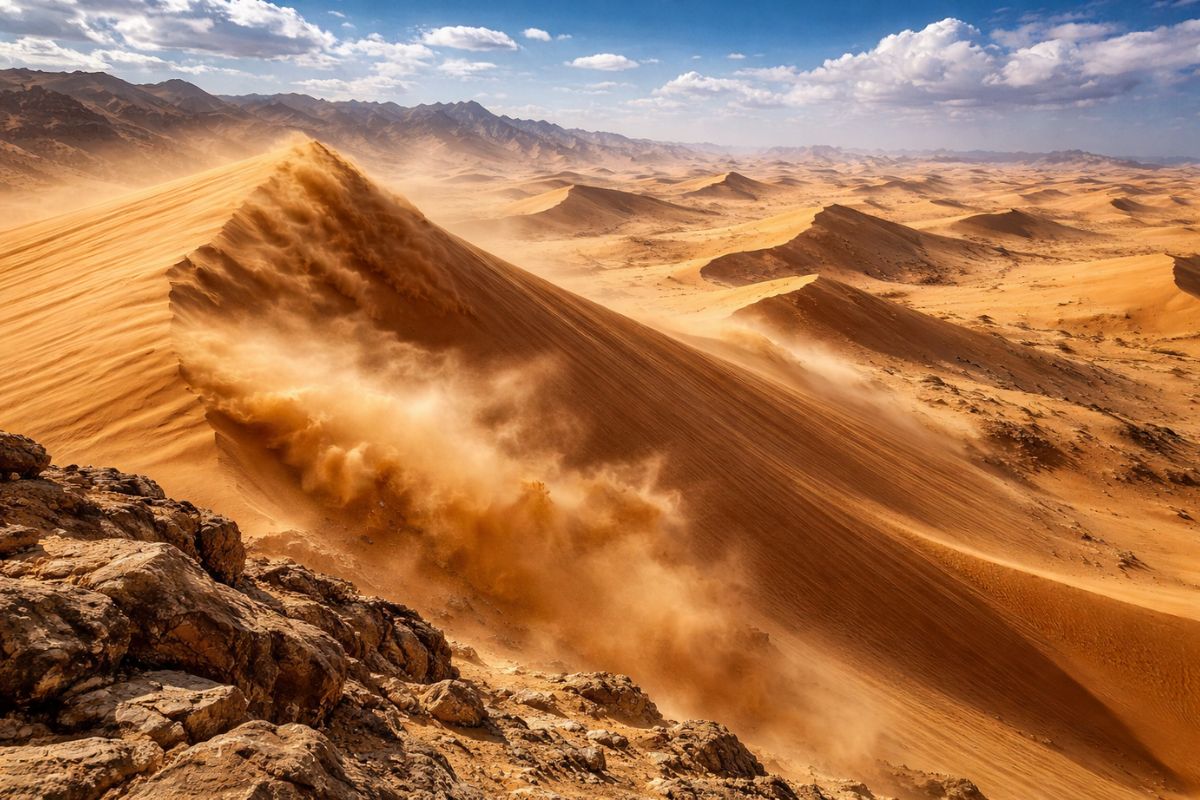
Wind, Erosion, Dunes and Millions of Years Help to Understand Why the Desert Accumulates So Much Sand Even with Very Little Rain.
The classic image of the desert with endless dunes hides a process that is much more complex than it seems. Over millions of years, rocks were broken down, crushed and carried by the wind until they transformed into fine grains, which today form some of the planet’s most extreme landscapes.
When someone asks why there is so much sand in the desert if it hardly rains, the answer is not in the lack of rain, but in the combination of dry climate, intense erosion, persistent winds and huge scales of geological time. What today seems like a sea of sand began as solid rock, exposed to the sun, cold and winds for entire eras.
Desert Is Not Synonymous with Sand
Despite the immediate association, most deserts in the world are not made up of dunes, but rather exposed rocks, pebbles, gravel and hardened soils. In many places, the desert is a vast field of stones, not a carpet of soft sand like in the movies.
-
Motorola launched the Signature with a gold seal from DxOMark, tying with the iPhone 17 Pro in camera performance, Snapdragon 8 Gen 5 that surpassed 3 million in benchmarks, and a zoom that impresses even at night.

-
Satellites reveal beneath the Sahara a giant river buried for thousands of kilometers: study shows that the largest hot desert on the planet was once traversed by a river system comparable to the largest on Earth.

-
Scientists have captured something never seen in space: newly born stars are creating gigantic rings of light a thousand times larger than the distance between the Earth and the Sun, and this changes everything we knew about stellar birth.

-
Geologists find traces of a continent that disappeared 155 million years ago after separating from Australia and reveal that it did not sink, but broke into fragments scattered across Southeast Asia.

The dune areas occupy only a fraction of these environments. They arise where the desert offers the right combination: sources of sediment, strong winds and little or no type of vegetation to hold the soil in place. In these special zones, sand can accumulate, reorganize and form large mobile structures.
Where the Desert Sand Comes From
The sand of the desert did not appear all at once. It originates from the slow and continuous erosion of rocks, in a process that takes thousands and even millions of years. In desert regions, extreme temperature variations constantly work against the rocks.
During the day, the heat causes the rock to expand. At night, the sharp drop in temperature causes contraction. This daily cycle leads to cracks, chips, and fragments that break off from the larger structures.
Over time, these rock fragments continue to break down, getting closer to the typical size of sand grains.
The wind plays a leading role in this stage. As it blows, it lifts, drags, and causes the grains to collide with each other, rounding off the particles and further wearing down the material.
Each impact removes small portions of rock, thinning and polishing the sediment until it becomes light enough to be transported over long distances.
How the Wind Shapes the Desert Over Millions of Years
The wind does not create sand, but selects and organizes what remains from erosion. Very large grains cannot be easily moved, so they stay closer to their origin.
Very fine particles, like dust, can be lifted and transported hundreds of kilometers away, leaving the original area almost clean.
What remains in the desert is a “middle ground”: grains of the ideal size to be dragged, bouncing close to the ground and being deposited a little further ahead.
This repeated movement does not happen over days or months, but rather over immense periods of geological time, during which small amounts of sediment accumulate and get reorganized.
Throughout these endless cycles, entire fields of dunes arise, recede, advance, and change shape according to the direction and intensity of the winds.
Visually, the desert seems static, but on a scale of decades and centuries, its forms are constantly changing.
Why So Much Sand Accumulates in Certain Parts of the Desert
Not every desert turns into a sea of dunes. For that to happen, several factors need to work together for a long time:
In regions with a large availability of exposed rocks, erosion breaks the solid material into smaller fragments.
Then, the wind takes over to concentrate the sand where there is not enough vegetation to hold the soil, pushing the grains toward areas with more favorable terrain.
Over time, these deposition zones transform into true reservoirs of sand, where the dunes grow, advance, and reorganize nonstop.
Even without rain, the constant flow of wind ensures that the landscape remains alive, with shapes that move slowly but never stay exactly the same for long.
Little Discussed Curiosities About the Desert
When talking about the desert, many people imagine only heat and sand, but some details help to better understand this type of environment.
In many cases, the sand in the desert tends to be rounder than the sand on the beach, precisely because it spends so much time in motion, hitting and scraping grain against grain.
Another curiosity is that not all sand is the same. Composition and color vary according to the type of rock that gave rise to the grains. There are deserts with lighter, darker and even reddish sand, resulting from specific minerals present in the original material.
In some places, the dunes have occupied areas that were once the sea floor or even forests, leaving behind records of environments very different from the current one.
Moreover, the desert dunes are always in motion, even though this movement may be imperceptible in a single day. Over the years, they can completely change position, swallow roads, advance over cities, or recede, leaving behind surfaces that were once covered by sediments.
What Science Explains About Deserts
Science seeks to understand deserts precisely because they are extreme environments and at the same time very sensitive to climate change. Processes such as erosion, weathering, sediment transport and wind dynamics help explain why these places accumulate so much sand.
In educational content, such as that produced by scientific communication channels, the formation of the desert is presented as the result of millions of years of joint action between dry climate, little water, constant wind and slow transformation of the Earth’s crust.
The difference between sandy and rocky deserts is often used to show that the landscape we see today is just a snapshot of a much longer story.
The Desert as a Living Record of the Planet’s History
The large amount of sand in the desert is not a sudden phenomenon, nor a “mystery” linked to the lack of rain.
It is the final product of an almost infinite sequence of natural processes, which begin with the breaking of rocks and end with the organization of grains into giant dunes.
The desert, which at first glance seems empty, serves as a natural archive of the Earth’s geological history. Each dune, each layer of sand, and each field of stones records a piece of the interaction between climate, terrain, wind, and deep time.
Far from being static landscapes, deserts are environments in constant transformation, where sand never stops moving.
And you, when you look at a desert, what impresses you the most: the vastness of sand, the silence of the place or the idea that there have been completely different environments there?







-

Uma pessoa reagiu a isso.