





 Portuguese
  English
  Spanish
 7 min of reading
  0 comments


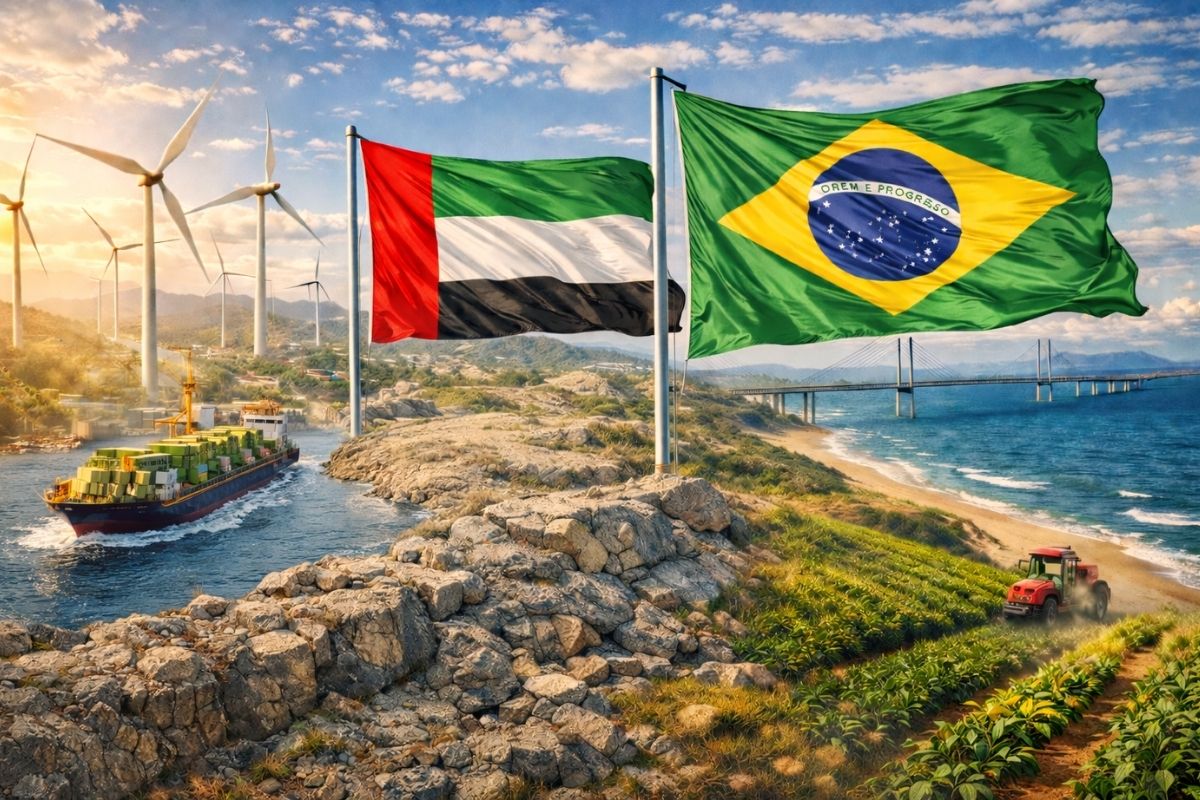
With Billion-Dollar Sovereign Funds, The United Arab Emirates Eye Bahia for Energy Transition, Infrastructure, and Bahian Agribusiness in a Post-Oil Strategy.
With a GDP of around US$ 550 billion and just over 10 million inhabitants, the United Arab Emirates have built one of the most influential economies in the Middle East and are now using their sovereign funds to invest in clean energy, infrastructure, and agribusiness in Bahia as part of their post-oil diversification strategy.
Supported by large oil reserves and an aggressive diversification policy, the country has channeled resources into tourism, infrastructure, and acquisition of global assets, placing funds such as ADIA, Mubadala, and ICD among the largest investors in the world. In recent years, these sovereign funds from the United Arab Emirates have begun to see Brazil, and especially Bahia, as a strategic platform for renewable energy projects, biofuels, logistics, and agribusiness with long-term regional impact.
Who Are the United Arab Emirates and Why Do They Need to Diversify?
With around US$ 550 billion in GDP and a relatively small population, the United Arab Emirates have consolidated a model based on oil but are focused on reducing that dependence.
-
The government requests the Federal Revenue Service for a new system to automate the income tax declaration, reducing errors, time, and bureaucracy for millions of Brazilians.

-
Pix in installments, international Pix, and contactless payment without internet: the Central Bank revealed the new features coming to the tool that is already used by almost every adult in Brazil.

-
Mercado Livre has just started selling medications with delivery in up to three hours to your door, and this move could completely change the way Brazilians buy medicines on a daily basis.

-
In Dubai, rising tensions from the war in the Middle East are causing super-rich individuals to leave the Gulf and direct their fortunes to a new financial refuge in Asia.


Oil revenue has fueled significant internal transformations, creating global hubs such as Dubai and Abu Dhabi and financing the expansion of companies and assets around the world.
Today, a significant portion of this wealth is managed by trillion-dollar sovereign funds, such as ADIA, Mubadala, and ICD, which operate with long-term logic.
The goal is not only to maximize financial return in the short term but to build resilient portfolios aligned with energy transition, infrastructure, and sectors considered strategic for the post-oil era.
Why Brazil Became the United Arab Emirates’ Platform in Latin America
The decision by the United Arab Emirates to use Brazil as a base for their investments in Latin America did not happen overnight.
Like other global sovereign funds, they follow strict criteria in allocating capital: institutional stability, economic diversification, potential for structural growth, and the ability to generate sustainable returns over decades.
In this scenario, Brazil stands out compared to its South American neighbors. Instead of relying on one or two sectors, the country combines a highly competitive agribusiness, a relevant industrial base, a broad services sector, a relatively sophisticated financial market, and an increasing role in renewable energy.
For the United Arab Emirates, this diversity reduces systemic risks and makes the country more resilient to external shocks, such as commodity crises or regional turbulence.
Additionally, the long-term expansion potential weighs heavily. An internal market of over 220 million inhabitants, still incomplete urbanization, a historical infrastructure deficit, and the need for modernization in logistics, sanitation, transportation, and energy create a wide array of large-scale projects, exactly the type of assets that interest sovereign funds.
Diplomacy, Neutrality, and Geopolitical Security


Another factor that favors Brazil in the eyes of the United Arab Emirates is the way the country positions itself in the region. Historically, Brazil has remained relatively neutral in geopolitical disputes in South America, avoiding taking on roles of direct confrontation.
In recent crises, such as the tensions between Venezuela and Guyana over the Essequibo territory, Brazil acted cautiously and pragmatically, which reinforces its image as a predictable actor.
For external investors, this matters. Brazil is seen as a stable strategic asset, less exposed to sanctions, trade retaliations, or regional conflicts.
This diplomatic stance has helped Brazil establish itself as an investment platform in Latin America, functioning as a neutral space where the interests of different powers can coexist economically.
Why So Much Money from the United Arab Emirates is Ending Up in Bahia
If Brazil as a whole offers opportunities, the central question is: why are so many resources from the United Arab Emirates concentrating specifically in Bahia?
The answer lies in a combination of history, energy, logistics, and agribusiness. In 2021, the Mubadala fund, responsible for managing part of Abu Dhabi’s oil resources, acquired the Landulfo Alves refinery in Bahia.
In 2023, the same fund committed to building a green diesel and sustainable aviation fuel plant, with potential investments reaching 12 billion reais over ten years.
Additionally, the United Arab Emirates see Bahia as a strategic hub for green hydrogen projects, taking advantage of the integration between wind, solar, and other renewable sources.
The energy matrix of Bahia, already strongly supported by clean energy, aligns directly with the priorities of Arab sovereign funds, which seek assets aligned with decarbonization and the global energy transition.
Bahia as a Leader in Brazil’s Energy Transition
Bahia did not just enter the country’s energy map. Historically, the state was one of Brazil’s first oil producers, built a robust industrial base linked to the sector, and developed specific infrastructure, such as the Camaçari petrochemical complex, which brings together dozens of chemical, petrochemical, and other industrial companies.
In recent years, Bahia has taken a prominent role in the energy transition, maintaining its position as the leading state in wind and solar energy generation in the country. This consistent advancement has created a favorable ecosystem for integrated projects in renewable energy, biofuels, and associated logistics.
For sovereign funds from the United Arab Emirates, which prioritize businesses capable of combining financial return with alignment to global climate goals, this energy diversity becomes a central attraction.
Instead of relying on a single vector, the state offers a complete portfolio: large-scale renewable energy, advanced biofuels, structured port logistics, and a consolidated industrial base.
This enables the creation of integrated value chains that go from production to the export of high-demand derivatives in the low-carbon economy.
Logistics and Geographic Position Engaging Sovereign Funds
The geographic position of Bahia also weighs heavily in the equation. Facing the Atlantic, Bahia serves as Brazil’s closest gateway to Africa, Europe, and the Middle East, shortening routes and reducing logistics costs.
The state has a port network capable of handling industrial products, energy, and commodities on a large scale, with movement reaching tens of millions of tons in a single year.
For investors from the United Arab Emirates, who consider global hubs of energy, fuels, and derivatives, this combination of strategic location and port infrastructure makes Bahia a natural platform for exporting clean energy and products associated with the energy transition.
Bahian Agribusiness and the Food Security of the United Arab Emirates
Bahia is not just about energy. The state is also one of the country’s major food producers, with a focus on crops such as soybeans, corn, and cotton, as well as fruits, cocoa, and other strategic crops.
Bahian agribusiness accounts for about 22.5% of the state’s GDP and half of its exports, establishing itself as one of the pillars of the local economy.
For the United Arab Emirates, which face a hostile climate and experience low domestic food productivity, investing in productive agricultural regions means reducing structural vulnerabilities and ensuring stable access to food and agro-industrial inputs.
By reinforcing their presence in Bahia, sovereign funds enhance their food security indirectly while capturing financial returns in one of the most competitive agribusiness sectors in the world.
Bahia as a Hub of Innovation, Energy, and Arab Capital
In investing in Bahia, the United Arab Emirates are not just seeking passive income. Each capital allocation is designed to build a portfolio with a real capacity for regional transformation.
This includes renewable energy, biofuels, port infrastructure, logistics, and potentially new fronts such as technology applied to agribusiness and industry.
If the state can seize this movement, it can expand partnership with sovereign funds beyond energy and agribusiness, attracting capital for tech parks, applied research centers, and startups focused on sustainability, agribusiness, and technology-based industry.
In this scenario, Bahia consolidates itself as a major hub for distribution, production, and innovation directly connected to the capital of the United Arab Emirates.
What Bahia Needs to Do to Stay on the Radar of the United Arab Emirates
Despite the advantages, nothing guarantees that this window will remain open forever. To remain in the sights of the sovereign funds from the United Arab Emirates, Bahia needs to project predictability, economic stability, and legal security, along with clear policies for attracting and retaining foreign capital.
This means maintaining a transparent regulatory environment, strengthening institutions, organizing long-term projects in partnership with the private sector, and aligning local agendas with major global trends of decarbonization, energy efficiency, and food security.
If it can achieve this, the state is likely to increase Arab investments in sectors still on the rise, such as high-tech agribusiness, green industry, and integrated infrastructure.
In the end, the United Arab Emirates are using Bahia as a strategic piece in their post-oil diversification, combining clean energy, logistics, industry, and food production to build a future less dependent on the oil that financed their rise.
After understanding why the United Arab Emirates are investing so much in Bahia, do you think the state should prioritize energy, agribusiness, or technology as the main target for these new billions in investment?








-

-

-

4 pessoas reagiram a isso.