





 English
  Francês
  Alemão
  Italiano
  Japonês
  Norueguês
  Portuguese
  Spanish
  3 min of reading
  0 comments


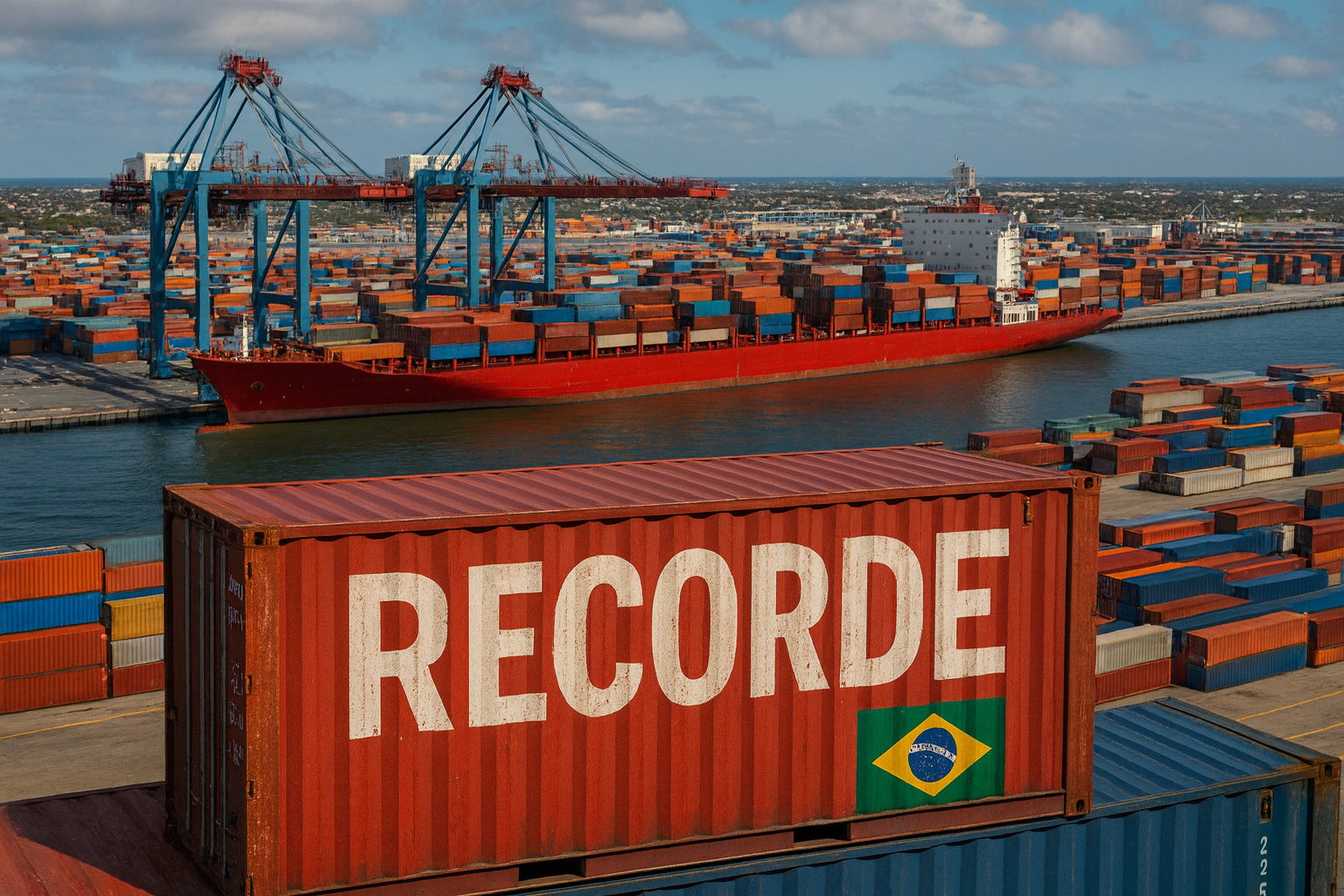
Best Monthly Result in History Reinforces Strategic Role of Port Logistics in Brazilian Economy
In July 2025, Brazilian ports registered the highest monthly cargo volume in history, reaching 124.7 million tons, according to the Federal Government’s Social Communication Secretariat.
This performance is unprecedented and, therefore, marks a fundamental advance for the sector. Moreover, it reinforces Brazil’s role in global logistics chains.
Year-to-Date Accumulation Confirms Consistent Growth
From January to July 2025, port activity totaled 780.4 million tons, representing 1.76% growth compared to the same period in 2024.
-
Unemployment rises again to 5.8% at the beginning of 2026, raising alarms about the end of temporary positions and its impact on the Brazilian job market.

-
Document organization can cut invisible costs in small businesses, a simple step that prevents waste, rework, and losses in daily operations.

-
Chinese giant worth nearly R$ 4 billion that manufactures cables for electric cars, solar energy, and robotics wants to open a factory in SC.
-
Many employers do not know, but the law guarantees domestic workers a 25% increase in salary during trips, 50% for overtime, 20% for night shifts, and 17 additional benefits that can lead to labor lawsuits if not paid.


- 73% of the movement was allocated to deep-sea navigation, that is, exports and imports.
- 20% corresponded to cabotage, conducted between national ports.
- The remaining portion included other types of maritime transport.
Thus, the performance not only ensures economic stability but also strengthens the trade balance. In addition, it demonstrates the resilience of the port sector.
Government Prioritizes Investments and Concessions
In August 2025, the Minister of Ports and Airports, Silvio Costa Filho, declared that the government will continue to expand port infrastructure.
According to the minister: “Our focus is to ensure legal security and attract private capital. This policy, led by President Lula, strengthens port capacity and expands exports”.
Thus, the government reaffirms the importance of modernizing terminals. Furthermore, it guarantees that expansion is essential to ensure competitiveness in the global market.
Solid Bulk Dominates Movement
The highlight of July was the movement of mineral and vegetable solid bulk, which totaled 76.6 million tons.
Additionally, all cargo categories grew compared to July 2024, confirming the consistency of the sector’s evolution.
- Liquid bulk, focusing on fuels, saw a 6% increase.
- Solid bulk grew by almost 4%.
- Containerized cargo increased by 3%.
- General cargo recorded a growth of 0.9%.
Therefore, the diversity of cargo ensures greater balance. In addition, it strengthens Brazil’s position against fluctuations in the international market.
Port Logistics as an Economic Engine
The numbers from July 2025 and the year-to-date accumulation highlight that investments in infrastructure have a direct impact on national competitiveness.
Thus, the combination of commodity exports, cabotage, and containerized transport ensures logistical efficiency. Moreover, it contributes to economic stability and job creation.
July Summary in Numbers
- 124.7 million tons moved, the highest volume in history.
- 73% allocated to international deep-sea navigation.
- 1.76% accumulated growth between January and July 2025.
- Solid bulk above 76.6 million tons.
- All cargo categories registered growth.
Therefore, the indicators confirm that ports are at the center of the national economic strategy. Moreover, they show the decisive role of the sector in foreign trade.
Outlook for the Remainder of 2025
According to the Ministry of Ports and Airports, the expectation is for continuous growth until the end of 2025. This will occur, especially, due to the boost from agribusiness and mining.
Additionally, new private investments in port terminals and concessions planned for this year should increase capacity and reduce bottlenecks.
In summary, the record of July 2025 represents a historical milestone for Brazilian logistics. Furthermore, it proves that the combination of concessions, investments, and cargo diversity is essential for strengthening the economy.
What do you think is more important for the future of Brazilian ports: rapid expansion to take advantage of the positive scenario or gradual growth, prioritizing sustainability and innovation? Share your opinion!










-

-

-

-

-

6 pessoas reagiram a isso.