





 Portuguese
  English
  Spanish
 6 min of reading
  0 comments


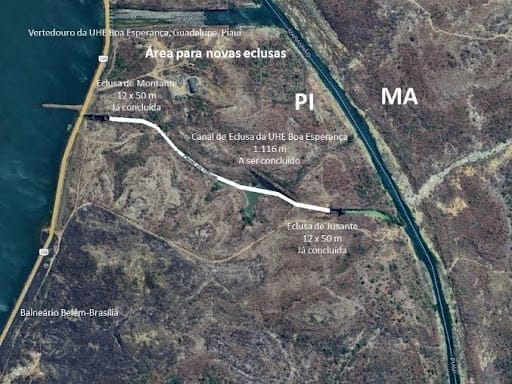
Hydroelectric Power Plants in the Parnaíba Boost Water Security, Renewable Energy, and Navigation, Fundamental for Economic Development and the Energy Security of the Future.
Hydroelectric power plants play a fundamental role in water security and in the production of renewable energy, significantly contributing to the navigability of rivers and regional economic development. In the Parnaíba River, new plants are being built and will have an impact far beyond energy generation, helping to ensure a more secure and stable energy future. These initiatives are vital to mitigate the effects of severe droughts that frequently hit the region, and to ensure long-term sustainability.
The construction of these hydroelectric power plants in the Parnaíba also involves the creation of new dams, which play a crucial role in managing water resources. The dams help stabilize river flow, improving navigability and water storage, essential for facing drought periods. In addition to providing energy, these hydroelectric power plants boost regional infrastructure, promoting the integral development of local communities and strengthening resilience against adverse climate events.
In 90% of the affected cities, there was a lack of even potable water, which led the government to declare an ’emergency’ in 204 localities, following a severe drought that caused immense suffering and losses to over two million people. Over three years, livestock, farming, and crops were completely compromised, and water reservoirs nearly dried up, like the Bocaina Dam, which has 54 million cubic meters.
-
Oncorp wins auction and enables biodiesel and gas thermal plants in Brazil, with strategic projects in Suape and Xavantes Aruanã.

-
Raízen Recovery: Shell Cosan May Reduce Control After R$ 65 Billion Debt

-
Outback Montes Claros: Chain Confirms First Unit in Northern Minas in 2026

-
Inpasa Creates Advisory Council and Brings José Olympio to Strengthen Corporate Governance


Scientific Studies on Climate Events
Several studies, including those by Mead, Clayton, Schell, and Haurwitz, have proven a direct relationship between the 11-year solar cycle and terrestrial hydrology, resulting in floods and droughts that occur, on average, every 11 to 12 years. These events are also influenced by local factors. It is striking that, despite these natural predictions, the unpredictable behavior of human society in face of such extremes of drought and floods continues to be a constant, preferring to take risks, quickly forgetting past experiences.
The term of the governor of the state of Rio Grande do Sul, Eduardo, is a recent example of this recklessness, as he has ignored the water security of the areas under his administration, even after being alerted years ago by experienced scientists and technicians. Apparently, the prevailing rule in Brazil is: ‘why spend money to prevent a drought or a flood that is not happening right now?’ Voters and administrators tend to forget that engineering works, which take more than 10 years to be planned, licensed, and built, work effectively and have a long lifespan.
Importance of Hydroelectric Energy
The World Economic Forum in Davos positioned Brazil in 12th place globally in the Energy Transition Index (ETI), being the first in the Americas and the third among G20 countries. This assessment was due to Brazil’s commitment to hydroelectric energy, solar, wind energy, and biofuels, encouraging investments in sustainable infrastructure. At the event in Teresina, during the Dialogue Panel ‘Innovations and Sustainability of Hydroelectric Power Plants’ of the International Conference on Renewable Energy Technologies, promoted by the State Government, UNDP, and ICIMA, I highlighted that Piauí has already reached third place in installed capacity of solar and wind energy in Brazil.
Although my invitation emphasized solar and wind energy, I reminded everyone of the importance of hydroelectric power plants, particularly the UHE Boa Esperança, which has produced 97% of the state’s needs since 1968. I assume that Piauí’s proposal also involves generating hydrogen using renewable sources, aiming to sell this gas as a cheap commodity for the steel and fertilizer industries in Europe. During the event, while thanking Governor Rafael Fonteles, I was warmly received, and he reinforced the importance of hydroelectric plants as permanent sources of water storage.
Debate on Energy and Food Security
During the three days of CITER, there were over 45 debates among experts and businesspeople from major global economies, including SPIC, the owner of the Marangatu photovoltaic plant and the São Simão hydroelectric plant. In these debates, the inconsistency of producing green hydrogen with up to 48% fossil thermal power plants in the energy matrix was addressed. The International Renewable Energy Agency (IRENA) defines green hydrogen as that derived from water electrolysis using exclusively electricity from renewable sources. The European Union, on the other hand, intends to include the production of green hydrogen from natural gas with carbon capture and storage, which would increase the fuel cost.
Sources of Green Hydrogen Generation
In Brazil, the Ministry of Mines and Energy proposes a concept similar to that of IRENA, focusing on low carbon emissions throughout the hydrogen lifecycle. The production of hydrogen is highly dependent on the cost of electricity; therefore, green, yellow, blue, or colorless hydrogen is not an energy source in itself, but a fuel with high calorific power. Its cost depends on the energy sources used for its production and the environmental costs associated with these sources.
Energy sources are classified as intermittent or permanent. Intermittent sources, such as solar and wind, are not controllable, while permanent sources, such as hydroelectric and thermal power plants, are controllable. Thermal power plants, in particular, are more expensive and more polluting compared to hydroelectric plants. Therefore, to produce green hydrogen using solar energy, it is crucial to have a permanent source to complement during hours without sunlight. Only hydroelectric and thermal power plants provide this continuity.
Investments and Water Security in Piauí
Choosing hydroelectric plants to complement green hydrogen production brings additional benefits such as replenishing underground water reserves, facilitating irrigation, supporting fish farming and fruit cultivation, controlling floods, combating drought, and regulating water levels, contributing to water security. Moreover, they enable river navigation, tourism, and recreation. Ignoring these options increases dependence on thermal power plants during night and cloudy days, jeopardizing water security until the next drought.
The lack of new hydroelectric plants in the national energy matrix has resulted in thermal power plants currently representing 38% of the installed capacity. According to the Ten-Year Energy Expansion Plan, developed by MME, this proportion could reach 48% in the critical months between 2026 and 2030. The increasing use of fossil thermal power plants contradicts Brazil’s environmental commitments and hinders the production of genuine green hydrogen.
Plans for Waterways and Hydroelectric Plants
Hydroelectric plants and waterways are essential for Brazil’s agricultural and industrial competitiveness. In Parnaíba, ANEEL has inventoried eight hydroelectric plants, all with environmental licenses and designed with locks. These plants serve municipalities in several states and could generate more than 115 million reais per month and 24 million in ICMS. An investment of 12.16 billion made by private companies would reduce dependence on fossil fuels and ensure energy security for the future.
The construction of locks on Brazilian rivers, similar to the model of the Tennessee Valley Authority (TVA) in the USA, would contribute to water security, navigability, and food security in the country. In addition to promoting tourism activities, recreation, and relocating submerged banks. However, Brazilian waterways are underutilized due to powerful opposing interests that prefer investments in road transport and high freight costs, reducing our international competitiveness.
Initiatives for Strategic Regional Planning
The World Economic Forum in Davos highlights the importance of hydroelectric plants for renewable energy in Brazil. The ability to generate continuous and stable energy puts the country in a strategic position. Waterway and hydroelectric projects must follow the precautionary principle to ensure long-term economic and social viability, socioeconomically in Piauí, similar to the development structured by the TVA in the USA. The TVA showed how multifunctional management of water resources can bring significant economic, social, and environmental benefits.
In Parnaíba, it is crucial to consider the long-term impacts of dredging without level regulation; just recall the failures of uncoordinated planning initiatives, as seen in the Amazon. An integrated project that reconciles water security, navigability, and sustainable resource use could transform the region, generating wealth and opportunities.
In conclusion, the development and water security of Piauí and other regions depend on careful planning and the implementation of projects that reconcile public and private interests. The Regional Strategic Planning and Development Program should be the key to this success, facilitating the necessary collaboration to achieve common goals of sustainability and economic growth.
Source: ENERCONS










Seja o primeiro a reagir!