





 Portuguese
  English
  Spanish
 4 min of reading
  3 comments


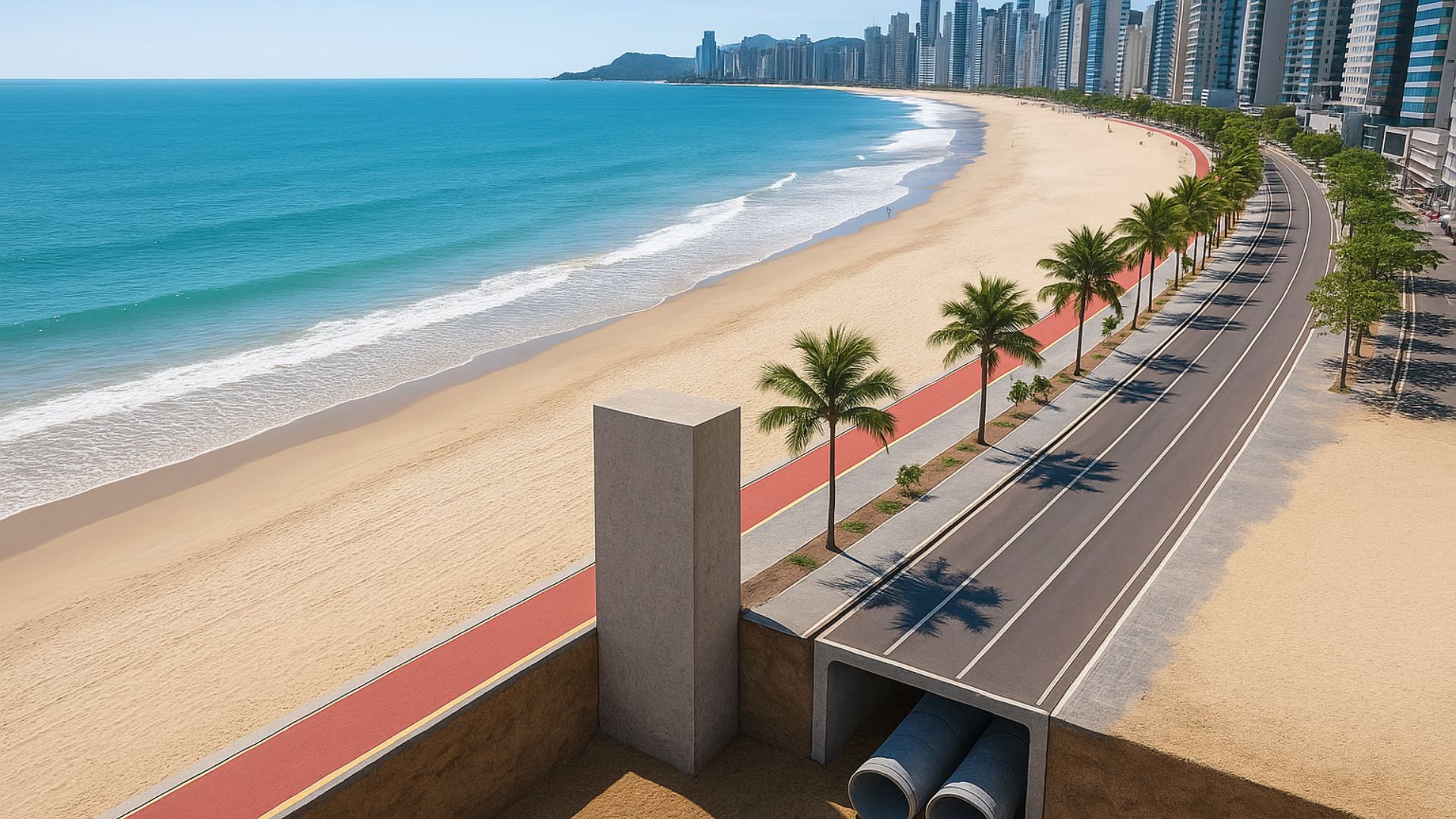


Underground Structure in Balneário Camboriú Combines Retention, Drainage, and Urban Revitalization in a Large-Scale Project Aiming to Protect the Waterfront Against Erosion and Flooding and Transform Public Space with New Amenities and Landscaping.
An underground wall of 6 km has begun to be implemented at the Central Beach of Balneário Camboriú to contain erosion and protect the waterfront after the artificial widening carried out in 2021.
The first phase, covering 1.5 km between Rua 3920 and the Barra Sul jetty, has been underway since August 2025 and is part of the beachfront revitalization package.
The project foresees 20 months of work and an investment of R$ 34.83 million, encompassing infrastructure and public lighting.
-
A couple buys an old chalet, breaks the kitchen floor for renovation, and finds over a thousand coins of gold and silver hidden since the English Civil War over 4 centuries ago.

-
Rigid bags with their days numbered: new trend prioritizes comfort in 2026.

-
YouTuber creates an excavator equipped with a giant 4.5-meter sword to challenge his brother to a rematch, and the invention quickly goes viral on social media.
-
The U.S. Army surprises the world by presenting the UH-60MX Black Hawk helicopter capable of flying without pilots, controlled by a tablet, featuring the MATRIX system, smart sensors, and full autonomy in real combat and rescue missions.

In parallel, the city is implementing a macro-drainage system designed to drain up to 12 thousand liters per second to reduce flooding during rainy days and high tides.
Underground Retaining Wall
The structure is built at the boundary between the sandy area and the boardwalk, below the surface, to act as a physical barrier against the advance of the sea and sediment movement.
The portion under construction uses reinforced concrete supported on a stone base of the type rachão, a solution used in coastal works due to its resistance and stability.
According to municipal planning, construction proceeds in successive segments to mitigate impacts on beach access and pedestrian circulation.
The choice of an underground wall meets the goal of enhancing protection without altering the landscape.
As the interventions progress, the surroundings include signage and fences with controlled passages, allowing for the continuity of tourism and commercial activities along the waterfront.
Beach Widening and Coastal Dynamics
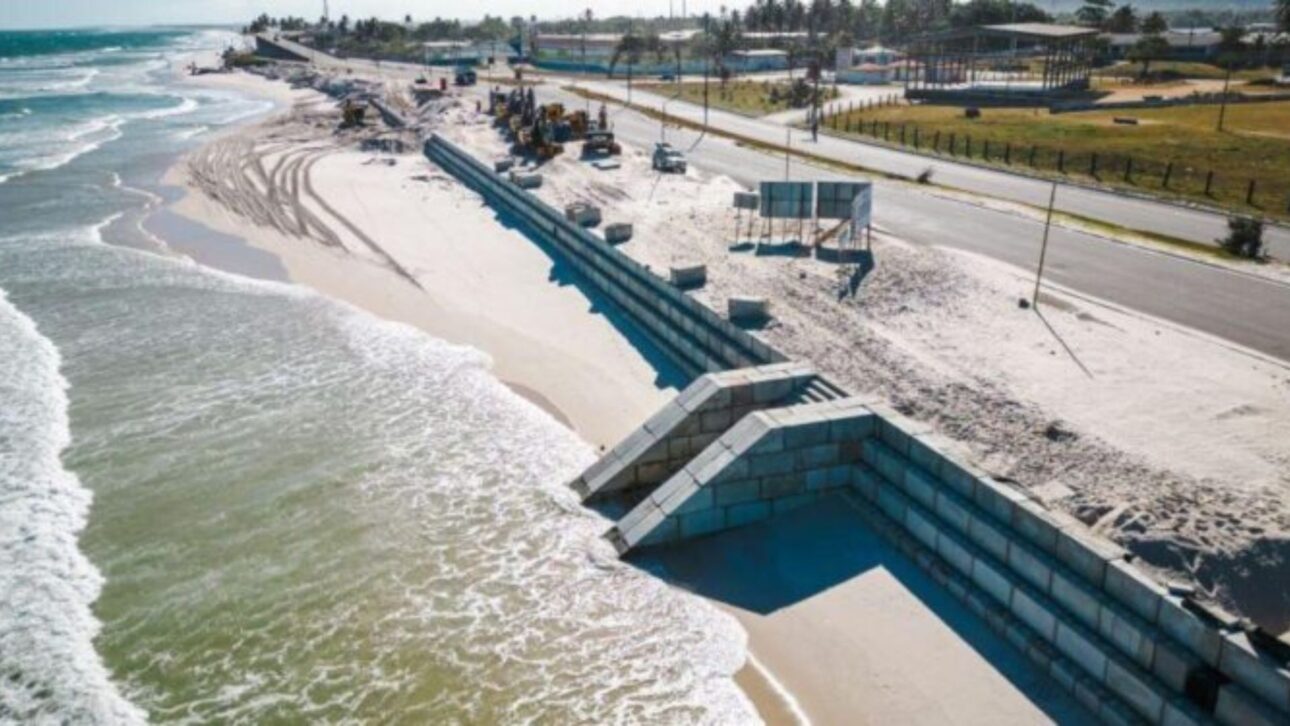
The artificial widening completed in 2021 expanded the sandy area from approximately 25 to 70 meters.
The intervention increased leisure capacity and protection of the coastal avenue, but required additional adjustments to handle new water and sand circulation patterns.
During high tide and storm events, puddles and points of water accumulation formed, as well as local lowering of the coastal profile in specific sectors, reinforcing the need for permanent containment and drainage works.
In this context, the underground wall acts as a structural safety element of the waterfront and a component of the long-term plan to keep the beach stable during extreme events.
The design follows the geography of the boardwalk and considers variations in tide and temporary lowering of the water table during construction.
Macro-Drainage System Against Flooding
The city hall has implemented an integrated macro-drainage system to the new waterfront, with large-scale stormwater drains and emergency outlets aimed at increasing drainage flow.
In critical conditions, the structure reaches a capacity of 12 thousand liters per second, relieving pressure on vulnerable points in the city center.
The goal is to reduce the recurrence and intensity of flooding associated with rain combined with high tides, a situation that gained relevance after the alteration of the beach profile.
In addition to the drains on the sandy area, construction fronts are working on the connection with the Marambaia Canal and in strategic crossings of Avenida Atlântica.
The phases are scaled to maintain traffic and access to essential services, with temporary routes for light vehicles and lanes dedicated to cyclists and micro-mobility modalities during the closures.
Waterfront Revitalization
The wall is part of the revitalization project for the Central Beach, which foresees a new design for the boardwalk and the creation of a linear park with leisure areas, bike paths, outdoor gyms, pet areas, kiosks, and shaded spaces.
The landscaping includes the planting of 2,500 seedlings of native species, selected for their resistance to salinity and wind, to restore stretches of restinga and enhance thermal comfort along the promenade.
With the reorganization of pedestrian flow, services, and urban maintenance, the layout of the boardwalk accommodates cleaning, security, and logistics operations without interfering with the recreational use of the beach.
The goal is to distribute the amenities along the waterfront, balancing areas for staying, circulation, and contemplation.
Geotechnical and Environmental Monitoring
The project employs geotechnical monitoring to track hydrostatic pressure, sediment movement, and possible settlement along the structure.
The technical monitoring informs adjustments during construction and in the operational phase, with periodic inspections by the engineering body of the city hall.
Research institutions in oceanography participate in the assessment of impacts and recommendations for coastal management, in line with the environmental licenses issued for the set of interventions.
The real-time data transmission guides short-term decisions, such as localized reinforcements, and contributes to a historical record of beach behavior, essential for risk management during storms and spring tides.
Deadlines, Costs, and Next Steps
The schedule foresees 20 months to complete the first phase of the wall at Barra Sul, with progress made in sections to reduce interference.
The reported investment for this phase is R$ 34.83 million and covers civil works, infrastructure networks, and public lighting of the new waterfront.
In parallel, the macro-drainage continues to be executed in phases in the northern portion and internal connections, with a total estimated budget of R$ 53 million for the two planned phases.
Ultimately, the beach should combine a stabilized sandy area, a robust drainage system, and a continuous linear park, articulating coastal protection and the qualification of public space.
The expectation is that the infrastructure will act as a buffer during extreme events and provide support for urban operation during the high season.




Balneário Camboriú e seus gestores. De tempo em tempo uma notícia medíocre. É erro atrás de erro, mas tem público no circo aplaudindo. Mais uma C*g*d*.
Cidade artificial, perfumaria, totalmente desconectada com a preservação do meio ambiente.
As consequências virão, sempre vem e nos vamos rir bastante.
Os caras vivem em uma bolha, no seu mundinho particular. O mais irônico é k projeto que apresenta vegetação de Resti ga em frente ao “Muro”, vegetação essa que não terá tempo hábil para desenvolver suas características que naturalmente mitigar os impactos das ressacas.
Concordo 100% e não irei me alongar. Cidade medíocre, administração idem. Foi acertivo no que diz respeito a bolha.
Os retardados bostileiros que atravancam o Bostil. Se nao fosse essa escoria, até dava pra trocar o nome para Brasil. São mediocres, incapazes, invejosos. Criticam tudo que dá certo. E Camboriu, como Santa Catarina, que nao elege escumalha é sucesso e isso os deixam furiosos.