





 Português
  Inglês
  Espanhol
  5 min de leitura
  0 comentários


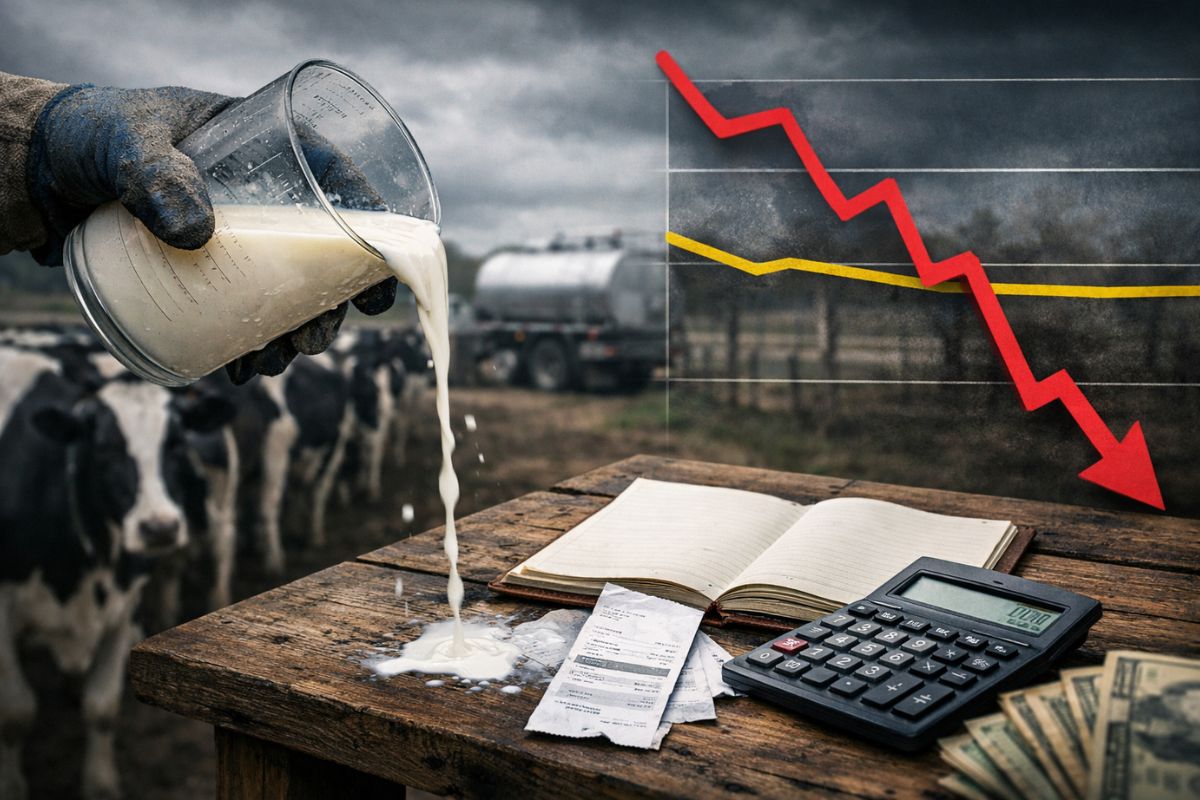
As Milk Price Plummets in Brazil, A Producer Opens His Spreadsheet and Reveals How 10 Dairy Cows Produce 6,000 Liters of Milk Per Month, Generate A Tight Profit of 5,000 Reais, and Expose the Heavier Production Costs of Milk on Brazilian Farms
In 2025, with greater milk imports from Uruguay, the rain season reducing production costs, and dairies lowering the amount paid to producers, the milk price plummets in Brazil and raises a silent alarm among small farms. In several regions, the question has shifted from how much to grow to whether it is still worth staying in the activity.
In a recent account, producer Wesley opened his cost spreadsheet and showed, with updated values, how much is left each month with 10 dairy cows producing around 6,000 liters: gross revenue around R$ 13,020, expenses nearing R$ 8,000, and net profit just below R$ 5,000 to sustain the family and the farm.
When the Milk Price Plummets in Brazil
According to the producer, the current pressure combines three fronts: widespread decrease in the price paid per liter, increased domestic supply during the rain season, and cheaper milk imports from abroad, especially from Uruguay.
-
Alone, the producer applies 7,400 hectares with the T100 drone in an optimized structure, replaces the generator with a silent battery, and demonstrates how technology reduces costs, increases productivity, and even challenges the uniport in the field.

-
China banned the export of 22 tons of meat from Argentina.
-
JBS, founded by the Batista brothers, continues to conquer the world: entrepreneurs built a ‘factory in the desert’ creating 3,000 jobs.
-
With only 1% of Brazil’s territory, Santa Catarina has built one of the most competitive industrial parks in the country, with 64,000 companies, nearly 1 million jobs, and a growth rate of 5.3% while the national industry is practically stagnant.


In practice, the milk price plummets in Brazil exactly when the cost of maintaining the farm structure remains high.
At the end of the year, with more abundant grass and less silage needed, productivity increases and national supply rises.
At the same time, imported products reinforce competition in wholesale.
The result is a scenario where dairy companies pay less per liter just when many producers believe they would be in the “breathing” phase after the more expensive dry season.
How 10 Cows Produce 6,000 Liters Per Month
The calculation presented is based on a relatively common system in small and medium farms. There are 10 dairy cows producing around 200 liters per day, which leads to a monthly volume of about 6,000 liters.
This average considers animals with good genetics, proper management, and feeding compatible with 20 liters per cow per day.
With the current amount received on the farm, this production guarantees an approximate gross revenue of R$ 13,020 per month just from the milk.
Theoretically, this amount seems sufficient to pay rent for a small farm, care for the family, and still reinvest part of it into the herd.
In practice, the daily calculations show that the margin for error has become minimal.
Recipe, Silage, and the Impact of Cutting Corn


In the producer’s spreadsheet, the first major cost block comes from bulk feed.
Maintaining the traditional system with corn silage, each cow consumes about 25 kilograms per day, leading to around 250 kilograms daily and 7,500 kilograms over 30 days.
Considering a production cost of around R$ 0.25 per kilogram, the silage consumes close to R$ 1,900 per month.
Faced with the falling prices, many producers have started testing alternatives like well-managed paddocks, capiaçu, or other cheaper bulk feeds, reducing or even eliminating the ensiled corn.
The account shows that this switch does save money, but it is not a straightforward solution for any herd, especially when it comes to high-producing animals that are more sensitive to sudden diet changes.
Feed: The Item That Weighs Most in the Spreadsheet
The largest expense, however, is with concentrated feed.
To maintain the average of 20 liters per cow per day, the system uses a practical rule: for every 3 liters of milk, 1 kilogram of feed.
With 10 cows, consumption reaches approximately 2 tons per month.
Producing their own mix on the farm, the cost per kilogram is around R$ 2.40.
Summing the monthly volume, the feed cost approaches R$ 4,800 in 30 days, making this item the main factor for margin compression.
If the producer chooses to buy ready-made feed, the impact is even greater, reducing some percentages from the already tight profit.
Energy, Maintenance, Medications, and Other Invisible Costs
Besides feeding, the producer includes in the account about R$ 400 monthly on electricity and cooler operation, an amount that covers milking, milk refrigeration, and household consumption directly related to the activity.
There is also a maintenance block estimated at R$ 300 per month, covering repairs of fences, renovation of barns, cleaning of paddocks, purchase of drums, hoses, and small structures that wear down continuously.
In months with heavier constructions, this number can be much larger.
For sanitary costs, the budget considers around R$ 400 for medications and supplies, such as products for pre-and post-dipping, snake antivenom, cleaning solutions, and targeted treatments.
It is an amount described as “comfortable,” but it only paints a picture without major emergencies with the herd.
Adding feeding, energy, maintenance, and medications, the total cost for these 10 cows approaches R$ 7,800 per month, making clear why so many people feel that the milk price plummets in Brazil while expenses, in practice, hardly decrease.
What Really Remains: Almost R$ 5,000 and A Lot of Work
With gross revenue around R$ 13,020 and costs near R$ 7,800, the monthly net profit sits around R$ 4,845, almost R$ 5,000 with 10 dairy cows.
On average, this represents around R$ 500 of profit per cow per month.
It seems a reasonable amount compared to urban salaries, but the producer himself warns: milk is work from Monday to Sunday, with no breaks, holidays, or weekends.
When considering the continuous work hours, the need to be present on the property, and climate risk, the per hour wages decrease significantly.
And If Land Rent Is Included in the Account
In the presented scenario, the producer also simulates the inclusion of a typical rural property rent with some minimum structure, such as a barn and formed pasture.
With values around R$ 2,500 per month in rent, the profit drops to something close to R$ 2,500, already considering eventual sales of calves to boost revenue.
At this level, any additional price fluctuation paid per liter, drop in production, or unforeseen animal health expenses is enough to nullify the month’s results.
It is precisely at this point that the milk price plummets in Brazil and exposes the drama faced by those who live exclusively off dairy cows in small areas.
Is It Worth Living Only Off Milk with the Current Price?
The case shows that it is still possible to generate some profit with 10 well-managed cows, but the margin for error has become very narrow.
Without strict cost control, bulk feed planning, attention to the contract with the dairy, and constant market monitoring, the activity can quickly turn into a loss.
At the same time, the family’s monthly income depends on an intense daily workload, with no breaks and a high risk of unexpected events.
While the milk price plummets in Brazil, the discussion ceases to be merely technical and becomes social, involving succession in farming, quality of life, and the next generations’ decision about whether to stay or leave the countryside.
In your reality, looking at these numbers and your municipality, do you think it is still worth living only from milk with the current price, or has it become too great a risk for your family?










-

-

2 pessoas reagiram a isso.