





 Portuguese
  English
  Spanish
  4 min of reading
  0 comments


Findings Suggest Advanced Cognitive Skills Emerged Much Earlier Than Previously Believed in Human History
In the plains of western Ukraine, a discovery has caught the attention of the scientific world. Researchers digging in ancient soil found fragments of ivory that could change the understanding of early human capabilities. The find, made at the archaeological site Medzhibozh A, revealed 24 small pieces of ivory from the tusks of extinct mammoths.
At first glance, they seemed like merely broken fragments, but a closer look revealed something impressive.
Carefully Worked Ivory
Scientists noted that some pieces had marks that were not the result of accidental breaks.
-
Motorola launched the Signature with a gold seal from DxOMark, tying with the iPhone 17 Pro in camera performance, Snapdragon 8 Gen 5 that surpassed 3 million in benchmarks, and a zoom that impresses even at night.

-
Satellites reveal beneath the Sahara a giant river buried for thousands of kilometers: study shows that the largest hot desert on the planet was once traversed by a river system comparable to the largest on Earth.

-
Scientists have captured something never seen in space: newly born stars are creating gigantic rings of light a thousand times larger than the distance between the Earth and the Sun, and this changes everything we knew about stellar birth.

-
Geologists find traces of a continent that disappeared 155 million years ago after separating from Australia and reveal that it did not sink, but broke into fragments scattered across Southeast Asia.

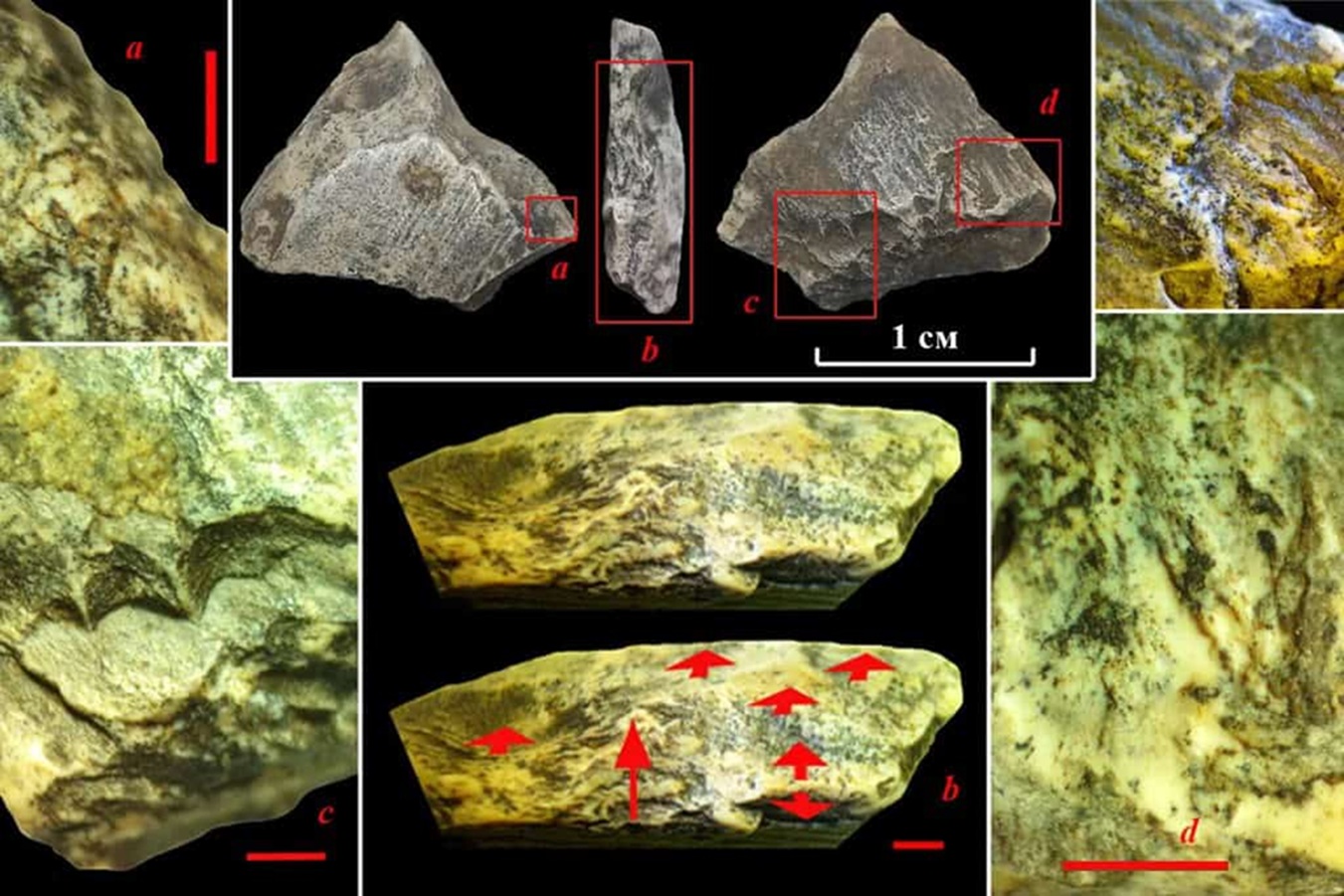
Several fragments showed signs of deliberate flaking, shaped with techniques similar to those used in stone tool manufacturing.
Dr. Vadim Stepanchuk, a Ukrainian archaeologist who led the study, told Smithsonian Magazine that Lower Paleolithic ivory artifacts had never been found until now.
The discovery site, located in the Southern Bug Valley, about 300 kilometers south of Kyiv, had already revealed flint, quartz tools, and bones of extinct animals like horses and woolly rhinoceroses. However, the presence of worked ivory surprised everyone.
“The discovery was truly unexpected,” Stepanchuk told IFLScience. Unlike stone, ivory is softer, wears down easily, and does not retain a cutting edge. Even so, at least 14 fragments displayed clear signs of modification, such as flaking scars, shaped tips, and even a characteristic core from the technique called “bipolar on anvil,” where the material is placed on a rock and struck with another to create flakes.
Artifacts Without Practical Function
Despite the meticulous work, the pieces do not appear to have been made for practical use. Stepanchuk explained to New Scientist that the fragments cannot exactly be called “tools.”
They show no signs of practical or technological utility, raising questions about their true purpose.
Scientists proposed several hypotheses. Perhaps they were training tools made by adults to teach children the technique of flaking materials.
Their shapes resemble real tools, but the fragility of ivory would prevent its use in daily work. Another possibility is that they were experiments, attempts to work with a new material when quality stone was not available.
A third hypothesis is more symbolic: just as modern children draw for pure expression, these fragments may have been created out of imitative or creative impulse without a defined function.
Anthropologist Gary Haynes from the University of Nevada, who did not participate in the research, highlighted that if the interpretations are correct, they reinforce the idea of complex intelligence already present in pre-modern hominins.
Indicators of a Different Intelligence
If the intentional production of the fragments is proven, the discovery points to cognitive abilities that were previously underestimated in early hominins. Although no human fossils have been found at the site, researchers believe that the authors of these pieces may have belonged to the Homo heidelbergensis group.
“The study of ivory began without a specific hypothesis,” Stepanchuk explained. But the unusual marks led scientists to investigate more deeply.
To strengthen the hypothesis of human manufacture, they plan to compare the fracture patterns of the fragments with those of modern elephant tusks, checking for significant differences between natural and artificial breaks.
So far, the earliest known worked ivory objects date back to the Upper Paleolithic, between 50,000 and 10,000 years ago. Some artifacts associated with Neanderthals are about 120,000 years old. The discovery in Medzhibozh could push this timeline back by approximately 400,000 years, placing these objects in the Lower Paleolithic.
This suggests that even at such an early time, pre-human communities were already experimenting, teaching, and possessing complex social behaviors. Stepanchuk asserts that even at this early stage of evolution, hominins may have engaged in social or imitative activities.
First Lessons of History
The discovery raises the exciting possibility that, 400,000 years ago, someone taught another person — perhaps a child — how to shape ivory, not out of practical necessity, but as a way to transmit knowledge or stimulate skills. A true “class” from prehistory, occurring long before the arrival of modern humans.
The evidence of this activity could represent one of the earliest records of deliberate teaching in human history. More studies and comparative analyses will still be needed to confirm this hypothesis.
The findings were published in the International Journal of Osteoarchaeology, and promise to fuel new research on the intelligence and behavior of early hominins.








-

Uma pessoa reagiu a isso.