





 Portuguese
  English
  Spanish
  6 min of reading
  4 comments


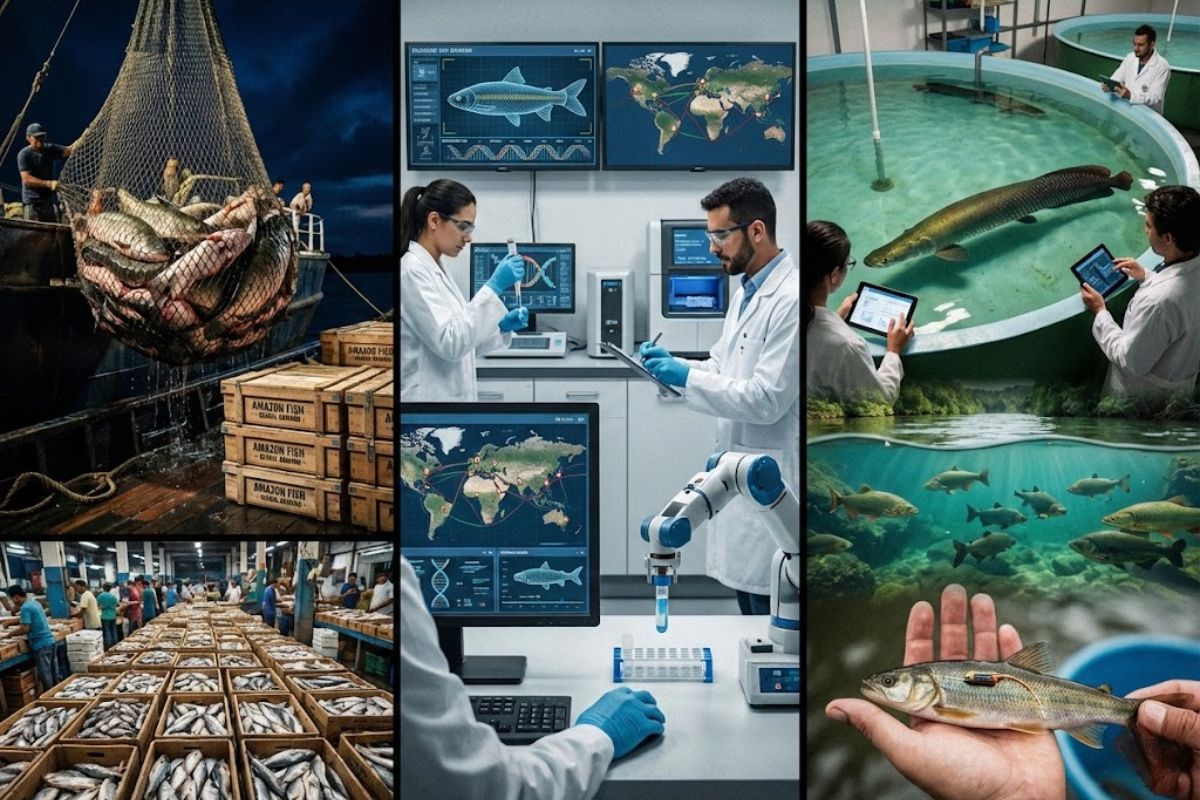


With Growing Demand And Predatory Fishing, Brazilian Fish Has Become Scientific Priority In Belém, Pará: Researchers Sequenced The Genome Of Pirarucu And Filhote, Created Traceability Capable Of Identifying Origin Even Abroad, Advanced In Hormones And Nutrition Of Aquaculture And Strengthened Conservation Policies In The Amazon Until 2030.
In Belém (PA), the Brazilian fish has entered the center of a direct scientific strategy against illegal fishing and predatory exploitation: Federal University of Pará (UFPA) deciphered the DNA of two highly sought Amazonian species, pirarucu (Arapaima gigas) and filhote (Brachyplatystoma filamentosum), uniting genetics, traceability, and aquaculture to reduce pressure on nature.
The initiative, led by a team from the Human and Medical Genetics Laboratory of the Institute of Biological Sciences, was born from the increasing demand and the difficulty of reproducing these species in controlled breeding. The goal is to transform genetic information into practical conservation, with the capacity to trace origin, guide reproduction, and support public policies to prevent definitive losses in Amazonian biodiversity.
Why Brazilian Fish Has Become Priority In Science In The Amazon

The pirarucu and filhote share the same origin biome and two points that make them particularly sensitive to human pressure: high demand in gastronomy and technical barriers for reproduction in aquaculture.
-
China accelerates global science and may surpass the United States in 2 years with increased public investment, continuous growth, and direct impact on the global technological competition.

-
Scientific studies indicate that drought may be strengthening a much greater silent threat: more resistant superbugs.
-
Man builds functional 5-meter submarine in his garage using gas cylinders, PVC pipes, and a refrigerator motor, and navigates with the vessel on a lake in Colombia.

-
Millions of people have been eating yam for centuries without knowing that this humble tuber contains a compound called diosgenin, which scientists have now discovered can improve memory and help control blood sugar levels.


When demand increases and legal supply does not keep up, it paves the way for predatory exploitation, and this scenario has pushed the Brazilian fish to the center of the debate.
According to researcher Sidney Santos, who led the team, the motivation was clear: to contain impacts caused by the advance of predatory exploitation in light of increasing demand.
The logic advocated in the project is to reduce direct removal from the natural environment through sustainable production, based on deep knowledge of the organism.
What It Means To Decipher The DNA Of Brazilian Fish

To protect the Brazilian fish more precisely, the team turned to the most comprehensive layer of biological information: DNA (deoxyribonucleic acid).
This molecule acts as a set of instructions and is composed of four types of nucleotides: Adenine (A), Thymine (T), Cytosine (C), and Guanine (G). The order of these nucleotides holds detailed information about physical traits, health, and ancestry.
In the study, scientists collected samples from over 100 fish.
Then, the DNAs were read by a genetic sequencer capable of identifying the order of the nucleotides.
Each sequence, when organized and interpreted, forms the genome of the species, a type of complete manual that describes the set of characteristics of the group.
This leap is decisive because it changes the level of control and knowledge: with the genome, it becomes possible to confirm origin, map variations, differentiate individuals, and build foundations for reproduction and management in artificial environments, focusing on sustainability.
Traceability: When Brazilian Fish Starts To “Carry” Its Own Origin

One of the most strategic gains was genetic traceability.
With the “story” stored in the genome, the Brazilian fish can have its origin tested with much more rigor.
The director of the Socio-Environmental and Water Resources Institute of the Federal Rural University of the Amazon, Igor Hamoy, highlighted that the genome allows genetic traceability, that is, locating the provenance of the animal based on its biological signature.
In practice, the resource allows differentiation between two critical situations for monitoring and market: whether the fish is a descendant of aquaculture breeding stocks or whether it was taken directly from nature and entered a commercialization route, including internationally.
The example itself makes this evident: it is possible to identify if a pirarucu sold abroad originated from the Amazon.
In addition to immediate use, all information generated has been recorded in a public genetic database, which allows other researchers to advance in new investigations, expanding the understanding of Brazilian fish and other Amazonian species.
Aquaculture: How The Genome Unlocks Hormones, Nutrition, And Controlled Reproduction
The study also advanced on barriers that hinder the aquaculture of highly valued Amazonian species.
Based on genetic knowledge, researchers began to focus on critical points to enable sustained production: induction of sexual hormones, development of adequate nutrition for artificial environments, and traceability to prevent Amazonian species from being sold illegally.
The reasoning is straightforward: if the Brazilian fish can be produced in a balanced and directed manner, with technical control and tracking, the pressure on nature tends to decrease, because a significant part of the demand moves from the natural environment to a more controlled production chain.
Where Did This Happen And Who Led The Advance
The research was conducted at the Federal University of Pará (UFPA), in Belém (PA), led by researcher Sidney Santos, from the Human and Medical Genetics Laboratory of the Institute of Biological Sciences.
On January 16, 2026, in Belém, the researcher highlighted that the expansion of genomic studies tends to progress in Brazil and worldwide, mainly because sequencing costs have been decreasing with the evolution of machines.
He also detailed a contrast that shows the extent of technological transformation: the human genome, the first to be sequenced, took 10 years and cost between US$ 2.5 billion and US$ 3 billion.
Today, with the MGI equipment used in the study, it is possible to sequence 48 human genomes in 3 hours, with an estimated cost of US$ 1,500 to US$ 2,000 per genome, with expectations for further reductions.
This technological leap helps explain why Brazilian fish has come under the scrutiny of genetics now: with greater processing capacity, science can transform sequencing into a recurring tool, not an exception.
The “Amazon Cost” And Why Doing Science In The Region Is More Difficult
Even with technological evolution, the Amazonian scenario poses its own challenges.
Hamoy pointed out that the region faces greater obstacles than other areas of the country, and Santos reinforced the point with a structural data: the UFPA equipment is the only genetic sequencer in the public sector of the Amazon.
Additionally, there is the so-called “Amazon cost”, linked to logistical and operational difficulties.
Even when global costs decrease, research still depends on supplies and funding, as the structure to collect samples, process data, and maintain applied lines requires continuous support.
Santos also clarified the limit: costs have decreased, but it is still not accessible to every researcher or university, and work requires technological park capable of executing all stages, from sequencing to processing.
Public Policies: How Brazilian Fish Enters Planning Until 2030
The advances of the Brazilian fish in genetics do not remain restricted to the laboratory.
The national secretary for Biodiversity, Forests, and Animal Rights of the Ministry of Environment and Climate Change, Rita Mesquita, stated that these advances serve as guidelines for conservation policies.
She mentioned the planning until 2030, foreseen in the National Strategy and Action Plan for Biodiversity (Epanb), designed based on what science indicates is necessary to reduce losses and regenerate Brazilian biomes.
The secretary also pointed out policies that directly depend on robust genetic information, such as the preparation of lists of invasive exotic species and the National List of Threatened Species of Extinction.
Another example was the National Plan for Recovery of Native Vegetation (Planaveg), launched in 2024.
In this context, genetics becomes a kind of library for future actions: in rewilding and restoration processes, genetic information helps return species to the right places, reducing errors, uncertainty, and improvisation.
What Is At Stake: Saving Brazilian Fish Before Collapse
By uniting genome, traceability, and controlled reproduction, science tries to build a defense line before predatory exploitation imposes irreversible losses.
Rita Mesquita reminded that the challenge accompanies the size of national biodiversity, the largest in the world, and reinforced the importance of working with science to improve information about priority areas and protect territories, especially for the most threatened species.
At the most practical level, what emerges is a management pathway that seeks balance: producing sustainably, tracking to curb illegality, and guiding public policies precisely.
For the Brazilian fish, this means a concrete chance of escaping the pressure that turns demand into a risk of collapse.
Do you think that genetic traceability and controlled reproduction will reduce illegal fishing of Brazilian fish in the Amazon or will demand continue to drive the clandestine market?








O contrário de trabalhador
****
A única pesca ilegal aqui e a pesca de navios chineses que roubam tudo com o consentimento desse governo mas como o costume vira obrigação o governo vendeu nossos rios para a mesma
por preço de bananas há não **** tá caro
Bom a china vem **** dos ribeirinho seu alimento e o governo proíbe a pesca com desculpa esfarrapadas mais os manos da china levam a qualquer época do ano para eles os chineses , não existe defeso , roubo na cara dura
governo que permite até seus eleitores serem roubados
mas eu nunca jamais votei nesse socialista ****