





 Portuguese
  English
  Spanish
  4 min of reading
  0 comments


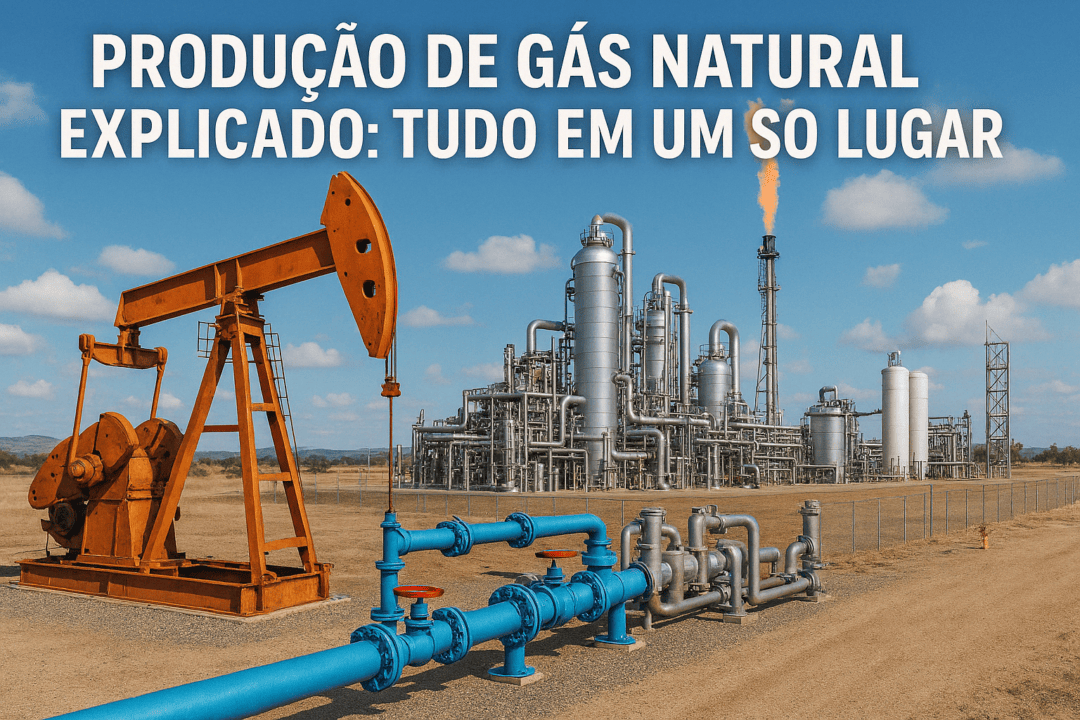
From Underground to End Use: Discover the Complete Process That Transforms Natural Gas into an Energy Source for Various Sectors
The production of natural gas is one of the most strategic activities in the global energy sector. Present in various countries and used in different sectors, it moves billions of dollars a year and directly impacts the economy, the environment, and energy security.
In this complete guide, you will understand what it is, how it works, where it takes place, what technologies are used, what the environmental impacts are, and the future of this important resource.
What Is Natural Gas?
Natural gas is a mixture of hydrocarbons, with methane (CH₄) being the main component. It forms naturally underground from the decomposition of organic matter over millions of years in environments with high pressure and temperature.
-
Offshore industrial demand in Macaé skyrockets with the recovery of oil and gas and could grow by up to 396% by 2026 in the Campos Basin.
-
Offshore industrial demand in Macaé surges with the recovery of oil and gas and could grow by up to 396% by 2026 in the Campos Basin.
-
Brazilian giant expands borders in the Southeast: Petrobras confirms new oil discovery in ultra-deep waters in the pre-salt of the Campos Basin.

-
Alert in the global energy market: Severe tropical cyclone hits the coast and disrupts gas production at major plants in Australia, threatening global supply.


It is considered a fossil energy source, like oil and coal, but emits fewer pollutants when burned. It is primarily used for electricity generation, heating, transportation, and as a raw material in industry.
How Does Natural Gas Production Work?
Natural gas production involves a long and complex chain, divided into three main stages:
1. Exploration
It all begins with geological exploration, which identifies locations with potential to contain natural gas. Techniques such as seismic analysis, sensors, and 3D modeling help find the reserves.
2. Drilling
After confirming the presence of gas, well drilling begins. These drillings can occur both on land (onshore) and at sea (offshore). Offshore platforms are common in major producers like Brazil and Norway.
3. Extraction
Once drilled, the gas is extracted from the reservoir and sent for processing. At this stage, the gas comes mixed with water, sand, and other compounds that need to be separated.

Processing of Natural Gas
The extracted natural gas cannot be used directly. It goes through a purification process, which removes impurities and separates components such as:
- Carbon Dioxide (CO₂)
- Sulfur
- Liquefied Natural Gas (LNG)
- Heavier Hydrocarbons
After processing, the gas is compressed and sent through pipelines for consumption or export.
Technologies Involved in Production
The production of natural gas involves cutting-edge technologies. Some of the most common include:
- Hydraulic Fracturing (Fracking): used to release gas from rock formations.
- Offshore Platforms: advanced structures operating in open water.
- Compression and Cooling Systems: essential for transportation in liquid form (LNG).
- Remote Sensing and Digitalization: monitor production in real-time.
Main Producing Countries
Production is concentrated in a few countries that dominate the global market:
- United States: leading in production, especially due to fracking.
- Russia: has vast reserves and is a major exporter.
- Iran and Qatar: together dominate production in the Middle East.
- China: a growing producer and large consumer.
- Brazil: stands out in offshore production in the pre-salt layer.
Production in Brazil
The production of natural gas in Brazil has been growing with investments in the pre-salt layer. The Santos and Campos basins concentrate a large part of national extraction. Petrobras is the main company operating in the sector.
Additionally, there are partnerships with foreign companies to enable processing and distribution. The country still faces infrastructure challenges but has great expansion potential.
Transportation and Distribution
Gas transportation can be done in two main ways:
- Through Pipelines: more efficient for short and medium distances.
- By Ships (LNG): gas is cooled to -162ºC and transformed into liquid for intercontinental transport.
After being transported, the gas is distributed to industrial, residential consumers, and for electricity generation.
Applications of Natural Gas
The production of natural gas supplies various sectors:
- Industries: as raw material for fertilizers, plastics, and chemicals.
- Homes: for cooking, heating water, and spaces.
- Transportation: in vehicles powered by CNG.
- Electricity: in thermoelectric plants.
Its versatility and lower environmental impact, compared to coal and oil, make it an increasingly valued option.
Environmental Impacts of Natural Gas Production
Although it is less polluting than other fossil fuels, natural gas production still causes impacts:
- Methane Emissions: a greenhouse gas more potent than CO₂.
- Leakage Risks: particularly in pipelines and platforms.
- Intensive Water Use: in hydraulic fracturing.
- Local Impacts: such as deforestation and noise pollution.
For this reason, the sector seeks more sustainable solutions, such as carbon capture and storage (CCS) and more efficient technologies.
Challenges and Future of Natural Gas Production
The global energy transition is one of the biggest challenges for the sector. Although natural gas serves as a “bridge” between fossil fuels and renewable sources, it needs to adapt to new demands:
- Decarbonization: pressure to cut emissions.
- Clean Energy: advancement of renewables like solar and wind.
- Green Technology: investments in hydrogen and biomethane.
Still, the production of natural gas will remain relevant for decades, especially in developing countries seeking energy security and economic growth.
Curiosities
- Natural gas was first used in China over 2,500 years ago.
- Brazil has the potential to double its production by 2030.
- Liquefied natural gas (LNG) occupies 600 times less volume than gas in its natural state.
The production of natural gas is a pillar of the global energy matrix. Its versatility, efficiency, and relative “cleanliness” make it an important ally in the energy transition. However, it is necessary to invest in technology, safety, and sustainability to ensure its future.
This guide brings together, in one place, everything you need to know about the topic—from extraction to distribution, from impacts to challenges. Following this industry is essential to understand the future of energy in Brazil and around the world.








-

2 pessoas reagiram a isso.