





 Portuguese
  English
  Spanish
  5 min of reading
  3 comments


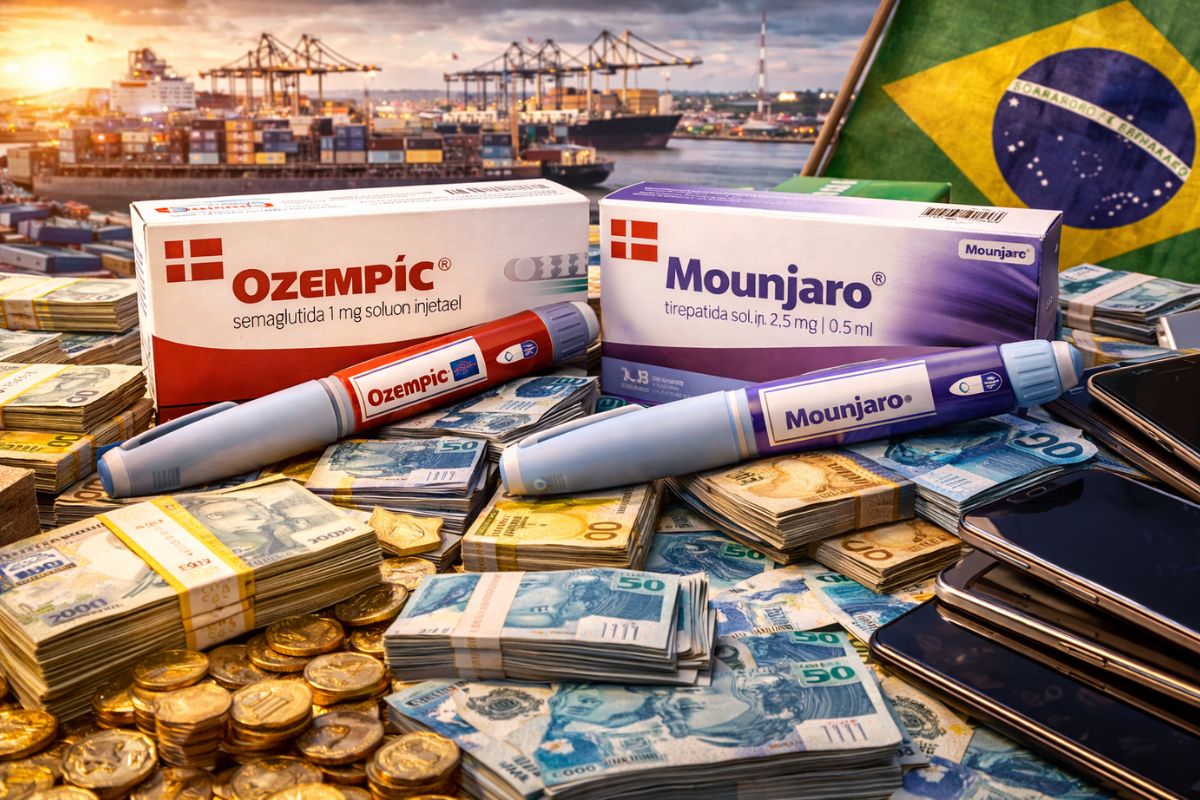


In Brazil, Product Manufactured in Denmark Leads External Purchases of Slimming Pens: US$ 1.669 Billion in 2025, Around R$ 9 Billion. Imports Rose 88% and Now Surpass Salmon, Olive Oil, and Cell Phones. Patents Expire in 2026 and Could Reduce Prices by 30% to 50% with Generics and Similar Products
The explosion in demand for weight loss medications in Brazil has placed the product manufactured in Denmark at the center of a billion-dollar import movement, directly affecting the trade balance and the pace of external purchases in the pharmaceutical sector in 2025.
Just last year, the country imported US$ 1.669 billion, approximately R$ 9 billion, in slimming pens, a leap that repositioned these items above historically strong categories in Brazilian imports and opened an accelerated dispute between manufacturers and origins.
Billion-Dollar Imports in Brazil and the 88% Jump in Just One Year
Brazilian foreign trade numbers show that purchases of slimming pens reached US$ 1.669 billion in 2025, roughly equivalent to R$ 9 billion, making the segment one of the most significant movements in the recent pharmaceutical market in Brazil.
-
Larger than entire cities in Brazil: BYD is building a 4.6 km² complex in Bahia with a capacity for 600,000 vehicles per year, but the discovery of 163 workers in conditions analogous to slavery has shaken the entire project.

-
With an investment of R$ 612 million, a capacity to process 1.2 million liters of milk per day, Piracanjuba inaugurates a mega cheese factory that increases national production, reduces dependence on imports, and repositions Brazil on the global dairy map.

-
Brazilian city gains industrial hub for 85 companies that is equivalent to 55 football fields.

-
Peugeot and Citroën factory in Argentina cuts production by half and opens a layoff program for more than 2,000 employees after Brazil drastically reduced purchases of Argentine vehicles.


The increase was described as an 88% jump in one year, a pace that, in practice, indicates an acceleration in demand and increased supply through imports to meet expanding consumption.
This data also shows that the category has ceased to be a niche and is now competing with traditional imports, directly impacting the financial volume that leaves the country to acquire these products.
When Slimming Pens Surpass Cell Phones: What the Comparison Signals
The imported volume has already surpassed external purchases of well-known items that have a significant weight in Brazilian imports, such as cell phones, as well as products cited as benchmarks for commercial strength, such as salmon and olive oil.
This comparison acts as a thermometer because it places the advancement of slimming pens on par with products that typically dominate headlines in consumption and logistics.
In practice, the message is simple: Brazil has started purchasing slimming pens at a scale comparable to large import categories, a sign of market consolidation and ongoing pressure on supply.
Denmark and the United States Compete in the Brazilian Market with Ozempic and Mounjaro
Denmark appears as the main source of imports, accounting for US$ 734.7 million, equivalent to 44% of the total purchased by Brazil in 2025.
It is also home to Novo Nordisk, a manufacturer associated with products like Ozempic and Wegovy, which helps explain the Danish weight in supply.
Following closely, the United States accounted for US$ 593.7 million, representing 35.6% of the total, driven by the entry of Mounjaro, produced by Eli Lilly.
The turning point lies in the speed: while purchases from Denmark grew by 7% over the past year, imports from the United States skyrocketed by 992%, indicating that the recent expansion of the Brazilian market has been strongly driven by the newer competitor.
This scenario creates a competitive landscape for shelf space and distribution, with two dominant sources and explosive growth associated with the new American influx.
Market Expected to Quintuple by 2030 and Redesign the Size of the Sector in Brazil
The projection for Brazil indicates that the annual market, currently around US$ 1.8 billion, could grow to US$ 9 billion by 2030, something close to R$ 50 billion in the mentioned conversion.
Practically, this means an expectation of quintupling the size of the segment.
The explanation for this growth combines three operational factors of consumption: broadening the audience, continuous use, and the consolidation of these therapies as treatment not only for obesity but also for associated metabolic diseases.
With more people entering and staying in treatment, demand tends to be less episodic and more recurring, which sustains revenue and import growth.
2026 as a Turning Point: Patent Expiration and Expected Price Drop of 30% to 50%
A critical change is expected in 2026: the expiration of the semaglutide patent, an active ingredient associated with products like Ozempic and Wegovy.
The expectation described for the sector is that the arrival of generics and similar products will lead to a price reduction between 30% and 50%.
Today, the monthly cost of these medications ranges from R$ 900 to R$ 3,000, a range that helps explain why the topic of “affordability” has become the primary economic trigger for the market in the next cycle.
If the drop materializes, the immediate effect tends to be increased access, a broader buyer base, and greater competition among brands, which could also alter the mix of imports and local production.
Anvisa Has Already Received Applications and the Sector Prepares for a New Phase in Brazil
The preparation for 2026 is already evident in regulatory data. There are 11 applications for registration of medications based on semaglutide and seven for liraglutide, an active ingredient associated with Saxenda and Victoza, whose patent expired in November.
In addition to the applications for semaglutide and liraglutide, the agency is reviewing requests for biological medications, including combinations of semaglutide with insulin for weekly administration.
This detail signals a movement towards diversification: it is not merely about “copies,” but about new formulations and combinations that could expand the supply and reorganize competition.
National Production on the Radar: Investments and Competition for More Accessible Versions
With the expiration of patents approaching, companies such as EMS, Eurofarma, and Hypera have already announced investments to produce more accessible national versions.
The practical aim of this type of investment is to reduce external dependency, shorten supply times, and compete on prices with imports.
If local production gains scale, Brazil could see a significant shift: part of the money that currently leaves the country via imports could be replaced by domestic manufacturing, although the pace of this transition depends on registrations, production capacity, and commercial strategy.
The sector’s insight is that competition tends to pressure prices, especially when multiple companies are vying for the same consumer base.
What’s at Stake for Brazil: Trade Balance, Access, and a Growing Category
The 2025 scenario paints a clear picture in Brazil: US$ 1.669 billion imported in slimming pens, an increase of 88%, Danish leadership with US$ 734.7 million, and American growth with a spike of 992% in one year.
This combines fiscal and commercial impact with consumption transformation, while positioning 2026 as a pivotal moment expected for price changes following the end of exclusivity.
In the short term, the market remains pressured by high demand and strong imports.
Looking towards 2026, the discussion shifts to prices, generics and similar products, registration, and national production, with the potential to reorganize who sells, how much it costs, and how Brazil supplies this category that has already surpassed even cell phones in volume of external purchases.
Do you think that the end of patents in 2026 will actually reduce prices in Brazil, or will demand keep prices high even with more competition?









Acredito que a concorrência vai ajudar a diminuir os preços e uma camada bem maior da população vai ter acesso a exce tratamento…
Sim, e muito
Estou ansiosa pra essa mudança…preciso da medicação, porém o alto custo me impossibilta de obter…a obesidade hj não é estética e sim saúde!!