





 Portuguese
  English
  Spanish
 4 min of reading
  0 comments


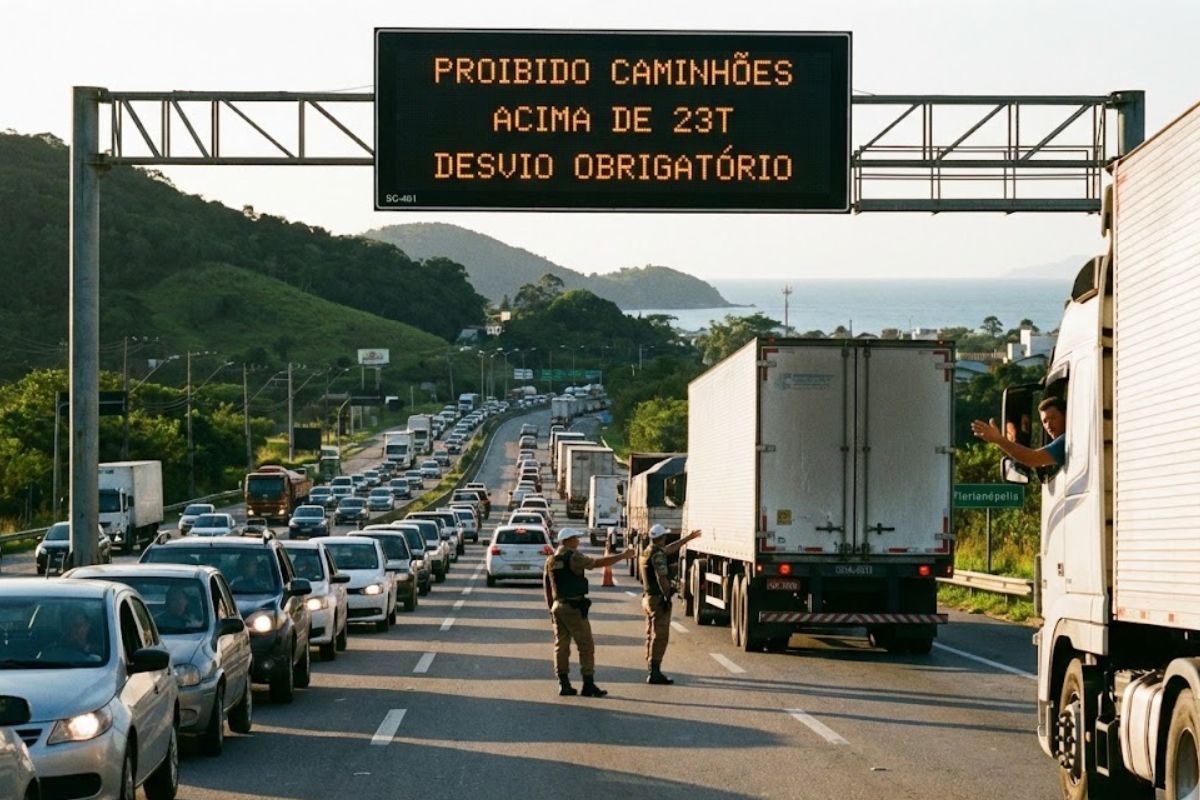
SIE Decision Imposes Truck Ban on SC-401 for Vehicles Over 23 Tons Between Km 19+130 and Km 16+870 from December 15, 2025 to February 22, 2026, During Peak Hours to Reduce Traffic and Congestion in Summer 2026 Towards the North of the Island
The truck ban on SC-401, announced by the State Secretary of Infrastructure and Mobility in the December 5, 2025 edition of the Official Gazette, applies to vehicles with a gross weight over 23 tons and affects the main traffic corridor between downtown Florianópolis and the North of the Island during summer 2026. The measure, effective from December 15, 2025 to February 22, 2026, aims to reduce congestion during peak hours on a stretch already pressured by highway expansion works.
The restrictions were defined after eight months of tripling works on SC-401, which are expected to deliver a third lane in October 2026 and require partial clearance by December 15, 2025 to maintain minimal circulation on the downtown-residential area axis. In this scenario, the state government seeks to balance the heavy construction schedule with the summer season, when tourist traffic increases and any failure in traffic management can block the connection to the North of the Island for hours.
Ban Rules and Directly Affected Sections
The SIE decision establishes that the truck ban on SC-401 applies to vehicles with a gross weight over 23 tons.
-
The government puts R$ 8.6 billion on the table to change the highway (BR) with 50 overpasses, 28 bridges, 4 tunnels, and 40 km of bike lanes in 180 km of historic duplication.
-
BRL 20.1 Million Bridge Project Kicks Off: 200-Meter Construction to Improve Access in Three Cities in Minas Gerais

-
‘Endless Road’ In Brazil Is One of The Largest In The World: 145 Km Stretch On An Important Highway (BR) Crosses The West Of Bahia And Had 135.9 Km Revitalized With R$ 35.3 Million
-
Engineer From ITA Who Worked at Embraer Leads Free Flow Expansion With National Artificial Intelligence and Technology for Toll Without Barriers in Brazil


Buses and minibuses are exempt, which concentrates the impact of the rule on trailers and heavy trucks that use the highway to supply residential neighborhoods, commercial centers, and hotels along the route to the North of the Island.
The directly affected stretch is between Km 19+130 and Km 16+870, in the downtown-residential area direction, considered the most sensitive point for queue formation.
Within this perimeter, trailers are prohibited from circulating during peak hours between 7 AM and 11 AM and between 4 PM and 8 PM, from December 15, 2025 to February 22, 2026, during which the combination of construction, high season, and accidents often paralyzes traffic.
Summer 2026 and Risk of Collapse Between Downtown and the North of the Island
The state government bets that the truck ban on SC-401 during peak hours can reduce the risk of total collapse of the corridor between downtown and the North of the Island in summer 2026.
In practice, the removal of heavy cargo trailers from the critical section frees up space for cars, buses, and tourist vehicles, which already compete for every meter of asphalt with constant queues in December, January, and February.
For drivers who use the highway daily, the expectation is for partial relief, not a definitive solution.
Without the completion of the third lane and without robust alternative access to the North of the Island, the system continues to operate at its limit, making the measure an emergency tool to get through the 2025-2026 season with fewer complete stoppages.
Tripling Works, Deadlines, and Daily Traffic Impact
The tripling works on SC-401 began eight months ago and are concentrated precisely in the section where traffic flow is most vulnerable.
The expectation is that the third lane will be delivered in October 2026, but the contract sets intermediate targets, such as partial clearance of the highway by December 15, 2025.
This date also marks the beginning of the full enforcement of the truck ban on SC-401 for vehicles over 23 tons during peak hours.
As the construction front advances, machines, physical barriers, and temporary detours reduce the highway’s capacity, compress travel lanes, and increase travel time for those who rely on the road for work, school, or accessing services.
The combination of active construction, seasonal holiday traffic, and high participation of heavy vehicles has increased the risk of successive collapses on recent weekends and holidays.
Driver Routine, Cargo Logistics, and Alternative Routes
For truck drivers and transport companies, the truck ban on SC-401 during designated periods forces trip reprogramming, changes in loading windows, and the search for alternative routes, including movements at night or outside the peaks defined by the ordinance.
Companies that service hotels, supermarkets, and private works in the North of the Island need to reorganize operations to avoid blockages and fines.
In urban traffic, the expectation from the government is that the removal of heavy trucks during the intervals between 7 AM and 11 AM and between 4 PM and 8 PM will reduce bottlenecks at accesses, turnarounds, and intersections along SC-401.
Still, the effectiveness of the policy will depend on oversight, compliance with the time slots, and the ability to coordinate with other major traffic routes, since part of the diverted flow tends to pressure secondary roads and internal streets in residential neighborhoods.
In your opinion, is the truck ban on SC-401 during summer 2026 sufficient to prevent traffic collapse between downtown and the North of the Island, or should it be combined with other stricter measures?










Seja o primeiro a reagir!