





 Portuguese
  English
  Spanish
  3 min of reading
  0 comments


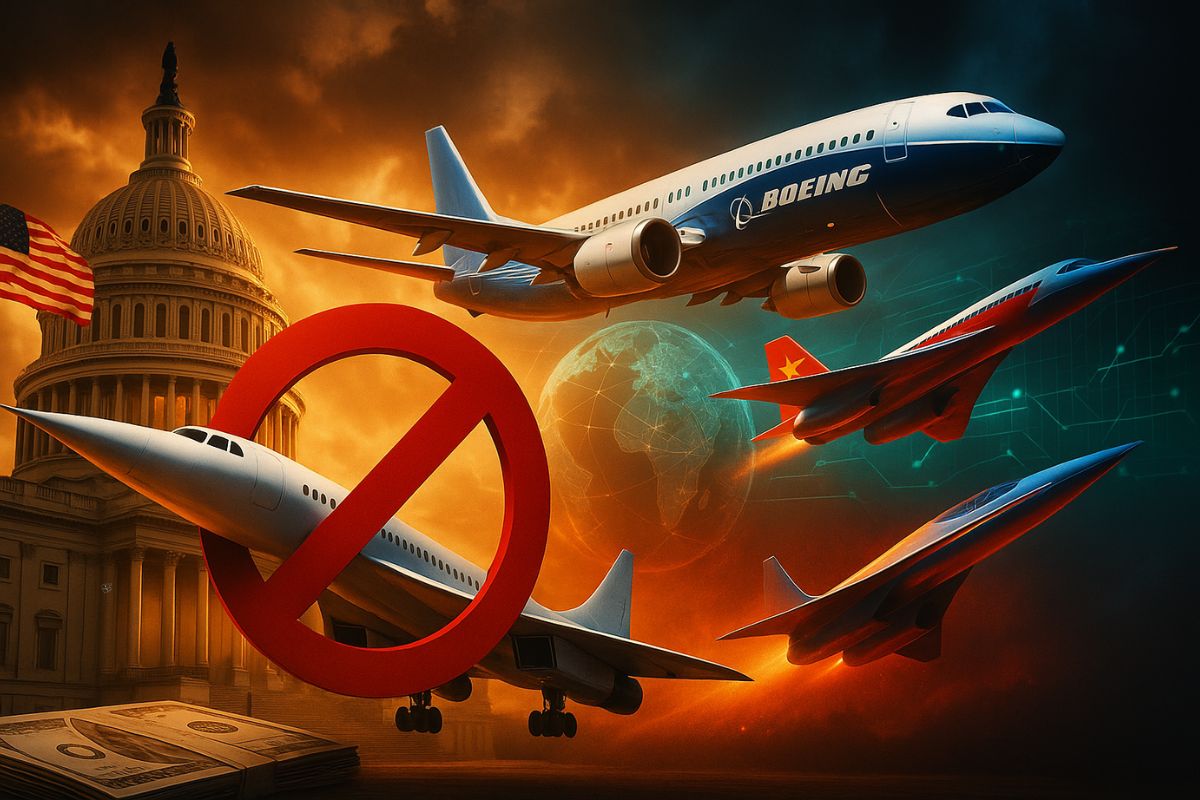
The End Of The Concorde And The Supersonic Race Was Not Just Due To Technical Or Environmental Issues, But Due To US Government Protectionism To Protect Boeing, Imposing A Ban On Supersonic Flights Over Land.
The end of supersonic flights was not just a matter of noise or high fuel consumption. According to experts, the ban imposed by the United States in 1973, which prohibited commercial flights above the speed of sound over American territory, was a measure of protectionism to preserve Boeing, which had lost the technological race to Europeans and Soviets.
According to Boom Supersonic founder Blake Scholl, this decision stifled the advancement of civil aviation and sealed the fate of the Concorde, the Franco-British icon that could have forever changed international travel.
Concorde, Tupolev, And The Shadow Of The American Ban
The Concorde, which debuted in 1969, carried just over 100 passengers at Mach 2 (twice the speed of sound). Despite its prestige, the aircraft never achieved profitability, operating with heavy state subsidization. On the Soviet side, the Tupolev Tu-144 also tried to compete in this market but struggled with technical issues and poor reputation.
-
With an investment of R$ 612 million, a capacity to process 1.2 million liters of milk per day, Piracanjuba inaugurates a mega cheese factory that increases national production, reduces dependence on imports, and repositions Brazil on the global dairy map.

-
Brazilian city gains industrial hub for 85 companies that is equivalent to 55 football fields.

-
Peugeot and Citroën factory in Argentina cuts production by half and opens a layoff program for more than 2,000 employees after Brazil drastically reduced purchases of Argentine vehicles.

-
A Brazilian city gains a factory worth R$ 300 million with the capacity to process 200 thousand tons of wheat per year, a mill of 660 tons/day, silos for 42 thousand tons, and an industrial area of 276 thousand m².


In the United States, Boeing had developed the SST (Supersonic Transport), but Congress canceled the project in 1971. Shortly after, came the decisive measure: the ban on supersonic flights over land, justified by the need to reduce the impacts of the “sonic boom.” Critics argue that this technical justification masked a political and economic goal: to prevent the Concorde from dominating high-value domestic routes in the American market.
The “Regulatory Capture” That Frozen Aviation
The concept of regulatory capture helps explain the episode: when public norms are shaped to serve the private interests of large corporations. Instead of imposing decibel limits, as is the case with conventional engines, the U.S. preferred a total veto, which in practice made it unfeasible for supersonic planes to operate in its territory.
The result was a technological freeze. Since the 1970s, commercial planes have continued to fly at 75% to 85% of the speed of sound, virtually without evolution in terms of speed. The dream of crossing the Atlantic in less than three hours was shelved in the name of protecting the national industry.
The Comeback: Startups And The Competition With China
In 2025, the debate returns to the center of geopolitics. Boom Supersonic, founded in 2014 by Blake Scholl, already has 130 orders for supersonic jets and promises to usher in a new era of commercial flights above Mach 1, with high-demand international routes. For Scholl, the challenge is comparable to the beginning of Elon Musk’s SpaceX: a fight of “David versus Goliath” against Boeing and Airbus.
The problem is that the same regulatory risk could repeat itself. In the U.S., there are pressures to maintain restrictions on supersonic flight, while China advances in its own projects, betting that it can lead the segment if it frees up its operation without so many barriers. Thus, the discussion about faster flights ceases to be just a matter of engineering and becomes a piece of the technological and strategic dispute between global powers.
Much Beyond Aviation: Economic And Geopolitical Power

The return of supersonic flights carries implications that go beyond passenger transport. The country that dominates this technology could enhance its economic influence, dictating new rules for air commerce, and even strengthen its strategic defense capacity.
The episode of the Concorde shows that political decisions can delay innovation for decades. Now, faced with pressure from China and the advancement of startups, the U.S. will have to decide whether to repeat its protectionist stance or allow the market and technology to advance.
Do you believe that supersonic flights will become a reality again on commercial routes? Was the American ban a necessary measure or just protectionism to favor Boeing? Share your opinion in the comments — we want to hear your thoughts on this historical and current debate.









-

Uma pessoa reagiu a isso.