





 Portuguese
  English
  Spanish
  4 min of reading
  0 comments


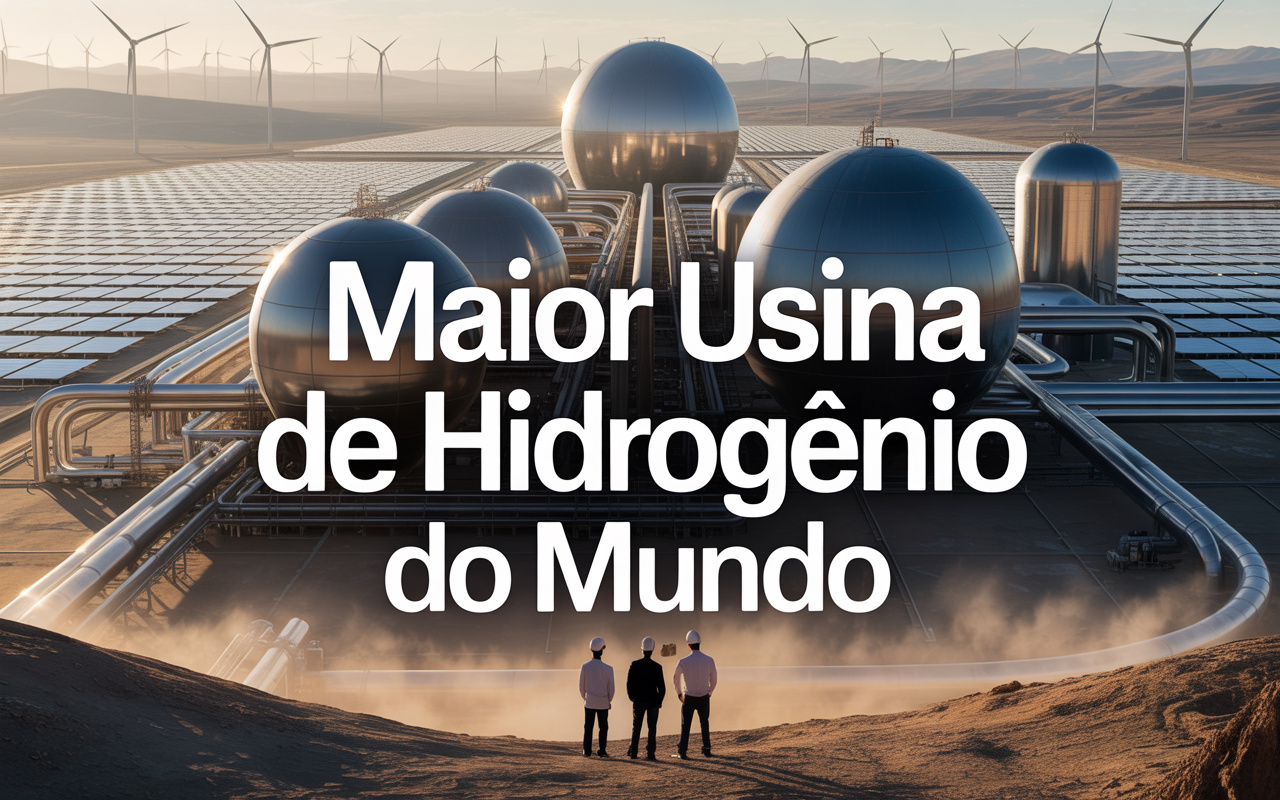
World’s Largest Green Hydrogen Plant Advances With US$ 8.4 Billion, 4 GW Renewables, and 600 Tons Daily Production to Supply Cities With Clean Energy at Industrial Scale.
At the heart of a global energy megaproject that is reshaping the future of the international matrix, an investment of US$ 8.4 billion (approx. R$ 41 billion) is bringing to life the largest green hydrogen plant on the planet. The colossal structure, located in NEOM, Saudi Arabia, is set to produce 600 tons of green hydrogen per day, enough volume to power entire fleets of trucks, industries, and even complete cities with clean energy, free of fossil fuels and carbon emissions.
Using only solar and wind energy at full industrial scale, the venture marks a historic chapter in the global energy transition: for the first time, a plant dedicated exclusively to renewable hydrogen is set to operate not as an experimental pilot, but as a practical and large-scale commercial solution.
This is not a conceptual project, nor a technological prototype; it is a real factory, under construction, with a projected commercial operation date and contracts already signed for the sale of clean fuel to global markets.
-
The Brazilian state accelerates industrial competitiveness with a focus on the extraction of strategic minerals to boost the energy transition in Goiás.

-
A Canadian retiree creates a hydroelectric system on a real river, generating energy continuously throughout the day and demonstrating how the power of water can supply a house with stability even in a simple structure.

-
Petrobras reaffirms its commitment to the market and ensures that it will carry out the energy transition safely to maintain national sovereignty.

-
Researchers discover a possible hydrogen deposit of up to 46 million tons beneath an ancient coal basin, and the volume could exceed half of the entire global production.


And the numbers give dimension to this historic leap.
Colossal Production to Redefine the Global Clean Energy Market
The plant is expected to generate:
• 600 tons of green hydrogen per day
• More than 220,000 tons per year in the form of green ammonia
• Dedicated renewable energy: 4 gigawatts (GW) of wind and solar
• Emissions avoided: 3 million tons of CO₂/year
In practice, the capacity would be sufficient to replace, every year, the equivalent of the consumption of:
• 15,000 heavy diesel trucks
• Complete urban fleets in major metropolises
• Thousands of urban buses and industrial logistics vehicles
Industry experts classify this milestone as the start of the global industrialization of green hydrogen, a key step towards decarbonizing sectors where electric batteries cannot operate efficiently, such as heavy transport, steelmaking, petrochemicals, and fertilizers.
An Integrated Project With Massive Infrastructure
The megacomplex is designed to operate as a complete energy system, involving:
• High-irradiance solar plants in the desert
• Coastal wind farms harnessing constant winds from the Red Sea
• Large-scale electrolytic production system (Thyssenkrupp technology)
• Green ammonia plant for global transport
• Dedicated transmission lines
The captured energy will feed giant electrolyzers capable of separating hydrogen from the oxygen in water, with industrial purity and optimized energy efficiency.
It is the transformation of an arid region into a technological and energy epicenter, capable of exporting future fuel to major global hubs.
Who Is Behind This Billion-Dollar Operation of the World’s Largest Green Hydrogen Plant
The project belongs to NEOM Green Hydrogen Company (NGHC), a partnership among three global giants:
• Air Products — global leader in industrial gases (USA)
• ACWA Power — Saudi renewable energy giant
• NEOM — futuristic mega-zone valued at US$ 500 billion under development
Air Products has already signed a purchase agreement for the production for 30 years, a strategic guarantee that demonstrates global confidence in the clean hydrogen market.
A Milestone for Saudi Arabia and the Planet
The initiative is part of the Vision 2030 plan, which seeks to:
• diversify the Saudi economy
• reduce dependence on oil
• transform the country into a clean energy hub
The region of NEOM already hosts other megaprojects, such as the linear city The Line, the futuristic island Sindalah, and automated industrial zones, but the hydrogen complex represents the energy backbone of this transformation, designed to supply even mobility sectors of the new urban ecosystem.
Why This Project Changes the Game
Until now, much of the global green hydrogen projects were pilot or limited to regional operations. The NEOM plant heralds the era of scalable industrial solutions, transforming hydrogen into:
• real commercial fuel
• global strategic commodity
• viable alternative for heavy decarbonization
In practice, it inaugurates a new chapter:
green hydrogen moves from being a technological promise to becoming a large-scale industry.
Geopolitical and Economic Impact
With this mega-investment, Saudi Arabia enters the global clean energy map with prominence, positioning itself as:
• a major global hydrogen producer
• strategic supplier for Europe and Asia
• energy innovation hub
And more: it paves the way for similar projects in the Middle East, Africa, Latin America, and Oceania — regions with high solar incidence and wind potential.
International consulting firms estimate that the global green hydrogen market could generate US$ 1 trillion per year by 2050, and this complex is the most concrete starting point for this economy.









Seja o primeiro a reagir!