





 Portuguese
  English
  Spanish
  3 min of reading
  0 comments


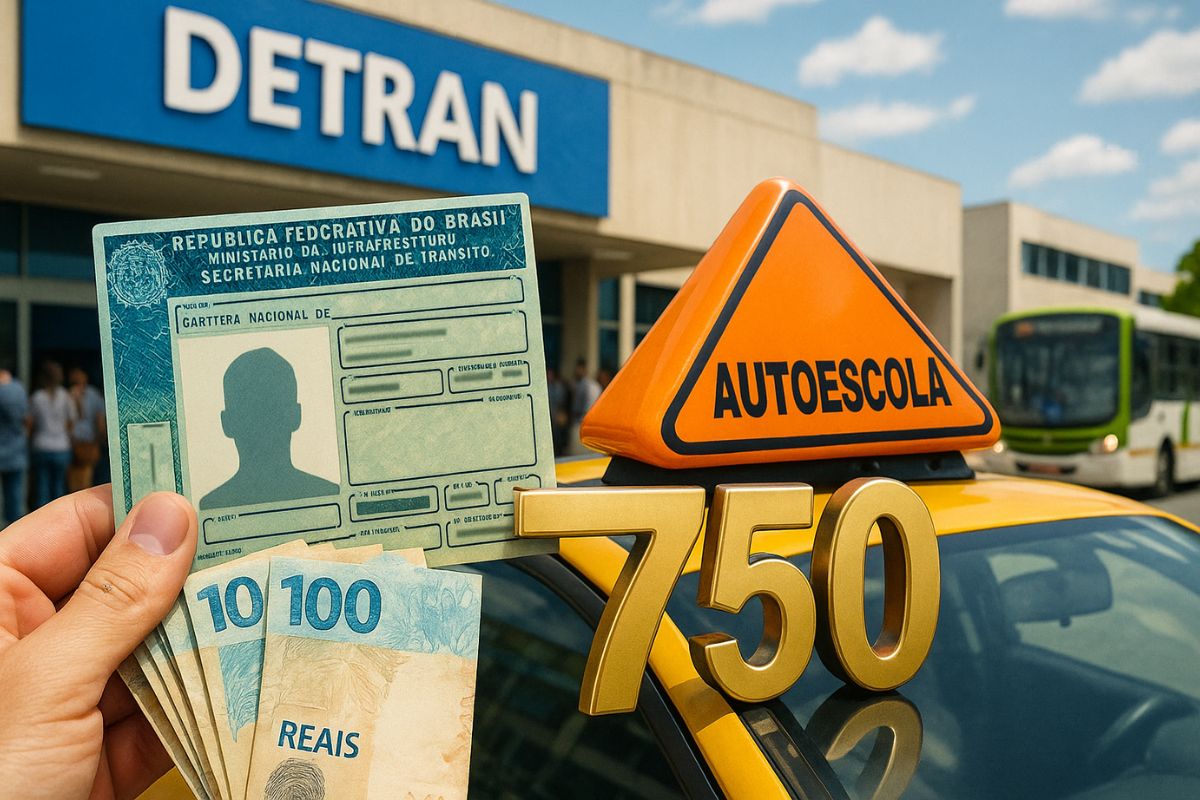
Government Project Plans to Reduce Up to 75% in License Cost by Eliminating Mandatory In-Person Classes
The Ministry of Transport’s proposal to allow Driver’s License Without Driving School for categories A and B has the potential to drastically reduce the cost of the first license in Brazil. Currently, the process can exceed R$ 3 thousand in various regions, but with the new regulation, the total cost could drop to between R$ 750 and R$ 1 thousand.
According to a CNN report and statements from the ministry itself, the goal is to give more freedom to the candidate while maintaining the requirements to pass the Detran tests, but removing the obligation to attend driving schools. However, the project is still under review by the Civil House and will need to be regulated by Contran if it progresses.
How Would Driver’s License Without Driving School Work?
Under the new model, the candidate for the driver’s license would still be required to pass the theoretical and practical tests from Detran, but would not be obligated to take the 20 minimum hours of driving lessons or attend in-person classes at the driving school. The theoretical part can be studied independently, via distance learning or with official materials provided by Senatran (National Department of Transit).
-
Piauí will produce a new fuel that replaces diesel without needing to change anything in the truck’s engine and reduces pollutant gas emissions by half: truck drivers from all over the Northeast are already celebrating the news that will arrive later this decade.

-
A new Brazilian shopping center worth R$ 400 million will be built in an area equivalent to more than 4 football fields, featuring 90 stores, 5 cinemas, a supermarket, a college, and parking for 1,700 cars, potentially generating 3,000 jobs.

-
Larger than entire cities in Brazil: BYD is building a 4.6 km² complex in Bahia with a capacity for 600,000 vehicles per year, but the discovery of 163 workers in conditions analogous to slavery has shaken the entire project.

-
With an investment of R$ 612 million, a capacity to process 1.2 million liters of milk per day, Piracanjuba inaugurates a mega cheese factory that increases national production, reduces dependence on imports, and repositions Brazil on the global dairy map.


In practice, the student will be able to prepare with credentialed independent instructors, and not just through driving schools. These professionals will have to undergo authorized digital courses and will be registered in the official system through the Digital Traffic License. The practical exam remains a mandatory step for the issuance of the license.
How Much Should the New Driver’s License Cost?
Currently, the total cost to obtain a driver’s license can vary significantly between states, but on average it ranges between R$ 2,500 and R$ 4,000, considering mandatory lessons, fees, and services charged by driving schools. With the new model, the estimated cost could be reduced by up to 75%, according to the government.
The expectation is that costs will be limited to Detrans fees, medical and psychological exams, in addition to the optional hiring of independent instructors. This simplification follows examples adopted in countries such as the United States, Canada, Japan, England, and Uruguay, where training is more flexible and personalized.
Who Is Against and Who Supports?
Driving schools and their unions are the main opponents of the proposal, arguing that the measure could reduce the quality of training and increase the risks of traffic accidents. The Ministry of Transport, on the other hand, argues that the new format does not compromise safety, as it maintains the requirement to pass the official tests.
“What changes is the freedom to study and train as you prefer. Driving schools continue to exist, but they are no longer the only option,” said Minister Renan Filho in a recent interview. He also highlighted that the flexibility may democratize access to licensing, especially among low-income youth.
Is It Worth Getting a Driver’s License Without Driving School?
The proposal still depends on approval, but it could represent a significant advancement for those seeking financial autonomy and flexibility in learning. On the other hand, it is important to consider that without professional guidance, some candidates may have more difficulties preparing effectively.
The presence of independent instructors, if well-regulated, tends to ensure quality and diversity in the training process. The change does not eliminate the need for individual responsibility and oversight from traffic authorities.
The new model can reduce costs and make life easier for those who need a license to work or study. But does this compromise road safety? Would you consider obtaining a driver’s license on your own, without in-person classes? Share your thoughts in the comments — we want to know what you think about this change.







-

-

-

-

11 pessoas reagiram a isso.