





 Portuguese
  English
  Spanish
  4 min of reading
  0 comments


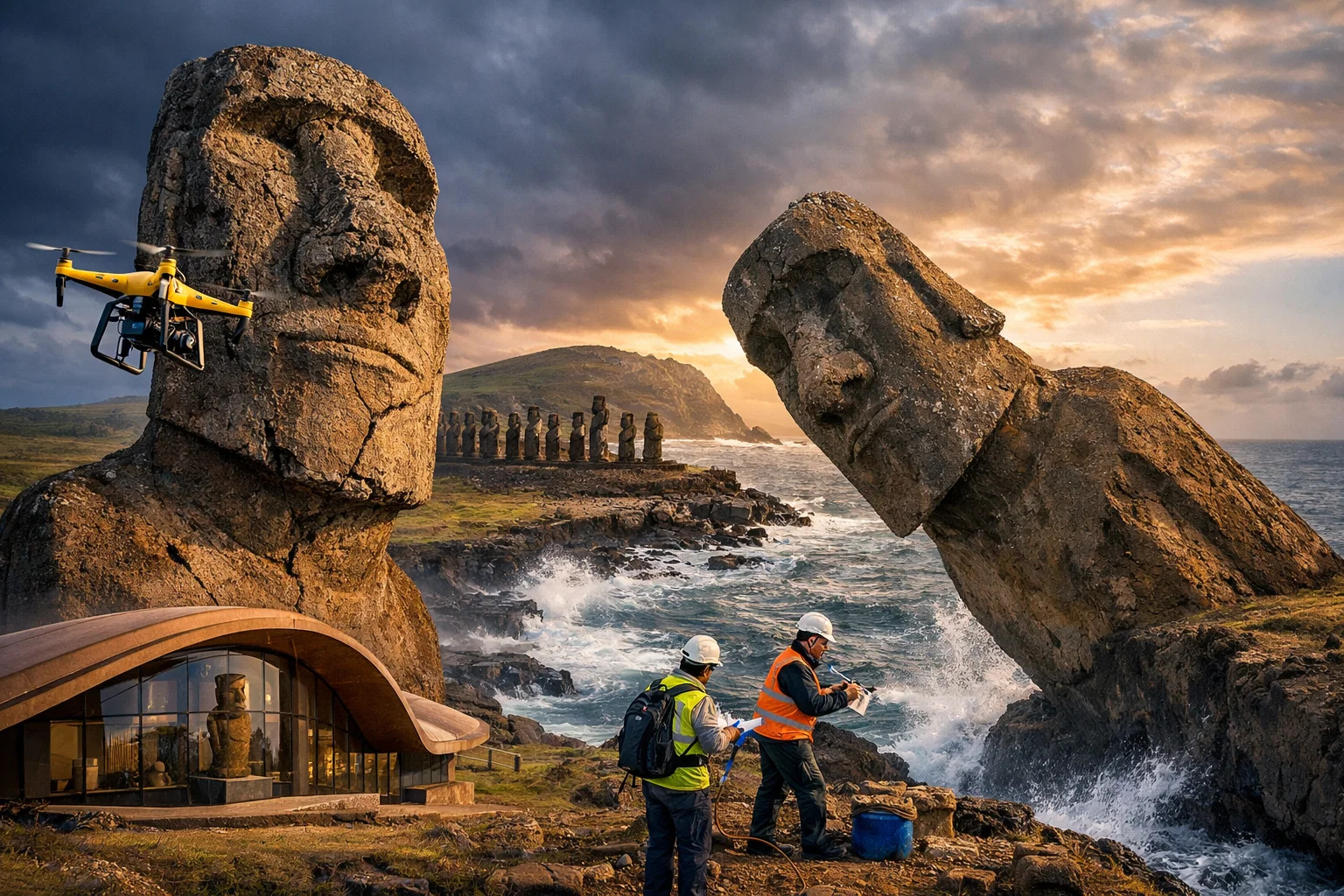
Climate Change, Sea Salt, and Recent Fire Put Giant Statues of Easter Island, Up to 10 Meters, at Real Risk, While 3D Technology and Engineering Come into Play to Prevent a Historic Collapse
They have always seemed indestructible. But the giant statues of Easter Island are literally crumbling. Rock cracking. Surface breaking. Parts coming loose.
And the reason is not just the weather. The sea, heat, salt, and even recent fires are accelerating a process that could change the history of one of the most famous places in the world.
Giants Up to 10 Meters Face the Sea for Centuries, Now the Same Sea Threatens to Topple Everything
There are about a thousand moai scattered across the island. Some are over 10 meters tall and weigh dozens of tons.
-
Friends have been building a small “town” for 30 years to grow old together, with compact houses, a common area, nature surrounding it, and a collective life project designed for friendship, coexistence, and simplicity.

-
This small town in Germany created its own currency 24 years ago, today it circulates millions per year, is accepted in over 300 stores, and the German government allowed all of this to happen under one condition.

-
Curitiba is shrinking and is expected to lose 97,000 residents by 2050, while inland cities in Paraná such as Sarandi, Araucária, and Toledo are experiencing accelerated growth that is changing the entire state’s map.

-
Tourists were poisoned on Everest in a million-dollar fraud scheme involving helicopters that diverted over $19 million and shocked international authorities.


They were carved between the 11th and 17th centuries from a soft volcanic rock called tuff. This type of rock made it easier for the ancient craftsmen to work.
The problem is that this stone acts almost like a sponge.
It absorbs water and salt. Over time, it begins to crack from the inside.
More than 90 percent of the statues still standing are facing the ocean. The sea has always been a symbol of protection. Now it has become a direct threat.
If the base weakens, the statue could topple over.
What Is Destroying the Giant Statues from Within While Few People Notice
Sea salt enters the stone. Then the water evaporates. The salt gets trapped inside.
This salt hardens and pushes the stone from within, creating small cracks. These cracks grow with the heat and cold.
Plants grow on the statues and help break the surface. Horses and cows roam among them, pressing the ground.
In 2022, a fire hit the region of Rano Raraku and damaged about 80 moai. Some marks are barely visible, but weaken the structure.
There is no official number released on how much it would cost to recover all the damage. According to experts, the amount would be high and require constant resources.
Drones, 3D Scanning, and Chemicals to Save Crumbling Stone
Now a race against time begins.
Drones fly over the statues to map every detail. 3D scans create exact digital copies. If something collapses, at least it will be recorded.
An organization called CyArk has already created virtual models of several moai.
Italian specialists are developing chemicals to try to make the stone less vulnerable to water and salt. The idea is to prevent the rock from continuing to absorb moisture.

Platforms near the sea have also been reinforced to try to hold back the advancing waves.
The biggest challenge is money. Everything needs to be brought to the island, which is isolated in the middle of the Pacific. The cost rises quickly.
Restore or Let Nature Take Its Course?
Not everyone agrees on what to do.
Some researchers argue that it is an obligation to protect each statue with modern technology.
Others believe that the sculptures should return to the earth, to their origin, as part of a natural cycle.
As the debate continues, the cracks advance.
Leaders of the indigenous community Ma u Henua say that protecting the moai is protecting their own people. They are not just blocks of stone. They are ancestors represented in monumental form.
New Museum and Active Sculptors Show That Tradition Has Not Ended, But Time is Running Out
A new museum is being built on the island. It could then house some statues for conservation in a controlled environment.
At the same time, local artists continue to carve new moai. Some of these works have already been sent to cities like Santiago, Valparaíso, Tokyo, and Madrid.
Teaching programs keep the traditional sculpting technique alive.
Even so, the question remains: how many of the original giants will still be standing in the coming decades?
Easter Island has become a global warning. If even statues that survived for centuries are unable to withstand current changes, what about other coastal heritage sites?
The moai still face the ocean. But now the whole world is watching to see if they will be able to remain there.
Do you think technology should save each statue or should nature take its course? Leave your opinion in the comments.










-

-

2 pessoas reagiram a isso.