





 Português
  Inglês
  Espanhol
  4 min de leitura
  0 comentários


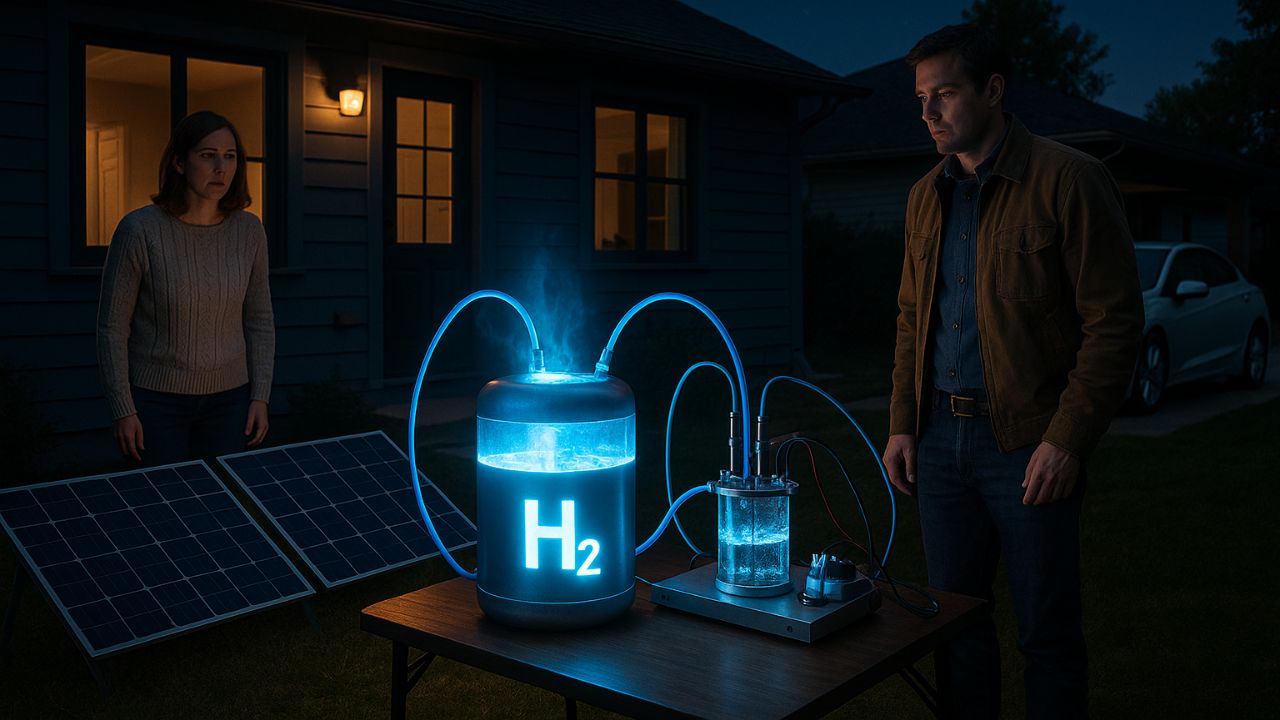
The Promise of Energy Self-Sufficiency with Hydrogen at Home Attracts Many Enthusiasts. However, Reality Encounters High Technical Challenges, High Costs, and, Most Importantly, Serious Safety Risks That Cannot Be Ignored.
The idea of producing homemade green hydrogen seems like a definitive step toward the future: a clean, autonomous, and accessible energy source. This optimistic vision raises the question of whether the technology has reached a point of simplicity and low cost. However, a fact-based scientific analysis reveals a considerable gap between the dream and reality, showing that expectations may be misaligned with the current maturity of the technology for home use.
What Is Green Hydrogen and Why Is It Different?
Hydrogen (H₂) is the most abundant element in the universe and a energy vector with great potential. The term “green” does not refer to the element itself, but to its production method: water electrolysis.
In this process, an electric current separates water molecules (H₂O) into hydrogen and oxygen. The fundamental characteristic is that the electricity used must come exclusively from renewable sources, such as solar or wind. This ensures production with virtually zero carbon emissions. When used as fuel, its only byproduct is water vapor.
-
Renewable energy advances over protected areas in Brazil, and a survey by the Energy Transition Observatory reveals silent impacts that challenge environmental conservation and pressure sensitive traditional territories.

-
Rio Grande do Sul accelerates energy transition: State invests in renewable technologies and consolidates decarbonization strategies and pathways to attract billions in new industrial investments.

-
With 160,000 m² of collectors, an area larger than 20 football fields, Silkeborg, in Denmark, hosts a solar thermal plant that heats 19,500 homes and could become the largest solar heating plant in the world.

-
A study reveals the expansion of renewable energy procurement in Brazil and shows how companies are taking advantage of opportunities to reduce expenses, ensure energy efficiency, and strengthen strategic environmental commitments.


It is crucial to distinguish it from other “colors”:
Gray Hydrogen: The most common and cheapest, produced from natural gas. It is a highly polluting process, emitting about 10 kg of CO₂ per kilogram of hydrogen.
Blue Hydrogen: Similar to gray but with technologies that capture some of the CO₂ emitted. The capture is not total, and concerns about dependence on fossil fuels remain.
Green hydrogen is seen as essential for decarbonizing sectors such as heavy industry and long-distance transportation. However, this “green” characteristic implies a higher production and infrastructure cost.
Is It Possible to Produce Hydrogen at Home?
The idea of generating your own clean energy at home is fascinating, driven by the desire for energy independence and sustainability. But is it technically feasible, accessible, and efficient?
Scientifically, it is possible to produce hydrogen on a small scale through electrolysis. There are technologies such as Alkaline Electrolyzers (AEL), which are more mature and cheaper, and Proton Exchange Membrane (PEM) electrolyzers, which are more compact and produce high-purity hydrogen, but at a higher cost due to the use of precious metals like platinum.
The notion that homemade green hydrogen is “affordable” is a misconception. The initial costs are very high and include:
- The Electrolyzer: Even small-scale units are expensive.
- Renewable Energy Source: A dedicated system is needed, like powerful solar panels.
- Additional Components: Safe storage tanks, compressors, and purification systems.
The total cost of a safe and functional home system is far beyond what most people consider affordable.
Hydrogen is not an energy source, but an energy vector. The energy obtained from it will always be less than the energy used to produce it. The overall cycle efficiency (electricity → hydrogen → electricity with fuel cell) is about 45%. In comparison, battery storage has an efficiency of about 90%. This means that to obtain a useful amount of energy, a very large and expensive renewable generation system would be necessary, making home application impractical.
The Real Risks of Domestic Hydrogen
This is undoubtedly the most critical aspect. Hydrogen is a powerful fuel but extremely dangerous when handled without the proper technical knowledge.
Hydrogen has characteristics that require extreme care:
- High Flammability: It ignites very easily, requiring just a small spark of static electricity.
- Invisible Flame: Its flame is almost invisible in daylight, making fire detection difficult and increasing the risk of severe burns.
- Explosive Potential: It can form explosive mixtures with air, with destructive power greater than that of natural gas.
- Leakage Propensity: Being the smallest molecule that exists, it leaks easily through joints and even through materials considered impermeable.
In a home, the risks are even greater. The lack of training in handling pressurized gases, proximity to numerous ignition sources (switches, appliances), and the difficulty of ensuring adequate ventilation create a dangerous scenario. Implementing mandatory safety measures, such as hydrogen sensors, forced ventilation, and specific materials, requires a level of investment and technical knowledge incompatible with a “do-it-yourself” project.
Don’t Fall for Scientific Traps
It is essential to differentiate green hydrogen from “HHO” or “Brown Gas” devices, often promoted online with promises of fuel savings or making a car run on water.
These kits use the vehicle’s energy to generate a mixture of hydrogen and oxygen (HHO) through electrolysis. The laws of thermodynamics prove that this is impossible. The energy spent to produce the gas will always be greater than the energy it can provide. Practical tests confirm that these devices do not generate savings and result in a net energy loss. It is a “thermodynamic fraud” that should be avoided.
What Do Experts Say About Homemade Green Hydrogen?
Expert and market analysis shows that the focus on green hydrogen is elsewhere. The overwhelming majority of investments and discussions concentrate on large-scale applications to decarbonize industries, petrochemicals, and heavy transport.
There are no available homemade green hydrogen systems “turnkey” that are certified, safe, and economically viable for the average consumer, as there are for photovoltaic solar energy. The kits available are for educational purposes, and small-scale commercial units are designed for laboratories or for integration by specialists in complex systems, not as a household appliance. The narrative of “simple homemade green hydrogen” ignores the critical safety, cost, and complexity aspects that make widespread domestic use, today, a distant and risky reality.









Seja o primeiro a reagir!