





 Portuguese
  English
  Spanish
  7 min of reading
  0 comments


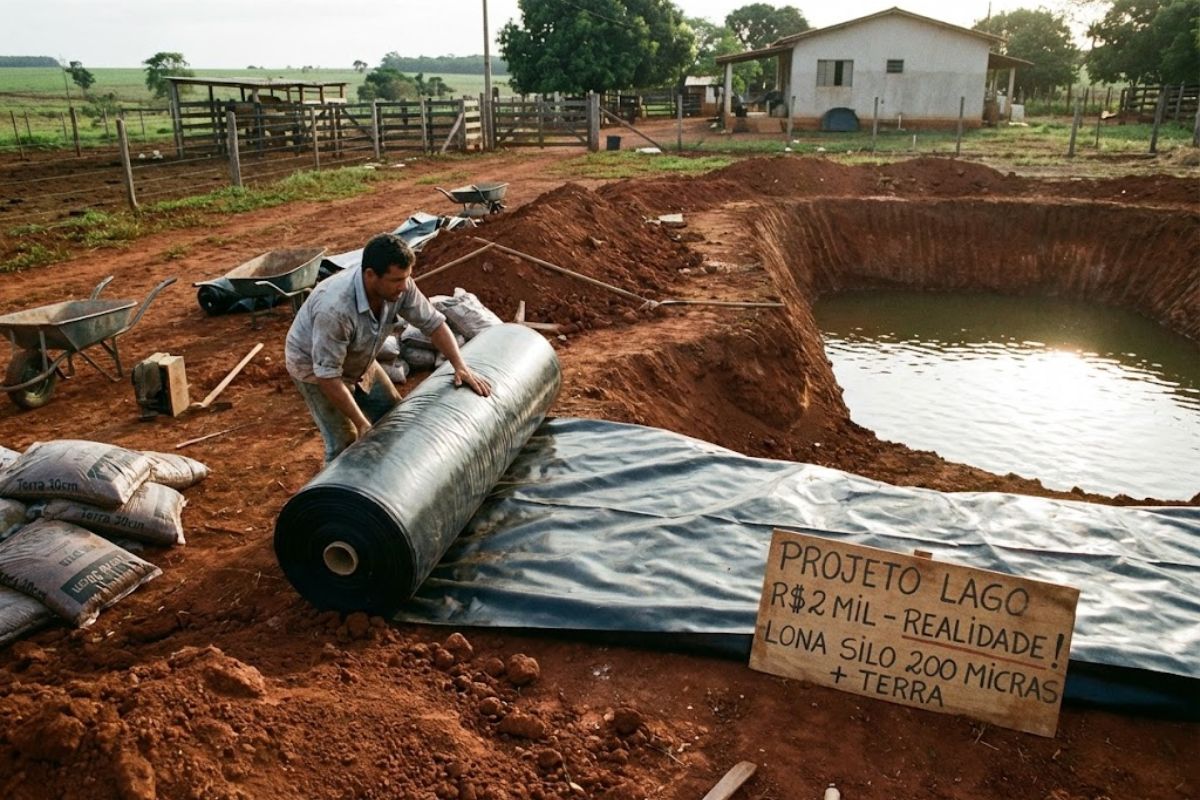
With Initial Promise of Spending BRL 2 Thousand, the Farmer Dug the Lake with PAC Loader, Laid Silo Membrane 200 Micras Glued at 40 cm Joints and Covered Everything with 25 to 30 cm of Soil, Raising the Total to BRL 2.8 Thousand and Reducing Infiltration in the Soil.
In the record, the lake is presented as a low-cost project that would have already been applied in a reservoir for more than 10 years, and as a method known for more than 30 years in different regions, according to the person responsible for the work. The narrative also describes execution in stages, with continuity the next day, to complete the soil covering and preparation for filling.
The final bill, however, contradicted the initial promise of BRL 2 thousand: the roll of silo membrane 200 micras, the glued joints, and the time of PAC loader raised the total to around BRL 2.8 thousand. The central technical argument is simple: the waterproofing depends less on “miraculous” thickness and more on physical protection against sun, perforations, and ground movements, reducing infiltration.
What Was Promised and What Appeared in the Actual Spreadsheet

The starting point was the idea of a “cheap” lake, with explicit reference to a spending goal of around BRL 2 thousand for an area mentioned as 600 m².
-
A rural producer from Urubici cries as he shows 50 tons of plums thrown on the ground because no one wanted to buy them, and in desperation, he records a video asking anyone to come to the property to pick the fruits before they rot.

-
Unable to pass through Hormuz, Brazil activated a plan B that uses Turkey as a gateway to the Middle East: the route through Gibraltar and the Mediterranean is longer and more expensive but ensures that chicken, beef, and corn continue to reach Arab markets.

-
You grew up hearing that the good coffee from Brazil goes all abroad and the bad coffee stays for Brazilians, but this story has completely changed, and the numbers show that in the 1980s, thirty percent of the coffee sold here was adulterated with corn and barley.

-
Engineer creates reforestation method that transforms small plots into dense forests in a few years using local biomass and can reduce environmental recovery costs.

The account itself admits that the estimate was a challenge and that the size could vary, which already put pressure on the budget.
The turning point in cost came with two items that usually do not stay invisible in practice.
The first is the silo membrane, described as a heavy roll of 12 m wide and 50 m long, requiring cutting and joining due to the width of the planned water mirror.
The second is the use of PAC loader, a machine cited as weighing 12 tons and that, in addition to digging, compacts the ground during operation.
In accounting, the price per square meter was negotiated at BRL 2.65, with the cost of the roll of membrane at BRL 1,590.
The difference to reach BRL 2.8 thousand is attributed to machine time and the set of steps necessary to finish the covering and prepare the lake to receive water, without speeding up the filling.
Why the PAC Loader Conditions the Design of the Lake
The narrative insists that the shape of the lake cannot have straight or very steep sidewalls.
The justification is operational: the PAC loader needs to be able to exit “on any side,” and the soil thrown needs to “stop” on the membrane without sliding.
This requirement changes the geometry of the reservoir.
The lake now has gentle slopes, with wide transitions.
In terms of risk, the decision reduces the chance of the soil sliding, exposing the membrane and creating vulnerable points to perforations, in addition to facilitating level corrections when the layer of soil is distributed.
The dimensional control is not treated as exact: the “ideal” cited was to limit the width to 24 m, but the excavation ended up at around 25 m, leading to the need for joints and a “missing” section in the corner, to be resolved with a new joint.
Silo Membrane 200 Micras and the Role of Soil Protection


The silo membrane 200 micras is described as the core of waterproofing, but with one condition: it cannot be exposed.
The method provides that the membrane be buried under 25 to 30 cm of soil, as a permanent “cover”.
The argument is one of durability.
The narrator states that when installed incorrectly, the membrane fails; when buried and protected, the lake can last “many years,” citing a case with more than 10 years without infiltration into the soil, only with losses due to evaporation.
There is also a practical quality criterion: the silo membrane 200 micras should withstand a small deformation without breaking, to withstand the settling and weight of soil on top.
This does not eliminate risk, but reduces the probability of tears during handling, especially in joints and corners.
Joints, Overlap, and Glue: Where It Usually Goes Wrong
As the membrane is 12 m wide and the lake ended up larger than planned, the process required joints.
The mentioned overlap was around 40 cm, precisely to increase the contact area between the sheets.
The logic presented is that the typical mistake is to glue too little, glue with a dirty surface or try to “save” on the area of overlap.
In the account, the joint is treated as a critical step because any discontinuity becomes a preferential path for infiltration, especially when the lake experiences water column pressure and soil movement.
Another recurring point is the order of execution: first the joint, then the soil protection.
Reversing this path, or filling the lake before the soil “sits,” is presented as a shortcut to rework, because the weight of the water can shift the membrane and create folds or concentrated tensions.
The Most Underestimated Step: 25 to 30 cm of Soil Distributed Without Perforating
The soil covering appears as the most labor-intensive part, even with PAC loader. In closing, the narrator says that there was still a need to “spread” mounds, correct points with less than 30 cm, and take excess to areas with a shortage of material.
The technical detail is not just thickness.
It is uniformity.
If a section receives less soil, the silo membrane 200 micras gets closer to the surface, more susceptible to impact, roots, hooves, and tools.
If it receives too much soil, it creates unevenness and increases the chance of sliding on slopes, especially if the compaction is not uniform.
Therefore, the account reinforces the wait after distribution: to wait for the soil to “settle” with rain or wet with a hose, only then begin filling.
In this logic, the lake functions as a layered structure, and not as a “hole with plastic.”
Water, Filling, and the Risk of Turning Into Swamp
The text also anticipates a common doubt: the water source.
The lake could catch rain, receive a little continuous water from a hose, or receive a large volume and fill quickly. Each scenario changes the behavior of the reservoir.
The implicit criticism is that, without renewal, the lake can degrade water quality and concentrate organic matter.
The account does not describe a specific filtration system, but suggests that the intended use, such as irrigation and fish farming, depends on planning water input and output, at the risk of the reservoir becoming useless in the dry period.
Why the Lake is Called “Multiuse” and Where Local Policies Come In
The economic justification of the project is based on the concept of a multiuse reservoir.
The lake is described as a structure for storing water, serving the garden, supporting larger production, and allowing fish farming.
There is also a dimension of local public policy.
The narrator claims that, in some municipalities, there are incentives and machines dedicated to rural work, which can reduce excavation, leveling, and compaction costs, making the lake cheaper for small producers.
The relevant point, from the perspective of rural management, is that the cost is not limited to the silo membrane 200 micras.
It includes access to the machine, soil logistics, execution time, waiting for compaction, and, depending on the case, environmental regularization and property security.
Safety, Animals, and Indirect Damages That Generate Infiltration
Even with soil protecting the membrane, the account acknowledges risks of indirect damage.
Any perforation that crosses the layer of soil can reach the silo membrane 200 micras, generating infiltration points that are difficult to locate after the lake is full.
In practice, this involves controlling access of large animals and avoiding unnecessary traffic that shortens the lifespan of the waterproofing.
The emphasis is that the problem rarely appears on the first day, but rather over time, when small failures become water loss.
How Much It Really Costs and What Does Not Enter the Account
In the accounting presented, the membrane cost BRL 1,590, with a negotiation at BRL 2.65 per square meter.
The total estimated cost of the project ended up around BRL 2.8 thousand, above the initial promise of BRL 2 thousand, with the difference attributed to time of PAC loader and completion of the soil covering.
The account itself leaves room for variations: lake size, volume of soil needed, type of supply, and availability of machines in the municipality.
Moreover, indirect costs are left out of the quick calculation, such as transport, equipment maintenance, fencing, possible corrections of joints, and labor to spread soil and adjust slopes.
The case of the lake shows how small numbers at first can grow when machinery, soil logistics, and finishing come into play, and how durability comes from the physical protection of the silo membrane 200 micras, not from easy promises.
If you are considering a lake on your property, the most realistic step is to map local costs of PAC loader, soil availability, and municipal requirements before defining your budget and schedule.
Have you ever tried to make a lake on your property and what item exceeded your budget the most in practice?









-

-

-

-

-

-

43 pessoas reagiram a isso.