





 Portuguese
  English
  Spanish
  6 min of reading
  0 comments


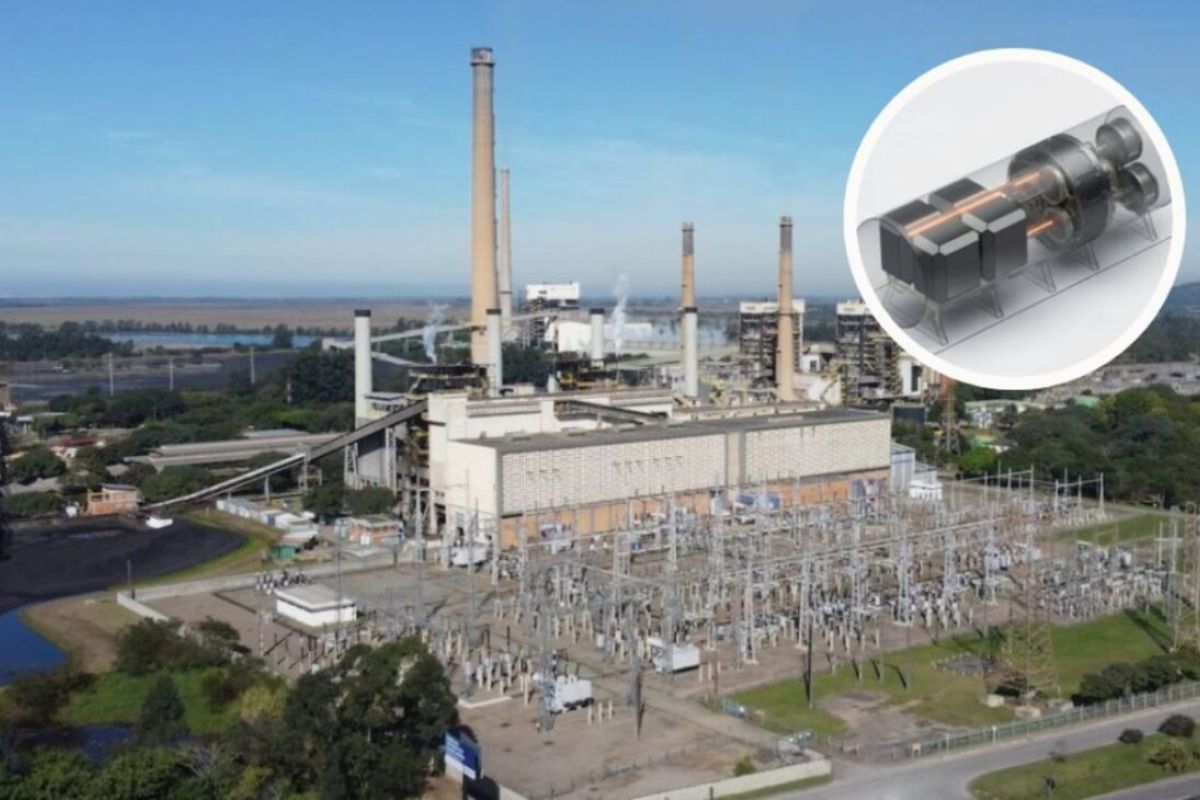
Nuclear Reactor on Factory Scale, with Compact and Transportable Module, Enters Study Funded by Finep and Executed by Terminus, INB and Diamante Energia, from Capivari de Baixo. The Proposal Foresees 5 MW Electric per Unit, Fuel with a Duration of 10 Years and Use in Off-Grid Regions.
The nuclear reactor that fits in a container has stopped being just a provocation among friends and has become a formal project, with an investment of R$ 50 million via Finep and executed by Terminus, INB (Indústrias Nucleares do Brasil), and Diamante Energia, a company based in Capivari de Baixo, in southern Santa Catarina.
The technical promise is straightforward and, at the same time, full of implications: 5 MW electric per module, fuel with a 10-year lifespan without replacement, and a design aimed at reaching places where the grid does not arrive with stability, targeting everything from isolated communities to entire municipalities with low population.
Who Owns the Project and How a “Bar Conversation” Turned into an Industrial Plan
The execution of the studies brings together Terminus, INB, and Diamante Energia, which manages the Jorge Lacerda Thermoelectric Complex and adds a “digital” participation from Santa Catarina to the project, even though the development is not concentrated in Santa Catarina but distributed in different parts of the country.
-
The government requests the Federal Revenue Service for a new system to automate the income tax declaration, reducing errors, time, and bureaucracy for millions of Brazilians.

-
Pix in installments, international Pix, and contactless payment without internet: the Central Bank revealed the new features coming to the tool that is already used by almost every adult in Brazil.

-
Mercado Livre has just started selling medications with delivery in up to three hours to your door, and this move could completely change the way Brazilians buy medicines on a daily basis.

-
In Dubai, rising tensions from the war in the Middle East are causing super-rich individuals to leave the Gulf and direct their fortunes to a new financial refuge in Asia.


According to one of the coordinators, the industrial director Adolfo Braid, the origin was informal, described as a casual conversation among friends, which even flirted with the idea of a startup before gaining traction with public funding made possible in 2024.
The shift from idea to engineering arises when schedule, experimental bench, and performance targets are established.
What Changes When a Microrreactor Fits in a Container

The breaking point, for those involved, is not just “having nuclear energy,” but having a nuclear reactor with dimensions much smaller than traditional plants, with about 60 centimeters in diameter, designed to be transported in a common container and produced on a factory scale.
This choice alters the logistical and industrial design: instead of a giant, singular construction site, the proposal suggests repeatable modules, manufactured in line, with components such as reactor core, support, and fuel organized like a mounting system.
The practicality is not only in size, but in the repetition of the process, something that, according to the project’s vision, paves the way for faster expansion where demand exists.
How Much is 5 MW in Practice and Why Does This Converse with Small Cities
In comparison with Angra 2, the 5 MW planned represents just a fraction of what a large plant delivers. Still, the project bets that the value becomes relevant when looking at the profile of municipalities, especially the smaller and more distant ones from robust infrastructure.
The team itself uses a reference to size up: 1 megawatt can serve up to 5 thousand inhabitants when also considering industry and commerce of a city.
Following this logic, a 5 MW module can be close to the necessary consumption for a small municipality, and the modularity would allow for additional units as needed locally.
What was “little” on a national scale becomes “sufficient” on a municipal scale, especially where alternatives are expensive, unstable, or dependent on long transmission lines.
The Demographic “Map” That Supports the Ambition to Reach Up to 68% of Municipalities
The reach argument emerges when the project crosses power with population distribution. The team highlights that 22% of Brazilian municipalities have fewer than 5 thousand inhabitants, 44% have fewer than 10 thousand, and 68% have fewer than 20 thousand residents.
From this, the proposed calculation suggests that a combination of one to four microrreactors could cover up to 68% of the cities in the country without needing grid energy, reaching approximately 30 million inhabitants.
It is here that the modular nuclear reactor turns into an alternative network narrative: not as a complete replacement of the electrical system, but as a solution for points where energy security is more fragile.
At the same time, the projection depends on fine alignments, such as the actual demand sizing of each city, consumption profile, local infrastructure, and how to integrate with essential services.
Industrial Scale and Supply Chain: Where Engineering Meets the “Real World”
The project coordinator recognizes a bottleneck that goes beyond the design of the microrreactor: after decades of stagnation in the nuclear sector in Brazil, there is technical capacity to design, build, and operate, but it would be necessary to develop a supply chain.
In simple terms, it is not enough to have the concept; it is necessary to have parts, processes, suppliers, and routines capable of repeating manufacturing with quality.
The metaphor used is that of an assembly line similar to that of automobiles, with medium and large factories producing modules.
The reasoning presented links annual production, the number of units, and the multiplier effect when the number of industrial plants is increased.
Scale, here, is not “more power,” it is “more identical units”, and this changes the type of planning and investment the country would need to make to turn prototypes into available solutions.
Clean Energy, Decarbonization and the Promise of Stability Off the Grid
The project is also presented as a response to an agenda that has gained strength in the industry: decarbonization.
The central justification is that this is a clean source, with no carbon emissions in generation, and capable of operating in isolated locations, where the grid may be insufficient or vulnerable.
This point directly relates to the idea of energy security: a modular nuclear reactor can be conceived to supply communities and municipalities that today rely on less predictable solutions.
Still, the jump from “possible” to “operational” is large, as it involves testing, technology validation, and a deployment path that, in practice, requires predictability of operation and public trust in the system.
What Should Happen in the Next Three Years and What Still Needs to Be Proven
The declared timeline for development is three years, focusing on testing the technology in relevant environments, described as experimental benches.
From these tests, the possibility opens for the microrreactor to actually start functioning in the future, should the results sustain performance, reliability, and viability.
Until then, what exists is a plan with well-defined goals, target power of 5 MW electric, and a fuel proposal with a duration of 10 years.
The project is at the stage where credibility comes from what is demonstrated, because a transportable microrreactor needs to prove, in practice, that it delivers what it promises before being seen as a solution for entire cities.
The discussion about a modular nuclear reactor touches on a dilemma that Brazil knows well: how to deliver stable energy to isolated regions without relying on giant and lengthy works, and how to do this without increasing emissions.
The proposal of 5 MW per module, fuel lasting a decade and industrial scale manufacturing points to a different path, but only holds if the tests confirm performance and if the supply chain follows suit.
If this technology reached your region, would you feel safer with a city powered by microrreactors, or would you prefer to rely exclusively on the traditional grid? And, considering your municipality, what would be the priority: reducing the risk of blackouts, accelerating decarbonization, or avoiding any nuclear solution even with small and transportable modules?









-

-

-

5 pessoas reagiram a isso.