





 Portuguese
  English
  Spanish
  6 min of reading
  26 comments


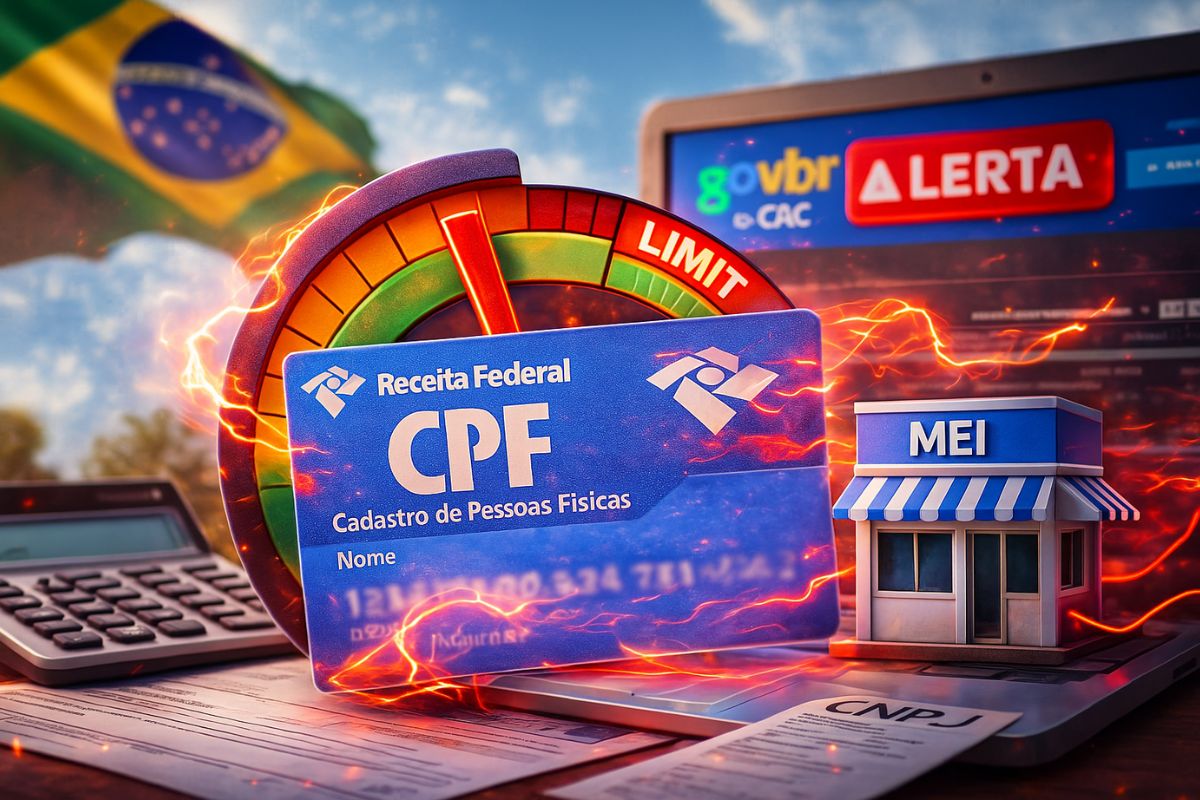


New Understanding of the Tax Authority Regarding MEI Causes Certain Income in Individuals to Enter the Revenue Limit of Micro-Entrepreneurs, Increasing the Risk of Declassification, Auditing, and Increased Tax Burden.
The Federal Revenue has raised an alert that directly impacts those who are MEI and have other sources of income as individuals. Depending on the origin of the amounts that enter the CPF, this income can now count toward the MEI revenue limit and trigger automatic declassification, fines, and even more serious problems with the tax authorities.
In practice, it is no longer possible to treat MEI as something completely separate from all incomes received in CPF. The understanding was detailed based on a resolution from the National Simple Management Committee, which clarifies what constitutes gross revenue for the purposes of the MEI limit and for companies opting for the Simple system. The sensitive point lies precisely in activities performed outside of MEI that are treated as individual contributor social security contributions or special insured contributions.
What Changed in the Tax Authority’s Understanding of MEI
A central point of the alert is the legal nature of MEI. Despite having a CNPJ, the individual micro-entrepreneur is not viewed by legislation as a typical legal entity.
-
Unemployment rises again to 5.8% at the beginning of 2026, raising alarms about the end of temporary positions and its impact on the Brazilian job market.

-
Document organization can cut invisible costs in small businesses, a simple step that prevents waste, rework, and losses in daily operations.

-
Chinese giant worth nearly R$ 4 billion that manufactures cables for electric cars, solar energy, and robotics wants to open a factory in SC.

-
Many employers do not know, but the law guarantees domestic workers a 25% increase in salary during trips, 50% for overtime, 20% for night shifts, and 17 additional benefits that can lead to labor lawsuits if not paid.


In practice, MEI is an individual with a CNPJ, which explains some conveniences, such as being able to operate using a personal bank account and having simplified accounting obligations compared to other regimes.
The new interpretation released by the Tax Authority is based on Article 100 of Resolution CGSN No. 140, which establishes that, for the determination of the annual gross revenue limit, the revenues obtained by the same individual entrepreneur through more than one CNPJ or when he/she also acts as an individual considered, for social security purposes, as an individual contributor or special insured must be summed.
In summary, the CPF income can indeed count toward the MEI limit, as long as it pertains to a professional activity that is classified under INSS as an individual contributor or special insured.
Which CPF Incomes Count Toward the MEI Limit
Not all individual income counts, but some are decisive. The revenues of activities that are not allowed within the MEI, but that characterize self-employed work or equivalent activity for social security contributions as an individual contributor or special insured, count toward the MEI limit.
The guidance material itself cites examples such as doctors, dentists, lawyers, architects, engineers, nutritionists, accountants, physical educators, consultants, and other regulated professions that cannot be registered as MEI.
The previous understanding circulated among entrepreneurs was that one could have an MEI for a permitted activity and, separately, engage in another activity as a freelancer without it reflecting in the MEI limit.
The Tax Authority now clarifies that, in certain situations, this separation does not exist for revenue limit purposes.
The classic example is a professional who works during the day as a self-employed nutritionist and at night operates a structured delivery restaurant as MEI.
The income from the nutritionist, even if declared in the CPF, starts to count toward the annual limit of 81,000 reais along with the income from the MEI.
If this person earns 40,000 reais in a year as a nutritionist and 50,000 reais under the restaurant’s CNPJ, the total of 90,000 reais exceeds the MEI limit, which can lead to automatic declassification and enforced migration to a higher tax bracket, with a significant increase in tax burden and ancillary obligations.
What Still Does Not Count Toward the MEI Limit
Despite the change in interpretation, not all income received in the CPF counts toward the MEI limit. The following remain outside the calculation:
- income from formal employment with a work contract
- income from financial investments
- income from real estate rentals
Thus, CLT wages, interest from investments, dividends, rental income from owned property, and other typical capital incomes continue to not be summed to the income of MEI.
The practical problem is that the Federal Revenue does not “see” the nature of each transaction just by looking at a bank statement or PIX flow.
Without minimal organization, the audit can treat everything that enters an individual account as possible income from economic activity, and it will be up to the taxpayer to prove that certain incoming amounts are not related to the MEI nor to professional activities subject to INSS as an individual contributor.
PIX, Bank Account, and the Risk of Confusion
The alert gains weight when considering how money circulates today. Receipts via PIX into a personal account easily mix salary, extra income, services performed off the books, rentals, family transfers, and income from MEI.
In practice, if the business money enters the same account that consolidates everything, it increases the chance that the Revenue will understand that volume as income from MEI or self-employed professional activity.
Although MEI is not legally required to have a bank account in the name of the CNPJ, the current scenario makes the separation increasingly strategic.
Using a free digital account solely for MEI, only recording business income in that account, and keeping personal finances in another helps to clearly show what the MEI income is and what the CPF income is.
In any eventual analysis, well-separated and organized bank reports greatly reduce the risk of misclassification.
Best Practices to Protect Against Declassification
In light of the new understanding, MEI needs to enhance care with controls and records. Some practices gain concrete importance:
Separate Accounts and Money Flows
Creating a specific digital account for MEI and receiving all business sales in it is the first step.
Payments to suppliers, business expenses, and transfers to the personal account must be clearly identified. This prevents the Revenue from confusing CPF income with MEI revenue.
Always Issue Invoices When Possible
While often not required for all transactions, issuing invoices helps to prove what is MEI revenue and clearly link the amount to the CNPJ.
In an analysis by the Revenue, having invoices compatible with the amounts that passed through the business account is an important element to demonstrate good faith and organization.
Fill Out the Monthly Gross Revenue Report
The gross revenue report is mandatory for MEI, even though many people ignore this point.
Keeping this document updated, with monthly revenue amounts, creates a history that facilitates demonstrating the annual limit used and proving that certain cash inflows are not related to the CNPJ.
Consider Support from Digital Accounting
Although MEI is not required to hire an accountant, having professional oversight helps to monitor revenue, separate CPF income from MEI revenue, and avoid surprises with automatic declassification.
A specialized accounting practice in small businesses also keeps track of regulatory changes and guides the transition to a microenterprise when the MEI limit becomes insufficient.
When It’s Time to Leave MEI and Become a Microenterprise
For some profiles, especially those engaged in activities outside of MEI with good compensation, the sum of incomes may render it unfeasible to remain in the category.
If the income as an individual contributor plus the revenue from MEI approaches or exceeds the annual limit, the safest strategy may be to plan the transition to a microenterprise (ME).
In a microenterprise, the annual ceiling rises to 360,000 reais, and it is possible to include activities that do not qualify for MEI.
On the other hand, obligations, costs, and management complexity increase. Therefore, the decision should be planned, preferably with technical support, rather than occurring forcefully after a notice or automatic declassification.
Finally, the Tax Authority’s alert also reinforces a point often forgotten: those who open MEI in the middle of the year do not always have the right to the full limit of 81,000 reais in the first year of activity.
The limit may be proportional, which makes it even more important to monitor real revenue and the sum with CPF incomes to avoid exceeding the ceiling without realizing it.

In light of all this, the question remains for you to reflect: have you added your CPF income to the revenue from MEI to know how close you are to the annual limit or are you still guessing, running risks with the Federal Revenue?










Será que é verdade que é teik
O governo é aquele sócio que não se importa se o que você recebe é pra gerar uma receita futura, arriscar um crescimento ou oportunidade. Ele quer o dele sem ajudar em quase nada, mas muitos que apoiam esse desgoverno não estão preparados pra essa conversa.
Porque o governo não acaba logo com o mei? Pra mim isso é truque do governo para fazer as pessoas virarem micro6e gerar impostos para arrecadar mais.
O MEI é ótimo. Fui MEI e hoje estou no simples Nacional. O que não dá é para ficar burlando o sistema. Imposto é regra do jogo. Ao invés de reclamar dele, tínhamos que fiscalizar era o uso dele.
Temos é que clamar por um aumento na margem permitida do MEi porque 81 mil no auto custo de tudo hoje, já está ultrapassado e sem chance do Mei continuar crescendo.