





 English
  Francês
  Alemão
  Italiano
  Japonês
  Norueguês
  Portuguese
  Spanish
  4 min of reading
  3 comments


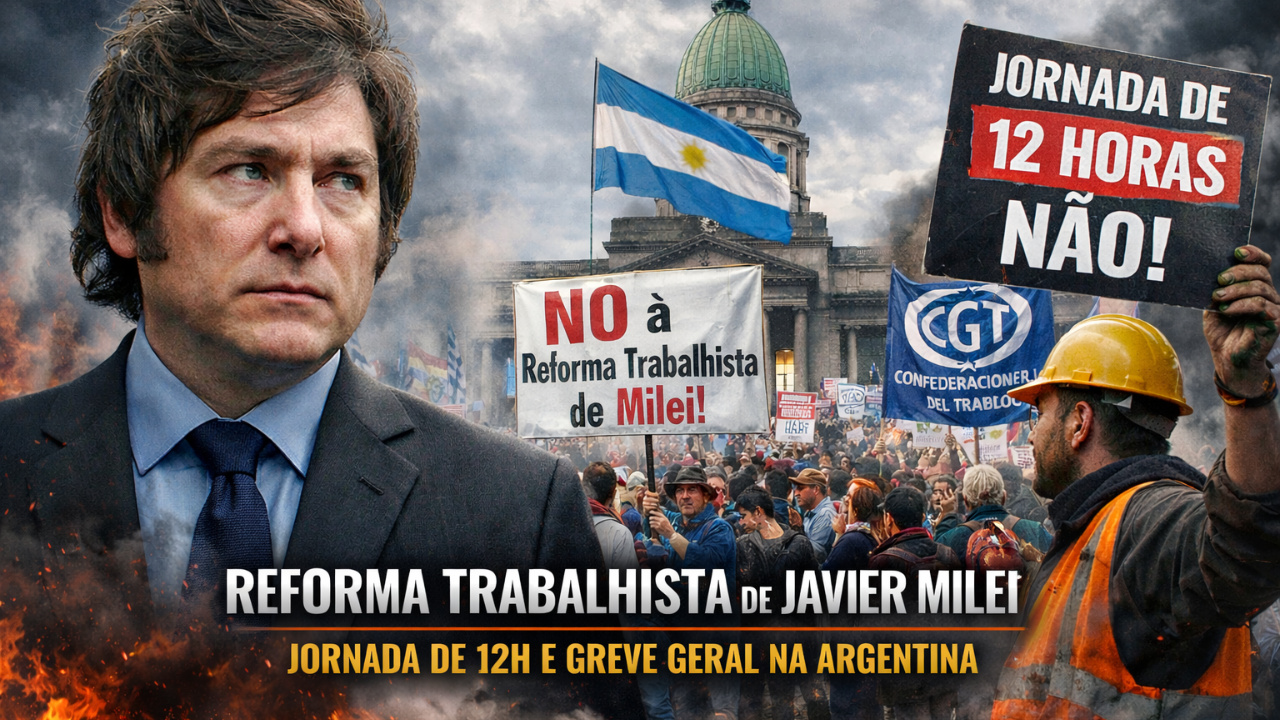


Javier Milei’s Labor Reform Proposes 12-Hour Workday, Alters Labor Rights, and Leads to General Strike and Protests in Argentina.
Argentina is experiencing one of the most intense debates in recent years: the Labor reform proposed by President Javier Milei was preliminarily approved in the Chamber of Deputies on Thursday (2/19), in Buenos Aires, after already passing through the Senate days earlier.
The project foresees, among other points, the expansion of the 12-Hour Workday, new rules for compensations, and changes in union rights.
The vote took place amidst a General Strike called by the General Confederation of Labor (CGT), with protests in front of Congress.
-
Employee Fired After Accumulating 114 Days of Medical Leave in One Year, Labor Court Upholds Company’s Decision

-
Employee Fired While Treating Depression Wins in Court and Vale Is Required to Rehire Him Following Decision Based on the CLT and INSS Benefits

-
Workers Should Be Aware! March 6 Will Be The Fifth Business Day Of March And The Final Deadline For Companies To Pay Salaries According To The CLT

-
2026 FGTS Anniversary Withdrawal Is Released According to Birth Month, Sets Amounts by Balance Range, Establishes Deadlines for March and April, and Changes Rules in Case of Dismissal


The government claims that the proposal modernizes the market; critics say it threatens historical rights.
Shortly after approval, a controversial article on medical leave was withdrawn by the government itself, which requires the text to return to the Senate before becoming law.
Even so, the basis of the Labor reform remains intact and continues to divide the country.
Labor Reform: What Changes with the 12-Hour Workday
One of the most debated points of the Labor reform is the possibility of extending the daily workday from 8 to up to 12 hours.
The rule stipulates that there will be no payment for overtime, as long as 12 hours of rest and the weekly limit of 48 hours are respected.
In practice, a time bank will be created.
Thus, the employer can compensate the excess time with days off, and not necessarily with additional payment.
According to Labor Law professor Miguel Ángel Maza, “Our labor legislation was consolidated in the 1970s and reflects a different world, a labor model based on office workers and factory workers.”
He also notes: “It’s not ideal, but the reality is that many people work more than 8 hours, a lot of people, and they do not always receive overtime.”
Salary in Foreign Currency and Changes in Labor Rights
Another central point of Javier Milei’s Labor reform is the possibility of paying salaries in foreign currency.
In a country where the dollar has a strong influence, this measure could profoundly alter work relationships.
Additionally, the project allows part of the remuneration to be paid in benefits such as housing or food.
It also introduces the concept of “dynamic wage negotiation,” which expands the employer’s freedom to renegotiate conditions after the contract is signed.
When calculating compensations for dismissals, vacations, and bonuses may be excluded from the calculation base.
The government argues that there is a “litigation industry” in the country, incentivized by judicial decisions that would multiply compensations.
Labor Reform and General Strike: Reaction in the Streets
The vote on the Labor reform took place under strong social tension.
The CGT called for a General Strike, while protesters occupied the Plaza de los Congressos.
In a statement, the trade union center declared: “They are attacking workers’ rights, attacking national industry and the future of the country. Rights are not negotiable.”
In addition to the union mobilizations, provincial governors also criticized the text.
Thus, Axel Kicillof stated: “We are convinced of the need to undertake reforms and transformations in the regulatory frameworks governing the world of work.”
However, he added: “No reform can aim to dismantle hard-won rights or reduce protections.”
The Argument of Javier Milei’s Government
The government maintains that the Labor reform is essential to combat informality.
Currently, almost half of Argentine workers are outside the formal system, without full access to labor rights.
Among young people under 29, informality reaches nearly 60%.
For the Executive, the rigidity of current legislation makes hiring expensive and discourages registered jobs.
Thus, after approval in the Senate, the Presidency declared: “This law represents a turning point in Argentine labor history.”
The statement further claims that the proposal seeks to restore “predictability, dynamism, and freedom in the labor market.”
The business sector also took a position. Gabriel Buenos, director of Rappi, stated: “We support this kind of discussion. We need clear rules that allow for the development of the platform economy.”
Criticism: Risk to Labor Rights
However, experts warn of risks.
For Maza, “The reform has a fundamental flaw that is very serious and dangerous.
It masks the ideological belief that labor relations are common relations, that labor law is not necessary.”
Then he reinforces: “Labor law is not a Peronist invention; it arises from the recognition that the worker, individually, cannot negotiate on equal terms with the employer.”
Germán Martínez, from the Union for the Homeland, stated that “the law is horrible and absolutely unconstitutional.”
According to him, it is a regressive process unprecedented in terms of labor rights.
What May Happen Now
Since the article on medical leave was withdrawn, the text returns to the Senate.
Therefore, the Labor reform is not yet definitively approved.
Meanwhile, the country remains polarized. On one side, Javier Milei’s government bets that flexibilization — including the 12-Hour Workday — can increase formal employment.
On the other, unions and the opposition fear a historic weakening of labor rights.
The outcome will define not only the rules of the Argentine labor market but also the political and social direction of the country in the coming years.










Acreditar que ampliar a jornada para 12 horas vai gerar emprego formal é ignorar uma matemática simples: se um estabelecimento funciona 24 horas com três turnos de 8 horas de trabalho, agora basta o empregador demitir um terço dos funcionários, que poderá, legalmente, com dois turnos de 12 horas manter a empresa funcionando.
Na Argentina nada está tão ruim que não possa ficar pior
Que **** que virou a Argentina