





 Portuguese
  English
  Spanish
 4 min of reading
  15 comments


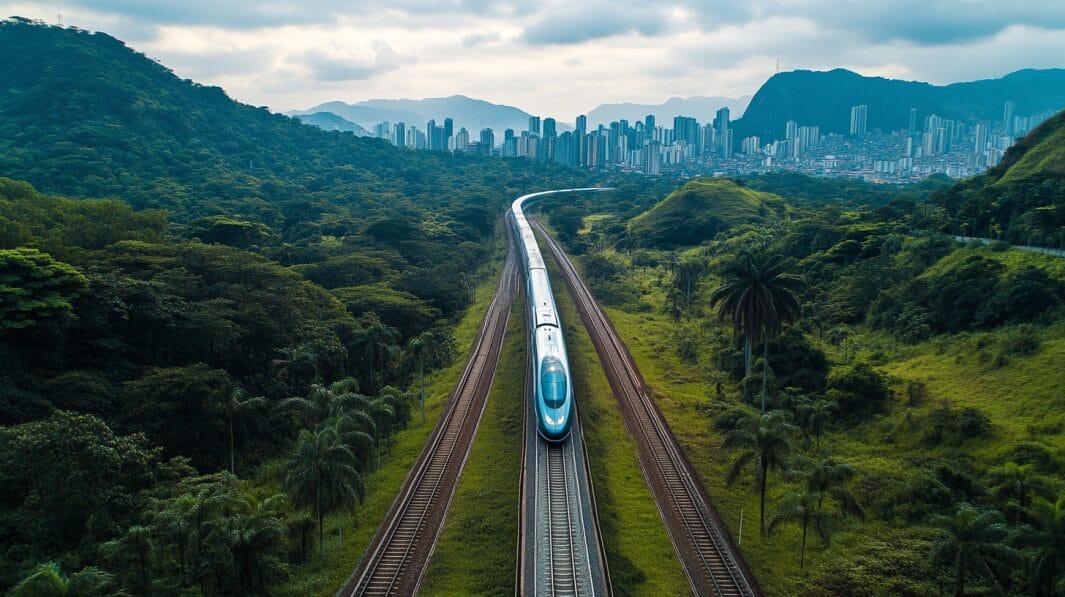

With the Promise of Revolutionizing Transport, the High-Speed Train Between Rio and São Paulo Begins Operations in 2032, Reaching 350 km/h. A Private Investment of US$ 15 Billion Bets on Sustainability and Economic Development for the Paraíba Valley.
The promise of a high-speed journey between Rio de Janeiro and São Paulo is close to becoming a reality.
With an inauguration scheduled for 2032, Brazil is preparing to welcome its first high-speed train.
This project promises not only to transform the way of traveling between the country’s largest metropolises but also to boost regional economic development.
-
A new Brazilian shopping center worth R$ 400 million will be built in an area equivalent to more than 4 football fields, featuring 90 stores, 5 cinemas, a supermarket, a college, and parking for 1,700 cars, potentially generating 3,000 jobs.

-
Larger than entire cities in Brazil: BYD is building a 4.6 km² complex in Bahia with a capacity for 600,000 vehicles per year, but the discovery of 163 workers in conditions analogous to slavery has shaken the entire project.

-
With an investment of R$ 612 million, a capacity to process 1.2 million liters of milk per day, Piracanjuba inaugurates a mega cheese factory that increases national production, reduces dependence on imports, and repositions Brazil on the global dairy map.

-
Brazilian city gains industrial hub for 85 companies that is equivalent to 55 football fields.


The high-speed train project, led by TAV Brasil, is ambitious: to reduce the travel time between the capitals of Rio de Janeiro and São Paulo to less than two hours.
With a length of 417 kilometers and stops in six cities in the Paraíba Valley, the system will represent a milestone in Brazil’s transport infrastructure.
According to data from a study by TAV Brasil, the journey today, which can take up to 7 hours by car or bus, will be drastically reduced thanks to the train, which will reach an impressive 350 km/h.
With plans to serve thousands of passengers daily, the project will offer a fast, efficient, and sustainable alternative for those needing to travel between the two largest urban centers in the country.
Strategic Stops in the Paraíba Valley
On this Monday (28), municipalities in the Paraíba Valley confirmed the existence of strategically defined stops in the region, in cities where passenger flow is intense.
The stops are planned for the following cities: Jacareí, São José dos Campos, Taubaté, Aparecida, Resende, and Volta Redonda.
Additionally, the train will stop at stations in São Paulo (Água Branca), Guarulhos, and Rio de Janeiro (Estação Leopoldina), further enhancing accessibility and connectivity along the route.
Economic Impact and Sustainability
The project, which has an estimated cost of US$ 15 billion (approximately R$ 75 billion), will be fully financed by private initiative.
As a result, the costs will not be passed on to the public sector, which represents a differentiator in the investment model.
According to data from TAV Brasil, the train will be powered by energy from renewable sources, drastically reducing carbon emissions compared to other modes of transport, such as buses and airplanes.
Another anticipated benefit is the positive economic impact on the cities along the route, which should see an increase in the flow of people and financial movement.
According to projections, the Paraíba Valley, in particular, will experience a boost in its development with the creation of new direct and indirect jobs during the construction and operation phases of the project.
Implementation Timeline in Progress
The execution of the high-speed train is already following a strict schedule.
According to TAV Brasil, the first phase, which consists of obtaining the preliminary license, is expected to be completed by June 2025.
The schedule also includes carrying out expropriations by December 2025, obtaining the installation license by June 2026, and finally, the operating license, which marks the beginning of operations in June 2032.
These steps are fundamental to ensuring that the project advances in an organized manner, ensuring compliance with established deadlines and the financial and structural viability of the high-speed train.
Restoration of the Historic Leopoldina Station
A notable detail in the project is the restoration of the historic Leopoldina Station, located in Rio de Janeiro, which will be one of the main stops of the high-speed train.
In an agreement between the federal government and the City Hall of Rio de Janeiro, the station will undergo a revitalization process to meet the operating requirements of the high-speed train.
With the renovation, the station is set to become a symbol of the modernization of Brazil’s railway system, blending tradition and innovation.
Beginning of a New Era for Transport in Brazil?
The promise of the high-speed train between Rio and São Paulo reignites hopes for a revolution in transport in Brazil.
If everything goes as planned, Brazil will be among the few countries in the world to have a rail transportation system of this magnitude, placing the country on the map of great nations with cutting-edge infrastructure for the fast movement of passengers.
With an eight-year timeframe until the first trip, the question remains: will Brazil finally have the high-speed train it has long awaited? Leave your answer in the comments!







Realmente não sei como eles pretendem fazer essa façanha. Trem-bala precisa de uma topografia muito específica. Ele precisa de grandes planíces e praticamente nenhuma curva, quando não curvas bem amplas, para desenvolver velocidades acima de 300km por hora. Basta perguntar para engenheiros japoneses que vão explicar sobre inércia.
Que bom!
Caso isso seja verdade e se estiver nas mãos da iniciativa privada os prazos serão cumpridos, porém, se tiver algum político no meio, virá pilantragem como tantas outras….