





 Portuguese
  English
  Spanish
  6 min of reading
  0 comments


Understand How Infrastructure Regulation Ensures Quality Public Services, Attracts Investments, and Drives National Development.
Infrastructure regulation plays a fundamental role in ensuring that essential services reach the population.
This includes everything from the supply of water and electricity to public transport, highways, railways, and telecommunications.
However, many do not recognize the importance of regulation in this process.
-
Employee Fired After Accumulating 114 Days of Medical Leave in One Year, Labor Court Upholds Company’s Decision

-
Employee Fired While Treating Depression Wins in Court and Vale Is Required to Rehire Him Following Decision Based on the CLT and INSS Benefits

-
Workers Should Be Aware! March 6 Will Be The Fifth Business Day Of March And The Final Deadline For Companies To Pay Salaries According To The CLT

-
2026 FGTS Anniversary Withdrawal Is Released According to Birth Month, Sets Amounts by Balance Range, Establishes Deadlines for March and April, and Changes Rules in Case of Dismissal

It organizes the interaction between public and private interests, balancing economic development with the delivery of quality services.
Historically, infrastructure regulation has become an indispensable tool for organizing strategic sectors and protecting the rights of society.
According to the National Electric Energy Agency (ANEEL), this regulatory model emerged more structured in Brazil starting in the 1990s, with the creation of independent regulatory agencies. This process aimed to improve governance and ensure higher quality public services.
Over time, this topic has remained current and continues to directly impact people’s lives, even if indirectly and often silently.
The Emergence of Infrastructure Regulation
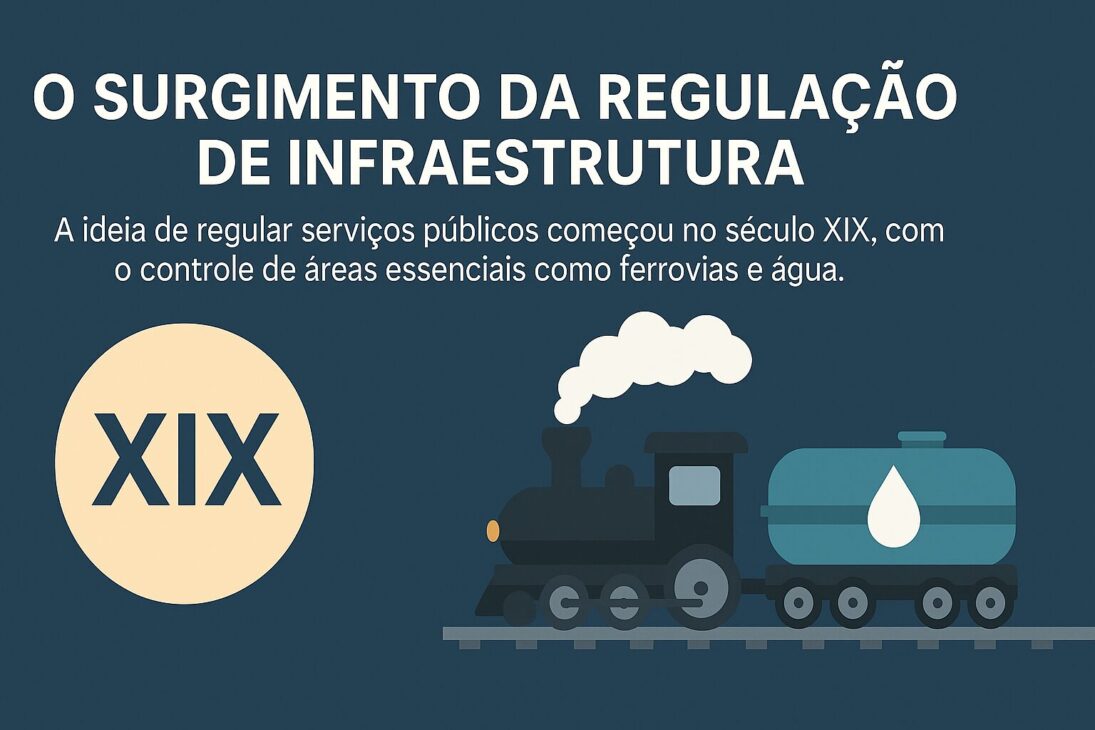
The idea of regulating public services is not recent.
In fact, since the 19th century, governments in different countries began to recognize the need for control over essential areas, such as railroad transportation and water supply.
In the United States, for example, the establishment of the Interstate Commerce Commission (ICC) in 1887 marked one of the first attempts to control tariffs and abusive practices by railroad companies.
According to the website of the U.S. Federal Trade Commission, this was the beginning of modern regulation.
Over the years, as new technologies emerged and urbanization expanded, more sectors began to be included in this logic.
In Europe, the post-World War II reconstruction brought a strong state presence in the provision and control of infrastructure services.
In developing countries like Brazil, rapid growth and social inequalities required the creation of regulatory agencies capable of organizing and overseeing strategic sectors.
According to the Brazilian Federal Government’s website, in the following decades, globalization and technological advancements brought new challenges for regulation.
The world began to change rapidly, forcing the state to adapt, promoting adjustments to the rules without losing the capacity for oversight and control.
The Role of Regulatory Agencies in Infrastructure Regulation
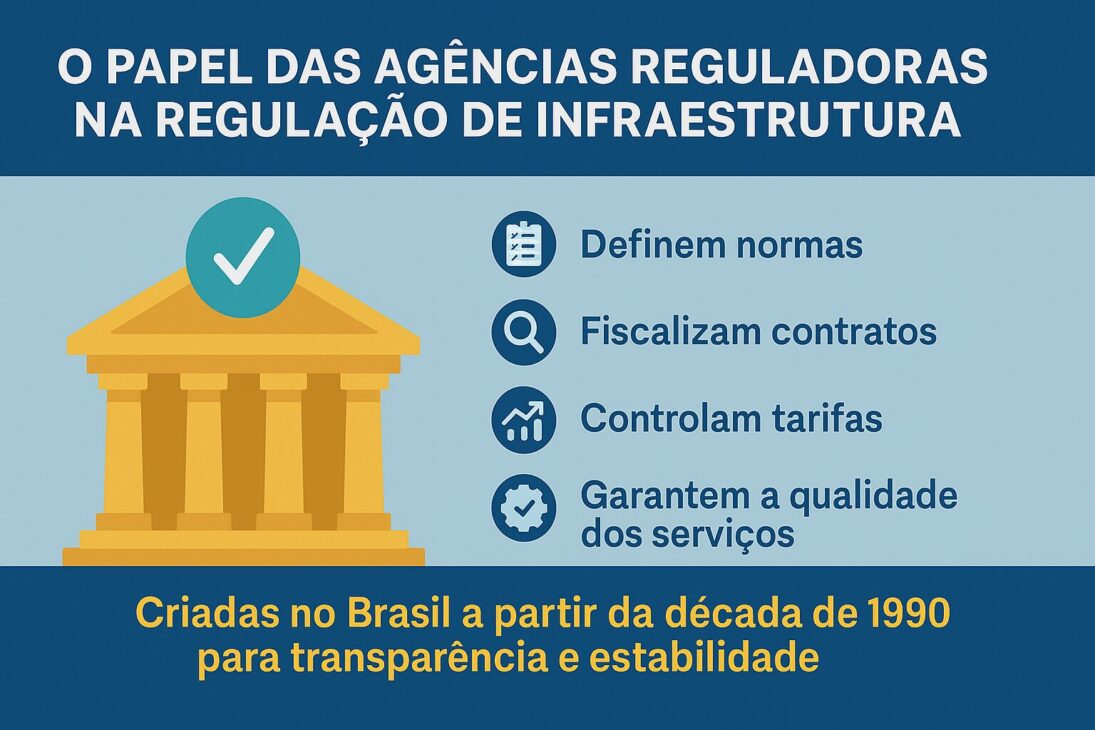
Starting in the 1990s, Brazil created a series of regulatory agencies to provide greater transparency and stability to the rules governing public services.
In this context, institutions such as ANEEL (electricity), ANTT (land transport), ANATEL (telecommunications), and ANA (water) emerged.
These agencies, with their technical and impartial operations, establish standards, oversee contracts, control tariffs, and, primarily, ensure that services are provided with quality.
According to ANATEL, the creation of these agencies aimed to create an environment conducive to both consumers and investors.
Thus, the creation of these agencies aimed to provide technical governance, with less political interference and more focus on the interests of the population.
In addition, this model also sought to attract private investments to sectors that previously depended almost exclusively on the public budget.
By creating clear and stable rules, the government offered legal security for companies interested in concessions or public-private partnerships (PPPs).
This movement also brought greater competitiveness to private sectors and encouraged innovation.
For instance, the telecommunications sector modernized, offering high-speed internet and quality mobile telephony, driven by a regulation that encouraged innovation.
Regulation and Economic Growth
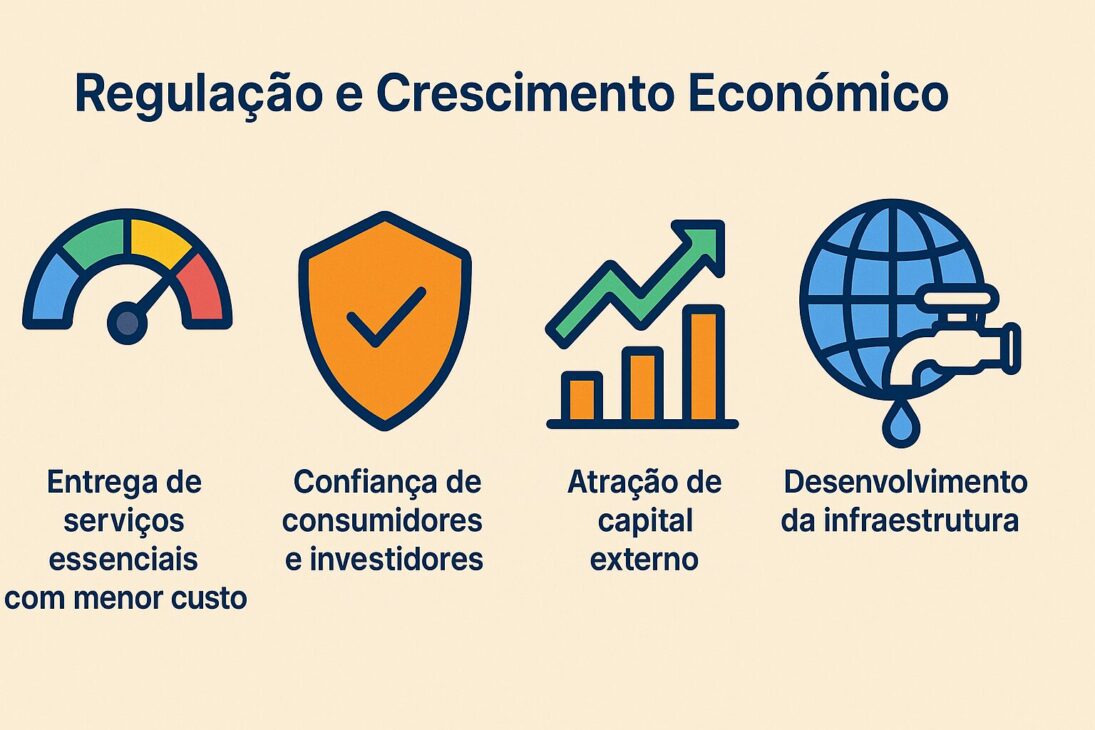
When we talk about infrastructure regulation, we are also talking about economic growth and quality of life.
The presence of efficient regulation allows essential services to be delivered with lower costs, greater speed, and more accountability.
On the other hand, in countries where regulation is weak or non-existent, it is common for service failures, abandonment of projects, price increases, and even supply crises to occur.
Moreover, regulation creates a favorable investment environment. Companies that wish to build highways, operate airports, or provide energy need to understand the rules of the game.
This includes knowing how the tariffs are calculated, how adjustments occur, what the contractual obligations are, and how oversight will be conducted.
According to data from the Brazilian Ministry of Economy, when regulation is well executed, it builds trust among both consumers and investors.
This facilitates the attraction of external capital, essential for large-scale projects and for the development of national infrastructure.
Brazil, for example, has attracted investments for the construction of new highways and airports due to the clarity of the rules and the credibility of regulatory agencies.
According to the Federal Government, concession projects have been one of the main sources of capital attraction for the country since the 2000s.
Countries that have grown economically have been those that knew how to balance market freedom with an efficient regulatory system.
Therefore, regulation does not aim to hinder the market but rather to organize it and prevent abuses.
Challenges and the Future of Infrastructure Regulation
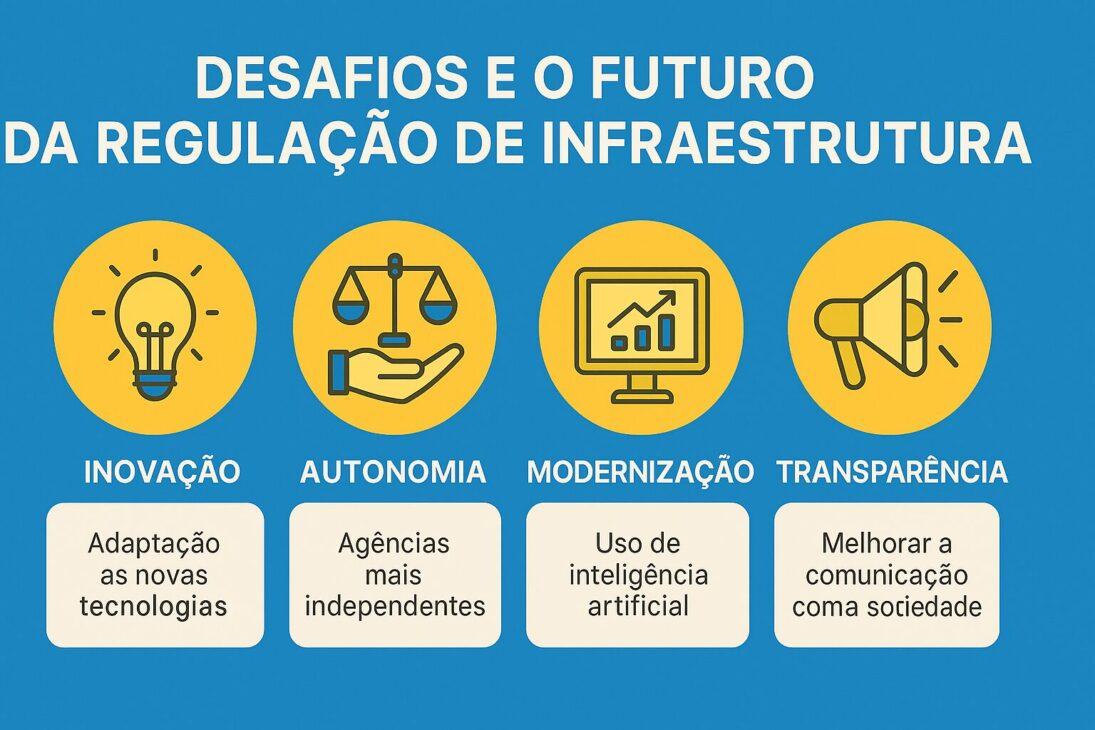
Although infrastructure regulation has evolved, it still faces many challenges. One of the main issues is the constant need for updates. The world changes rapidly, and rules need to keep pace with these transformations.
New technologies, such as solar and wind energy, require different regulatory models compared to traditional hydropower plants. Additionally, digital services and transport applications have also introduced demands that old models did not anticipate.
Another important point is the need to reinforce the independence and technical capacity of regulatory agencies.
For them to fulfill their role effectively, it is essential that they have political autonomy, sufficient resources, and qualified professionals.
Without these elements, regulation can become ineffective or even be captured by economic interests.
The modernization of processes and the use of new technologies, such as artificial intelligence and big data, are also challenges that agencies need to address.
These tools can optimize oversight, anticipating problems and improving processes.
The regulation of the future will be increasingly digital, and this will require a joint effort among governments, companies, and society to ensure that innovation is used for the benefit of all.
Communication with society also needs to be improved.
Often, agency decisions directly affect citizens’ lives, but they are made in a way that is not transparent or uses overly technical language.
Making regulation more accessible is an important step toward strengthening the population’s trust in institutions and encouraging social participation.
Why Infrastructure Regulation Matters
Infrastructure regulation is not just a topic for specialists. It is present in the daily life of everyone.
When you turn on the shower and the water comes with adequate pressure and temperature, a series of norms and oversight ensure that.
When you take a bus or board an airplane, you trust that the service will be safe because a regulatory agency is monitoring that sector.
Although we often do not think about it, regulation ensures the functioning of essential aspects of life in society.
The better it is, the more efficient, fair, and accessible the service provided will be.
The example of electricity supply is a good indicator: the growth of renewable energy generation in Brazil was only possible thanks to a set of rules that allowed for the advancement of clean energies, such as solar and wind.
According to ANEEL, solar energy concessions have grown considerably in recent years, positively impacting both consumers and companies, which have sought cleaner and more economical alternatives.
The Importance of Regulation for the Future
Infrastructure regulation is vital to ensure that public services work well and meet the needs of the population.
Since its early steps, it has evolved to become a solid foundation of modern governance, reconciling private interests with public objectives.
A country that invests in strong, transparent, and efficient regulation is, in fact, investing in its own future.
Infrastructure regulation influences not only the economy but also the daily lives of people.
It directly impacts quality of life, access to essential services, and the business environment.
In conclusion, a sustainable and prosperous future will depend on intelligent regulation that adapts to the new demands of society.











Seja o primeiro a reagir!